
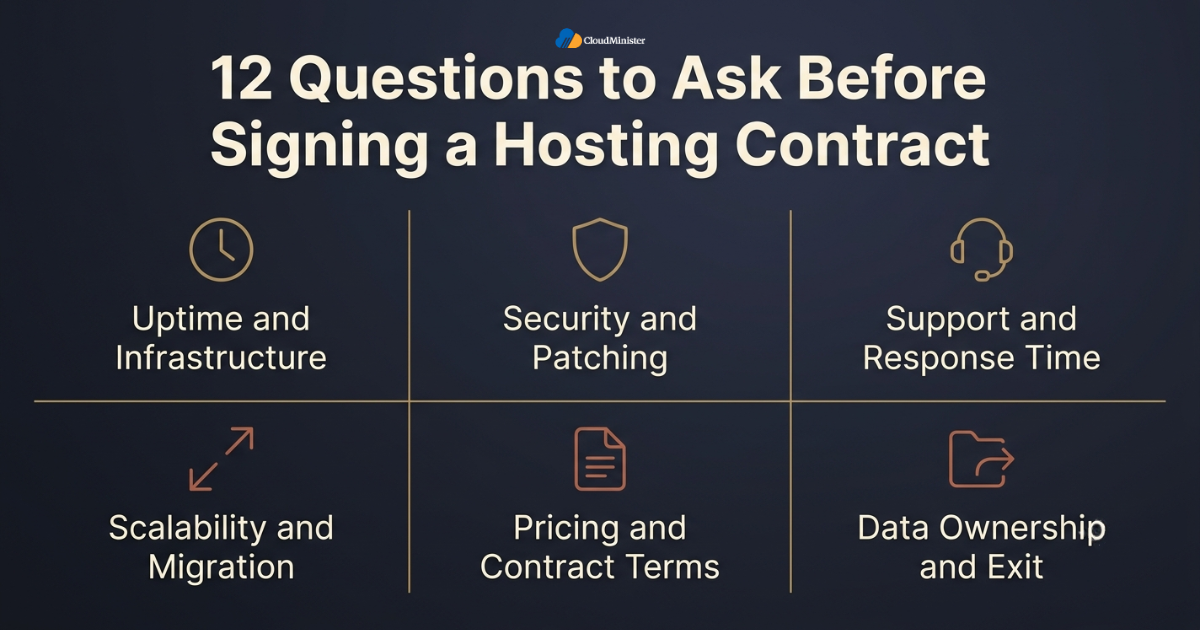
Signing with the wrong managed hosting provider is a decision most businesses only regret after the damage is already done, usually during an outage, a support ticket that goes nowhere, or a renewal invoice that quietly doubled. Choosing a managed hosting provider is not just a technical decision anymore; it is a business continuity decision that touches uptime, security, compliance, and how fast your team can reach a human when something breaks. This guide breaks the decision down into twelve direct questions every business should ask before signing a contract, along with the technical reasoning behind each one. Whether you are moving off a self-managed VPS, escaping an unreliable, shared hosting plan, or replacing a provider that has stopped meeting your needs, these questions apply the same way. A hosting contract is a long-term relationship, not a onetime purchase, and businesses that ask the right questions upfront are the ones that avoid painful surprises of eighteen months into the agreement. Read on for the full breakdown of what to ask before you sign anything.
Most businesses do not think much about their managed hosting provider until something goes wrong, and by then the options for fixing it are usually slower and more expensive than they should be. A slow website, an unexplained outage, or a support ticket that sits untouched for days all trace back to the same root decision, which provider was trusted with the infrastructure in the first place. The problem is rarely a lack of options, since the market is full of providers making similar promises about uptime and support. The real problem is that most businesses evaluate a managed hosting provider on price and polish rather than on the technical substance behind the pitch, and that gap only becomes obvious once something breaks.
The stakes behind this decision are also growing every year. According to Mordor Intelligence, the global managed hosting market was valued at roughly 140 billion US dollars in 2025 and is projected to grow past 415 billion US dollars by 2031. That kind of growth means more providers are competing for every contract, which also means more sales pitches promising reliability without necessarily backing it up with documented guarantees. A business that walks into a hosting decision without a clear set of technical questions is essentially trusting marketing language to hold up during a real incident, and that is rarely a safe bet.
This is why a structured evaluation matters more than it used to. A dependable managed hosting provider should be able to answer direct questions about uptime, security, support, pricing, and data ownership without hesitation or vague reassurance. The twelve questions covered in this guide are designed to cut through the sales pitch and get to the technical and contractual details that determine how a provider performs once you are a paying customer. Whether you are choosing a managed hosting provider for the first time or reevaluating one that has stopped meeting your needs, the same questions apply, and the same discipline pays off.
Table of Contents
- Why the Right Managed Hosting Provider Matters More Than Ever
- Question 1 and 2: Uptime Guarantees and Infrastructure Transparency
- Question 3 and 4: Security Posture and Patch Management
- Question 5 and 6: Support Availability and Response Time
- Question 7 and 8: Scalability and Migration Support
- Question 9 and 10: Pricing Transparency and Contract Terms
- Question 11 and 12: Data Ownership and Exit Strategy
- What to Know Before You Transfer Your Domain
- A Practical Evaluation Framework
- Red Flags That Should End the Conversation
- Why the Right Partner Matters for Indian Businesses
- Key Takeaways
- Conclusion
- Frequently Asked Questions
Why the Right Managed Hosting Provider Matters More Than Ever
The role of a Managed Hosting Provider has expanded far beyond simply keeping a server switched on, and businesses that evaluate providers using outdated criteria end up with coverage gaps they only discover during an incident.
- A Managed Hosting Provider today is expected to handle patching, monitoring, backups, security hardening, and performance tuning as a single bundled responsibility rather than separate line items.
- Businesses that treat domain registration and hosting as two unrelated purchases often end up managing two separate support relationships during an incident, which slows everything down.
- A provider that also functions as a genuine Web Hosting Company in India with local data centers can meaningfully reduce latency for an Indian customer base compared to hosting overseas.
- Every minute of unplanned downtime carries a real financial cost, and recent industry research from the Splunk and Cisco Hidden Costs of Downtime report puts the average cost of downtime at roughly 15,000 US dollars per minute across surveyed organizations.
- A provider without a documented incident response process leaves a business exposed exactly when it needs support the most.
- Growing businesses frequently outgrow their original hosting plan within eighteen to twenty four months, so infrastructure needs to support scaling without forcing a full migration.
- Evaluating a Managed Hosting Provider is closely tied to evaluating a reliable domain registration partner, since domain level issues can take a site offline just as easily as a server failure.
- A provider that bundles domain registration, hosting, and security under one contract removes a significant amount of coordination overhead for internal IT teams.
- Businesses that have never had to transfer your domain away from a difficult registrar often underestimate how painful that process can become with the wrong provider, which is exactly why it helps to ask upfront how simple it would be to transfer your domain if the relationship ever ends.
- The right Managed Hosting Provider treats infrastructure, security, and domain registration as one connected system rather than three disconnected products sold separately.
- A trustworthy domain registration partner and hosting provider working together should never make a simple domain transfer feel complicated or risky for the customer.
Before requesting a single quote, write down your actual technical requirements first, including current traffic patterns, compliance obligations, and expected growth over the next two years. A provider cannot give you an accurate, honest recommendation if you walk into the conversation without knowing what you actually need.
Question 1 and 2: Uptime Guarantees and Infrastructure Transparency
The first two questions any business should ask concern exactly what is being promised on paper and what infrastructure sits behind that promise.
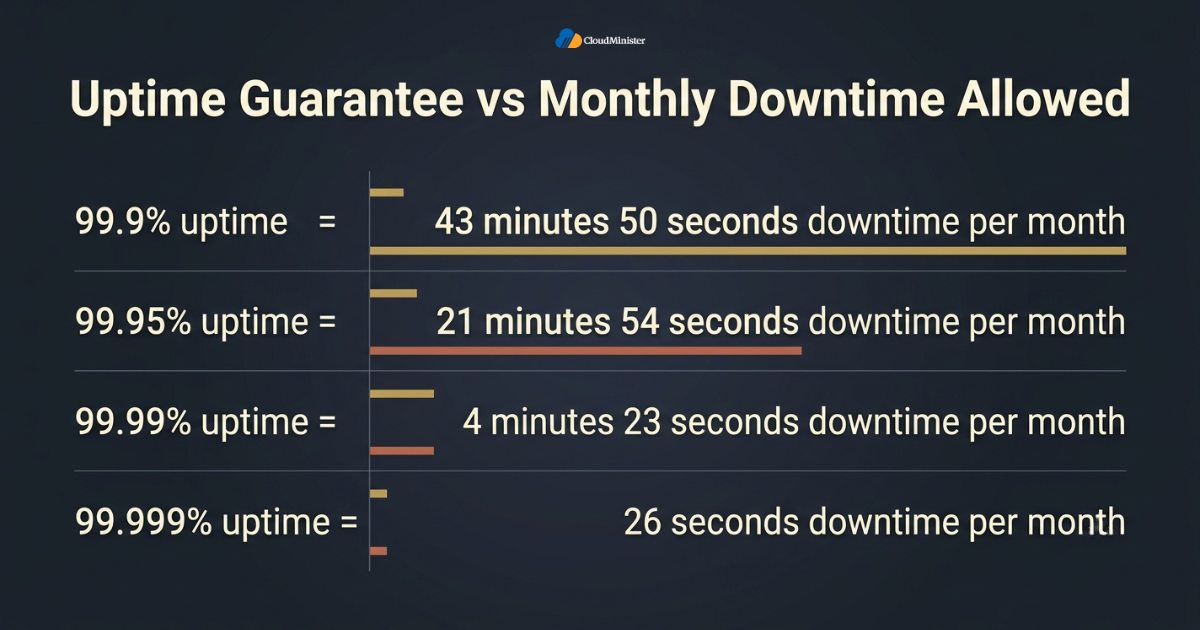
- Question one, what is the exact uptime guarantee in the service level agreement, and does the Managed Hosting Provider actually pay a defined credit when that guarantee is missed.
- A 99.9 percent uptime guarantee still allows for over 43 minutes of downtime every month, so ask how that figure was calculated and over what measurement period.
- Question two, is the infrastructure built on redundant, multi zone architecture, or does a single hardware failure take the entire environment offline.
- A Managed Hosting Provider should be able to explain, in plain language, how failover works if a primary server or data center becomes unavailable.
- Ask whether the provider owns and operates its own infrastructure or resells capacity from a third party, since this changes who is actually accountable during an outage.
- A provider that cannot clearly explain its physical or virtual infrastructure layout is not being transparent, regardless of how confident the sales pitch sounds.
- Request historical uptime reports rather than relying on a number quoted verbally, since a Managed Hosting Provider with nothing to hide will share this data willingly.
- Ask specifically how scheduled maintenance windows are handled and whether these count against the published uptime guarantee.
- A genuine Web Hosting Company in India should be able to confirm which specific data center region hosts your environment.
- A provider that also acts as your domain registration partner should be transparent about which data center handles both hosting and domain related records.
An uptime guarantee with no enforceable financial credit attached is effectively a marketing statement rather than a contractual commitment. Always request the exact clause covering service credits, the process for claiming them, and any exclusions buried in the fine print before treating an uptime number as a real commitment.
Question 3 and 4: Security Posture and Patch Management
Security has become one of the single most important factors separating a genuinely capable Managed Hosting Provider from one that simply keeps servers running without protecting them properly.
- Question three, how frequently are security patches applied, and is patch management proactive or dependent on the customer requesting it.
- A provider that waits for a customer ticket before patching a known vulnerability is operating reactively rather than defensively, which leaves a dangerous exposure window open.
- Question four, what specific security layers are included by default, such as a web application firewall, DDoS mitigation, malware scanning, and intrusion detection.
- Ask whether security monitoring runs continuously or only during business hours, since attacks do not follow a nine to five schedule.
- A capable Managed Hosting Provider should be able to explain its approach to isolating customer environments from one another on shared infrastructure to prevent lateral movement after a breach.
- Confirm whether automated backups come with a tested restoration process, rather than backups that have never actually been verified to work.
- Ask directly how a compromised account would be detected and handled, since detection speed determines how much damage an incident actually causes.
- A trustworthy provider will readily share its incident history and disclosure practices rather than deflecting the question entirely.
- Request specifics on SSL and TLS certificate management, since automatic handling prevents accidental certificate expiry that silently breaks a website.
- Ask whether the security policies covering your account also extend to domain level protections, since a compromised domain registration partner account can be just as damaging as a compromised server.
Conversations with businesses that have survived a genuine security incident consistently reveal the same pattern, the actual breach was rarely the most damaging part. The real cost came from slow detection, unclear communication, and a provider that had no tested plan for what to do next. Evaluate a Managed Hosting Provider on its response process as carefully as you evaluate its prevention tools.
Related Reading: Selecting the right domain extension for AI and SaaS
Question 5 and 6: Support Availability and Response Time
Support quality is where the difference between a genuinely reliable Managed Hosting Provider and a purely transactional vendor becomes most obvious, usually at the worst possible moment.
- Question five, is support genuinely available twenty four hours a day, seven days a week, or does after hours coverage rely on a queue that is checked the next morning.
- A provider that advertises round the clock support should be able to demonstrate an actual live chat or phone response during a late night or weekend test.
- Question six, what is the guaranteed first response time for a critical severity ticket, and is that number written into the contract rather than stated informally.
- Ask whether a dedicated technical contact is assigned to your account or whether every ticket is routed to a general queue with no continuity between conversations.
- A Managed Hosting Provider with tiered support plans should clearly explain what level of access your specific plan includes before you sign anything.
- Confirm whether the support team has direct access to make emergency infrastructure changes, or whether every request gets escalated through multiple layers first.
- Ask how many support requests are typically resolved on first contact versus requiring multiple follow ups, since this reveals actual technical depth.
- A reliable provider will let you speak with existing customers or share verifiable reviews rather than only offering curated testimonials.
- Businesses handling both domain registration and hosting through the same provider should confirm that support covers both areas under a single ticket rather than routing domain issues elsewhere.
- Ask whether the same support desk can assist with a domain transfer request, or whether that request gets pushed to an entirely separate domain registration partner team with its own queue.
Test support responsiveness before signing, not after. Submit a genuinely technical pre sales question to a prospective Managed Hosting Provider and time how long it takes to receive a knowledgeable, specific answer rather than a generic templated reply.
Question 7 and 8: Scalability and Migration Support
A provider that fits your business today needs to be evaluated against where your business is headed over the next two to three years, not just its current requirements.
- Question seven, can resources be scaled up or down without significant downtime, and does scaling require a full migration to a different plan or server.
- Ask how vertical and horizontal scaling actually work within the platform, since vague answers usually indicate limited actual flexibility.
- Question eight, is hands on migration support offered, including moving existing websites, databases, and email accounts without extended downtime.
- A Managed Hosting Provider that charges significant hidden fees for migration assistance is signaling how it will likely handle future support requests as well.
- Confirm whether the provider has experience migrating from your current specific platform, since some transitions carry far more technical risk than others.
- Ask how DNS changes are handled during migration, since a mismanaged DNS cutover is one of the most common causes of unexpected downtime.
- A capable Managed Hosting Provider should be able to walk through its exact migration checklist rather than offering a vague reassurance that everything will simply work.
- Ask specifically whether staging environments are supported for testing changes before they go live on the production site.
- Confirm that the environment can accommodate seasonal or campaign driven traffic spikes without requiring advance notice weeks ahead of time.
- Ask whether a migration ever requires touching domain registration settings, and if so, confirm the domain registration partner handling that step follows a secure, documented process.
A rushed migration handled without proper DNS planning can expose a business to domain hijacking risk during the transition window. Confirm that any provider handling your migration follows a documented, secure process for updating DNS records and verifying propagation before decommissioning the old environment.
Related Reading: Choosing a catchy new domain name covers
Question 9 and 10: Pricing Transparency and Contract Terms
Pricing is frequently where a hosting relationship goes wrong, not because the initial number was misleading, but because the fine print was never fully understood before signing.
- Question nine, does the quoted price include every service you actually need, or are backups, security monitoring, and support tiers billed as separate add ons.
- Ask for a complete, itemized breakdown of pricing rather than a single bundled figure that hides what is and is not included.
- Question ten, what happens to pricing at renewal, and is the introductory rate significantly lower than what is actually charged after the first term.
- A trustworthy Managed Hosting Provider will state its renewal pricing clearly in the contract rather than leaving it undefined until the renewal notice arrives.
- Confirm whether early termination fees apply, and understand exactly what triggers them before a contract is signed.
- Ask whether domain registration is bundled into the hosting contract or billed and renewed completely separately through a different vendor.
- A business that later decides to switch registrars and transfer your domain should understand upfront whether the process is made easy or deliberately difficult.
- Some providers use domain lock periods or non standard authorization codes specifically to make domain transfer harder than it needs to be, which is worth asking about directly.
- Ask a Managed Hosting Provider to clarify what happens to your domain registration and hosted data if you choose not to renew, including how much notice you receive beforehand.
Request the full contract, including all appendices and fine print, before making a final decision, not just the summary pricing page from the sales team. A confident provider will have no hesitation sharing the complete agreement early in the conversation.
Question 11 and 12: Data Ownership and Exit Strategy
The final two questions matter most when a hosting relationship eventually ends, whether that happens by choice or because the business outgrows the plan entirely.
- Question eleven, who legally owns the data, backups, and configurations stored with the provider, and can that data be exported at any time without restriction.
- Ask the Managed Hosting Provider to confirm, in writing, that you retain full ownership of your data regardless of contract status or outstanding disputes.
- Question twelve, what is the exact process for leaving, including how domain registration and DNS are handed over during an exit.
- A provider that makes it difficult to complete a domain transfer or export backups at the end of a contract is signaling a business practice worth avoiding entirely.
- Confirm whether exit fees apply for retrieving your own data, since this practice, while legal in most cases, indicates a customer unfriendly relationship.
- Ask how long historical backups remain accessible after a service is cancelled or a contract lapses.
- A business planning to switch to a new registrar, a new domain registration partner, or a new Managed Hosting Provider should request the exact authorization code process well before attempting to transfer your domain, and should also confirm the receiving Web Hosting Company in India is ready to accept the incoming transfer your domain request without delay.
- Understanding domain transfer timelines matters here, since a mishandled domain transfer can leave a business with an inaccessible domain for days during a critical period, which is exactly why a reliable Managed Hosting Provider documents this process clearly.
- A dependable Managed Hosting Provider treats an exit request professionally and cooperatively rather than treating a departing customer as a lost sale to be discouraged at every step.
Own a Domain That Matches Your Hosting Standards
A dependable managed hosting provider starts with a dependable domain registration partner. Register or transfer your domain with CloudMinister and keep your infrastructure and domain records under one accountable relationship.
Businesses that have gone through a difficult provider exit consistently report the same lesson, the terms that mattered most were the ones nobody read carefully at signing. A provider worth choosing is one whose exit terms are just as fair and transparent as its onboarding process.
Related Reading: Understanding exactly how domain ownership transfer works
What to Know Before You Transfer Your Domain
A significant number of businesses only think carefully about how to transfer your domain after they have already decided to leave a provider, which is exactly the wrong time to be learning the process for the first time.
- Ask a prospective Managed Hosting Provider or domain registration partner to walk you through the exact steps required to transfer your domain before you ever need to actually do it.
- Confirm whether the current registrar imposes a lock period that prevents you from being able to transfer your domain within the first sixty days of a new registration, which is common for many domain extensions but can vary depending on the specific TLD, registrar, and transfer circumstances, so this should always be confirmed directly with the provider.
- A responsible domain registration partner will provide the authorization code needed to transfer your domain promptly, without requiring multiple follows up requests or unnecessary delays, and a genuine Web Hosting Company in India should be able to confirm this process directly.
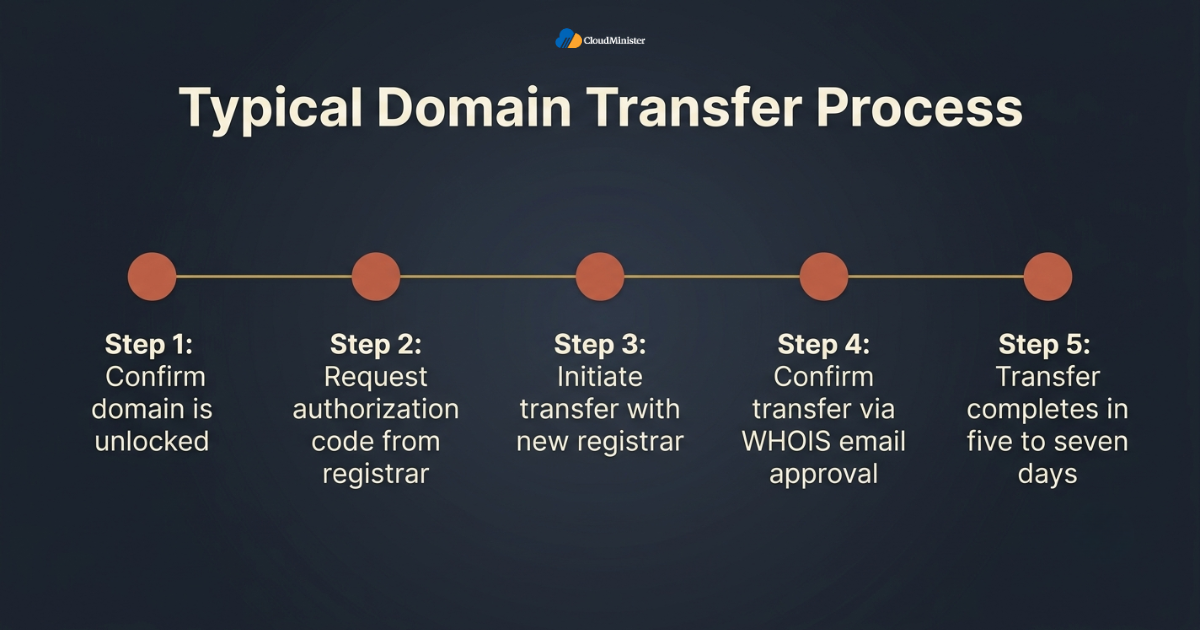
- Ask how long a typical domain transfer takes from initiation to completion, since a mishandled domain transfer can leave a business without a working website or email for several days.
- Confirm that email delivery and DNS records remain stable throughout a domain transfer, since poor coordination during this step can silently break inbound email without any obvious warning.
- Ask whether the provider charges any fee specifically to transfer your domain out, since some registrars quietly attach costs to this step that are never mentioned upfront.
- A dependable domain registration partner treats an outbound domain transfer the same way it treats any other customer request, promptly and without friction, rather than treating it as a lost account to be discouraged.
- Businesses planning a future domain transfer should keep WHOIS contact details current, since outdated contact information is one of the most common reasons a domain transfer gets delayed or rejected.
- Ask your domain registration partner directly whether domain transfer requests are handled internally or routed through a third party registrar, since this affects how quickly a domain transfer actually completes.
- If you are still unsure about the process, ask for a written walkthrough of exactly how you would transfer your domain step by step.
Do not wait until you are unhappy with a provider to learn how to transfer your domain. Test the process, or at minimum confirm the documented steps, while the relationship is still healthy so there are no surprises if you ever need to transfer your domain under time pressure.
A Practical Evaluation Framework
Rather than treating provider selection as a single rushed decision, it helps to work through a structured comparison before committing to any contract.
- Request a detailed proposal from at least three separate providers rather than accepting the first quote received, since pricing and inclusions vary considerably across the market.
- Compare each Managed Hosting Provider against the same twelve questions covered in this guide, using identical criteria rather than judging each on different terms.
- Ask each provider for references from businesses in a similar industry or of a similar size, since infrastructure needs vary significantly by use case.
- Confirm whether each candidate also functions as a genuine Web Hosting Company in India with verifiable local infrastructure, rather than reselling foreign capacity under an Indian brand name.
- Evaluate whether bundling domain registration, hosting, email, and security under one Managed Hosting Provider actually reduces complexity, or whether it creates a single point of failure.
- Review whether the provider under consideration has transparent, published documentation, since thorough documentation usually reflects a more mature support operation.
- Ask directly whether the provider has faced any major public outages or security incidents in the past two years, and how those were communicated to customers.
- Confirm the physical location of data centers used by each Managed Hosting Provider, particularly for businesses with data residency obligations under Indian regulation.
- Ask each Managed Hosting Provider whether they can also serve as your domain registration partner, since consolidating both under a genuine Web Hosting Company in India simplifies ongoing management considerably.
Readiness Checklist
- Uptime guarantee confirmed with a defined, enforceable service credit
- Security patching and monitoring practices verified as proactive rather than reactive
- Support availability tested directly before signing any contract
- Migration process and DNS handling explained in clear, specific detail
- Full itemized pricing reviewed, including renewal rates and cancellation terms
- Data ownership and export rights confirmed in writing
- Domain registration and exit process understood before signing
Related Reading: Configuring a mail server account in Microsoft Outlook
Red Flags That Should End the Conversation
Certain warning signs during the evaluation process are strong enough that a business should walk away regardless of how attractive the pricing looks.
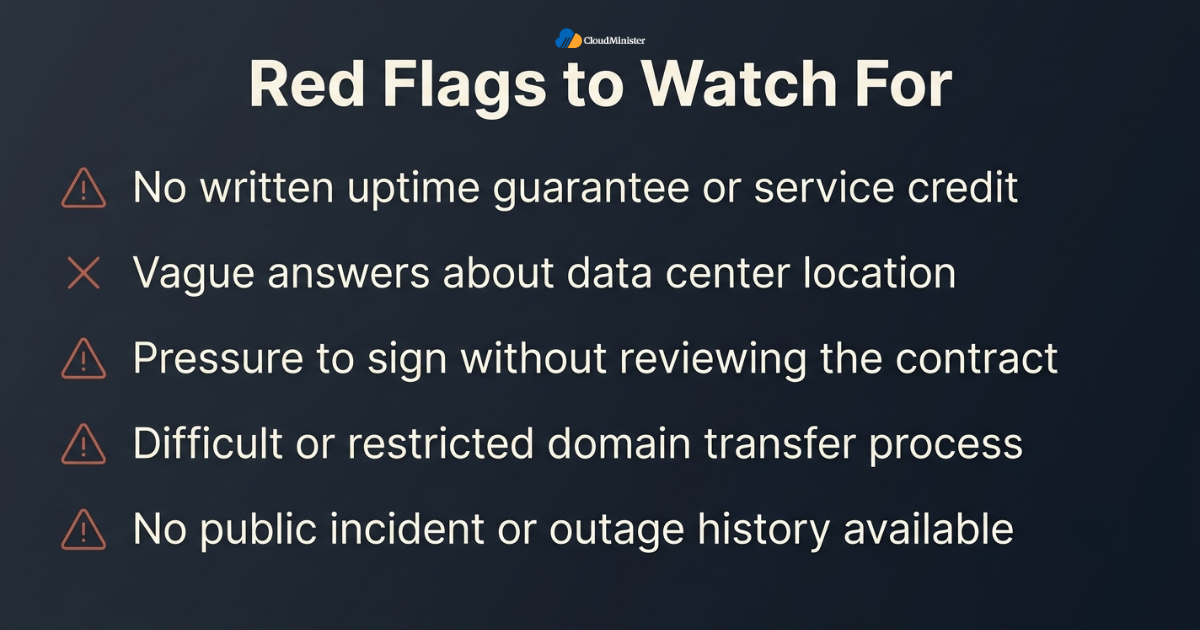
- A Managed Hosting Provider that refuses to put uptime guarantees or service credits in writing is not a provider worth trusting with critical infrastructure.
- Vague or evasive answers about data center locations, ownership structure, or security certifications are a serious red flag from any provider.
- A provider that pressures a quick signature without allowing time to review the full contract is prioritizing the sale over the relationship.
- Any provider that makes a domain transfer deliberately difficult, through hidden locks or unresponsive support, should be treated with significant caution.
- A Managed Hosting Provider with no documented incident response history or public status page transparency is likely to handle a real outage poorly.
- Extremely low introductory pricing with no clear explanation of renewal costs is a common tactic used by a provider planning to raise prices sharply later.
- A provider offering domain registration and hosting bundled together with no clear separation of billing or ownership terms deserves closer scrutiny before signing.
A provider unwilling to clearly document its security practices, backup verification process, or incident history is not simply being cautious about confidentiality, it is very often hiding a genuine capability gap. Treat evasiveness during evaluation as a preview of how that same Managed Hosting Provider will communicate during an actual crisis.
Why the Right Partner Matters for Indian Businesses
Indian businesses evaluating a Managed Hosting Provider face some considerations that are specific to the local market and regulatory environment.
- A genuine Web Hosting Company in India with in country data centers reduces latency for a primarily Indian customer base considerably.
- Regulatory frameworks around data residency make it important to confirm exactly where a Managed Hosting Provider physically stores customer and business data.
- Indian businesses managing both domain registration and hosting through one accountable Web Hosting Company in India avoid the coordination overhead of juggling multiple international vendors.
- A Web Hosting Company in India that understands local compliance requirements, payment processing norms, and regional traffic patterns offers a genuine practical advantage over a purely foreign provider, and the same applies when that Web Hosting Company in India also manages domain registration on your behalf.
- Smaller Indian businesses often assume enterprise grade infrastructure and support are unaffordable, when in reality a well structured Web Hosting Company in India can offer this at a competitive price point.
- Choosing a Web Hosting Company in India that also functions as a dependable domain registration partner simplifies renewals, ownership verification, and any future domain transfer.
- A Web Hosting Company in India with responsive local support removes the time zone friction that comes with relying entirely on an overseas Managed Hosting Provider.
- Working with a trusted domain registration partner and Managed Hosting Provider under one roof gives Indian businesses a single accountable relationship rather than several fragmented vendor contracts.
- Businesses that ever need to transfer your domain while operating under Indian data protection rules should confirm their Web Hosting Company in India follows a compliant, documented handover process.
- A Web Hosting Company in India that supports both new domain registration and an easy transfer your domain option gives growing businesses room to adjust their setup as needs change.
Key Takeaways
- A genuinely capable Managed Hosting Provider should offer a written, enforceable uptime guarantee backed by real service credits rather than a marketing number.
- Security posture, patch management, and incident response speed separate a dependable Managed Hosting Provider from one that only reacts after something breaks.
- Pricing transparency matters as much at renewal as it does at signing, and a trustworthy provider states both clearly upfront.
- Data ownership and a clean exit process, including how easily you can complete a domain transfer, protect a business from being trapped in an unsatisfactory contract.
- Indian businesses benefit specifically from choosing a Web Hosting Company in India that also acts as a dependable domain registration partner for combined domain registration and hosting needs.
Not Sure If Your Current Provider Still Fits
Use the twelve questions in this guide as a checklist and talk to our team about what a properly documented, transparent managed hosting provider relationship should actually look like.
Conclusion
Selecting a managed hosting provider should never be based purely on price or a polished sales conversation, since the real test of a provider only shows up during an incident, a migration, or a contract renewal. Every prospective provider should be asked the twelve questions covered in this guide, and the answers should be specific and documented rather than offered as informal reassurance. A dependable managed hosting provider treats uptime, security, support, pricing, and data ownership as equally important, not just whichever metric happens to look best in a sales pitch. Judging a provider on a single strong point while ignoring the rest is exactly how businesses end up with coverage gaps they only discover after something has already gone wrong.
Working with an established web hosting company in India that also acts as a dependable domain registration partner gives a business one accountable relationship instead of several fragmented ones. Whether you are signing your first hosting contract or replacing a managed hosting provider that has stopped delivering, the same evaluation discipline applies every time, and it does not get easier to skip just because you have been through it before. The businesses that avoid painful renewals and difficult exits are consistently the ones that read the contract carefully and asked direct questions before ever signing a hosting agreement, rather than assuming good intentions would carry through to the fine print.
Any business unsure whether its current setup still fits should treat its domain registration partner and managed hosting provider relationship as something to review regularly, not something to assume is still working well simply because nothing has broken yet. Confirm one final time that you understand exactly how to transfer your domain and how to switch providers entirely if the relationship ever ends, since knowing this in advance is what genuine flexibility actually looks like. A provider worth choosing is one that would pass this same scrutiny again today, not just the one that made the best impression during the original sales conversation.
Frequently Asked Questions
What is the single most important factor when choosing a Managed Hosting Provider?
There is no single most important factor, since a genuinely reliable provider needs to perform well across uptime, security, support responsiveness, and pricing transparency at the same time. A provider that excels in one area while quietly failing in another still leaves a business exposed during the exact moment that weak area gets tested.
How does domain registration fit into a managed hosting decision?
Domain registration and hosting are closely connected, since a mismanaged domain can take a website offline just as easily as a server failure. Choosing a Managed Hosting Provider that also acts as a reliable domain registration partner reduces the coordination overhead of managing separate vendors and simplifies any future domain transfer.
Why does the ability to transfer your domain matter when choosing a provider?
A business should never feel locked into a Managed Hosting Provider through an artificially difficult domain transfer process. Confirming upfront how easily you can transfer your domain, including authorization code access and any lock periods, protects a business from losing flexibility later, and a genuine domain registration partner will never make this step harder than necessary.
Should a business always choose the cheapest Managed Hosting Provider available?
No, the cheapest option frequently comes with hidden renewal pricing, limited support coverage, or weaker security practices that only become apparent after an incident occurs. A provider should be evaluated on total value, including uptime reliability and support quality, rather than the lowest sticker price alone.
What makes a Web Hosting Company in India a better fit for Indian businesses specifically?
A genuine Web Hosting Company in India with local data centers typically offers lower latency, easier compliance with Indian data residency expectations, and support available in local time zones. This combination gives Indian businesses a practical advantage over relying entirely on an overseas Managed Hosting Provider with no regional presence.
How often should a business re evaluate its current Managed Hosting Provider?
A business should formally review its provider relationship at least once a year, and immediately after any significant outage, security incident, or unexplained pricing change. Treating provider evaluation as a one time decision made years ago is one of the most common reasons businesses end up stuck with inadequate infrastructure.
Choosing the right Managed Hosting Provider is rarely about finding the provider with the most impressive homepage, it is about finding the one willing to answer twelve direct questions honestly and put the answers in writing. A Web Hosting Company in India like Cloudminister that pairs transparent hosting practices with dependable domain registration and support built for the Indian market gives businesses a genuinely accountable domain registration partner and starting point. From evaluating uptime guarantees to understanding exactly how to transfer your domain if the relationship ever ends, the discipline behind choosing a Managed Hosting Provider stays the same, ask direct questions, read the contract carefully, and never assume a polished sales pitch reflects what actually happens after the signature is on the page.