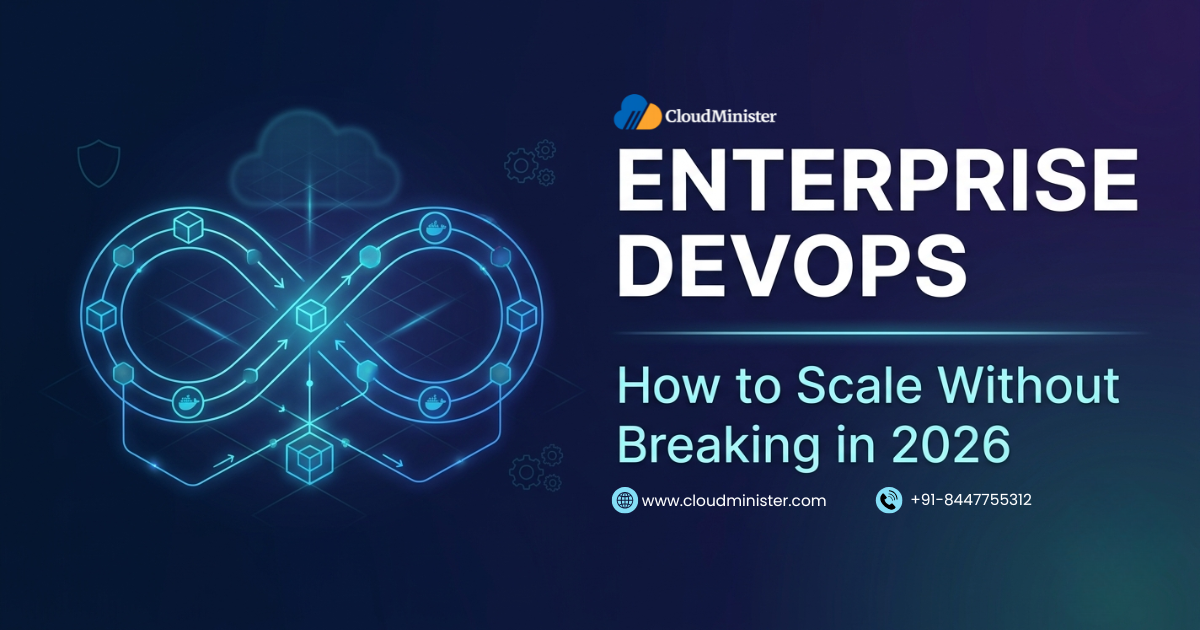
DevOps has moved from an experimental engineering practice to a core operational requirement for businesses competing in the digital economy. Over 80 percent of organisations have implemented DevOps services to accelerate software delivery, improve system reliability, and enable cross-functional collaboration, according to the 2024 State of DevOps Report. But the real test of enterprise DevOps maturity is not whether an organisation has adopted DevOps, it is whether that adoption scales effectively as the organisation grows in team size, geographic distribution, product complexity, and regulatory obligation.
For startups and small teams, implementing DevOps is relatively straightforward. Pipelines are simple, teams are colocated, toolchains are limited, and governance needs are minimal. But as organisations grow into enterprise scale, hundreds of engineers, multiple product lines, distributed offices, legacy systems, and compliance requirements, enterprise DevOps transformations frequently stall. The challenges are not primarily technical. They are cultural, organisational, and architectural: how to standardise workflows across autonomous teams without stifling their productivity, how to embed security without creating deployment bottlenecks, how to maintain visibility across hundreds of microservices and dozens of pipeline configurations, and how to govern delivery quality without recreating the bureaucracy that DevOps was adopted to escape.
This complete 2026 guide covers why scaling enterprise DevOps is fundamentally different from initial DevOps adoption, the specific challenges organisations encounter when scaling, proven solutions and best practices for each challenge, India-specific context including DPDPA 2023 security obligations, and how CloudMinister provides managed DevOps services for Indian enterprises. Explore CloudMinister DevOps Services for current managed DevOps offerings.
Why Scaling Enterprise DevOps Is Different from Initial Adoption
Enterprise DevOps at scale introduces complexity that does not exist in early-stage DevOps implementations. Understanding where this complexity comes from helps organisations address it systematically rather than reactively:
- Team multiplication effect: a team of 10 engineers shares context naturally and can coordinate informally. An enterprise with 500 engineers across multiple teams requires explicit coordination structures, documented standards, and automated governance to maintain the same quality and consistency that small teams achieve through proximity and shared understanding
- Legacy infrastructure coexistence: enterprises inherently maintain legacy systems that predate modern DevOps tooling. Enterprise DevOps must bridge modern CI/CD pipelines with legacy COBOL, mainframe, and monolithic application architectures that cannot be containerised or deployed with the same cadence as new microservices
- Toolchain proliferation: early DevOps adoption allows teams to choose their own tools. Enterprise DevOps at scale produces tool sprawl: dozens of different CI/CD tools, monitoring platforms, IaC frameworks, and security scanning tools that do not integrate with each other, making cross-team visibility and governance impossible
- Regulatory and compliance pressure: large enterprises in BFSI, healthcare, government, and telecommunications operate under regulatory frameworks (RBI guidelines, IRDAI requirements, SEBI compliance, DPDPA 2023) that require audit trails, change management documentation, and security validation at every deployment. Enterprise DevOps must accommodate these requirements without eliminating deployment velocity
- Organisational structure resistance: enterprises have established hierarchies, functional silos, and governance processes built over decades. Enterprise DevOps transformation challenges these structures, creating organisational resistance that technical tooling alone cannot overcome
The DORA (DevOps Research and Assessment) metrics, deployment frequency, lead time for changes, mean time to recovery, and change failure rate, provide the objective measurement framework that enterprise DevOps programmes use to quantify maturity and track improvement. High-performing organisations measured by the 2024 State of DevOps Report deploy on demand or multiple times per day, achieve lead times of less than one hour, recover from incidents in under one hour, and maintain change failure rates below 5 percent. Enterprise DevOps at scale aims to achieve these outcomes across the full organisation, not just within pilot teams.
Related Reading: Scaling DevOps in Large Enterprise: Challenge and Solution
Key Enterprise DevOps Challenges When Scaling
Challenge 1: Lack of Standardisation Across Teams
In early enterprise DevOps adoption, individual teams have significant autonomy to choose the tools and practices that work for their specific context. This autonomy produces fast initial progress but creates fragmentation at scale. When 20 teams use 15 different CI/CD tools, 8 different monitoring platforms, and 12 different approaches to infrastructure provisioning, the organisation cannot achieve cross-team visibility, enforce consistent security policies, share reusable pipeline components, or efficiently support teams when issues arise.
Standardisation in enterprise DevOps does not mean removing all team autonomy, it means defining a consistent core of shared standards (security scanning, deployment approval workflows, monitoring standards, branching strategies) while allowing teams flexibility in how they build within those standards. The distinction is between standardising outcomes and governance versus standardising every implementation detail.
Challenge 2: Cultural and Organisational Silos
Enterprise DevOps is as much a cultural transformation as a technical one. The DevOps philosophy of shared responsibility between development and operations conflicts with the organisational boundaries that large enterprises have built over decades. Development teams focused on feature velocity, operations teams focused on stability, security teams focused on risk mitigation, and business teams focused on compliance have historically operated with different objectives, different incentives, and different definitions of success.
Enterprise DevOps transformation requires these groups to develop shared objectives, particularly the DORA metrics mentioned above, and to develop collaborative workflows where security is a development team responsibility, infrastructure is version-controlled by engineers, and operations has input into architectural decisions. This cultural shift requires executive sponsorship, structural changes to team organisation, and sustained leadership investment over 12 to 24 months. Technical tooling alone cannot produce this cultural change.
Challenge 3: Toolchain Complexity and Integration Overhead
A typical enterprise DevOps environment in 2026 includes dozens of interconnected tools: version control systems (GitHub, GitLab, Bitbucket), CI/CD platforms (Jenkins, GitHub Actions, GitLab CI, CircleCI), Infrastructure as Code tools (Terraform, Ansible, CloudFormation, Pulumi), container platforms (Kubernetes, Docker, ECS), observability platforms (Prometheus, Grafana, Datadog, New Relic), and security scanning tools (SonarQube, Snyk, Trivy, Checkov). Making these tools integrate reliably, maintaining their versions and configurations, preventing integration failures from blocking deployments, and training new team members on the full stack represents significant ongoing engineering overhead.
Platform engineering is the enterprise DevOps response to toolchain complexity. Instead of requiring every engineering team to manage their own toolchain, a dedicated platform team builds and maintains an Internal Developer Platform (IDP), a curated, pre-integrated set of tools and workflows that engineering teams consume through a self-service interface. The platform team abstracts toolchain complexity; product teams get reliable, governed developer experience without managing infrastructure.
Challenge 4: Visibility and Governance at Enterprise Scale
When dozens of teams are releasing code continuously across hundreds of services, maintaining visibility into what is happening across the enterprise DevOps programme is operationally challenging. Questions like “which version of service X is deployed in production across all regions,” “which deployments happened in the last 24 hours that could have caused this incident,” and “which pipelines have not passed security scanning in the last 30 days” require cross-team visibility infrastructure that does not exist by default.
Governance in enterprise DevOps also requires mechanisms to enforce compliance and quality standards without requiring manual review of every pipeline. Policy-as-code tools (Open Policy Agent, Conftest, Checkov) allow security and compliance rules to be expressed as code, enforced automatically in CI/CD pipelines, and reported centrally. This governance-as-code approach enables enterprise DevOps organisations to enforce standards consistently across all teams without creating a centralised approval bottleneck.
Challenge 5: Security Integration in Enterprise DevOps
Security is frequently the dimension of enterprise DevOps transformation where progress is most uneven. Development teams focused on delivery velocity resist adding security scanning steps that slow pipeline execution. Security teams concerned about risk resist delegating security responsibility to development teams who lack the specialised knowledge to make appropriate security decisions. The result is a gap: security checks that exist on paper but are bypassed in practice, or security gates that block deployments without providing actionable remediation guidance.
DevSecOps is the enterprise DevOps approach to resolving this tension. It embeds security from the beginning of the development process rather than adding it as a gate at deployment. Static application security testing (SAST) runs on every code commit. Dependency vulnerability scanning (SCA) checks third-party libraries on every build. Container image scanning evaluates base images and installed packages before any image is deployed. Infrastructure-as-code security scanning validates Terraform and Kubernetes configurations before they are applied. Secret detection prevents API keys and credentials from being committed to version control. These automated checks provide immediate feedback to developers within their normal workflow, making security a development team capability rather than an external audit process.
For Indian enterprises, DPDPA 2023 directly requires security scanning and access controls as part of demonstrating reasonable security safeguards for personal data. Enterprise DevOps pipelines that automate these security checks generate the audit evidence that DPDPA 2023 compliance requires.
Challenge 6: Accelerated Delivery Across Distributed Teams
Enterprise organisations operate across multiple time zones, cities, and countries. Development teams in Bengaluru, Delhi, and Mumbai must coordinate with operations teams, security teams, and product managers who may be in other locations and time zones. Synchronisation points that work for colocated teams, stand-ups, pair programming, informal collaboration, do not scale to distributed enterprise DevOps environments.
Distributed enterprise DevOps teams depend on asynchronous collaboration supported by comprehensive documentation, automated workflows that eliminate human coordination bottlenecks, and shared observability that gives all team members visibility into what is happening across the pipeline without real-time synchronisation. GitOps practices, where the desired state of all infrastructure and deployments is expressed in version-controlled Git repositories and applied automatically by reconciliation controllers, provide a particularly effective coordination model for distributed enterprise DevOps teams.
Solutions and Best Practices for Scaling Enterprise DevOps
The following solutions address the enterprise DevOps challenges described above, drawing on practices from organisations that have successfully scaled DevOps across large, complex engineering environments:
1. Build a DevOps-First Culture with Executive Sponsorship
Enterprise DevOps transformation requires active and visible executive sponsorship. When senior leaders, CTO, CIO, CISO, publicly commit to the transformation, measure team performance using DORA metrics, and make staffing and budget decisions that reflect DevOps priorities, the cultural message is clear and credible. When enterprise DevOps is positioned as an engineering initiative without equivalent business and executive commitment, it remains a technology project rather than a business transformation.
Practical cultural practices that support enterprise DevOps at scale include: blameless post-mortems that focus on system improvement rather than individual fault when incidents occur; psychological safety that allows engineers to raise concerns about technical debt, security risks, and process problems without fear of negative consequences; cross-functional teams that include product, engineering, security, and operations representation for major product lines; and shared OKRs (Objectives and Key Results) that align teams on business outcomes rather than functional outputs.
2. Standardise and Automate Enterprise DevOps Workflows
Enterprise DevOps standardisation is most effective when it operates at the level of golden paths rather than rigid prescriptions. A golden path is the recommended, well-supported approach that teams are encouraged to follow for common engineering activities: starting a new service, deploying to production, adding a new monitoring alert, running a security scan. Teams that follow the golden path get pre-built tooling, documentation, and support. Teams with valid reasons to diverge can do so, but they manage the additional complexity of the non-standard approach themselves.
Automation in enterprise DevOps standardisation includes:
- CI/CD pipeline templates: provide pre-built, organisation-approved pipeline templates for common technology stacks (Java microservices, Node.js APIs, Python data pipelines, containerised workloads) that teams can adopt without building from scratch
- Infrastructure as Code modules: a library of approved, tested Terraform or Ansible modules that teams use to provision approved infrastructure patterns without writing infrastructure code from scratch
- Security scan integration: security scanning tools integrated into the standard pipeline templates so that every team inherits security scanning without needing to configure it themselves
- Deployment approval workflows: automated change management integration that captures deployment metadata for audit purposes and routes approval requests appropriately based on the risk level of the change
3. Implement Platform Engineering for Enterprise DevOps
Platform engineering is the discipline that produces the Internal Developer Platform (IDP) that centralises enterprise DevOps tooling and workflows into a self-service interface for product teams. The platform team, typically 5 to 15 engineers depending on organisation size, builds, operates, and continuously improves the developer platform. Product teams provision environments, run pipelines, check deployment status, and access observability data through the IDP without understanding the underlying infrastructure complexity.
Well-known IDP frameworks include Backstage (open-source, developed by Spotify), Port, and Cortex. These tools provide a developer portal where teams access their services, documentation, pipelines, and infrastructure through a unified interface. Platform engineering reduces cognitive load for product teams, eliminates the per-team infrastructure management overhead, and provides the organisation with a single point of governance for enterprise DevOps standards enforcement.
4. Adopt Governance-as-Code for Enterprise DevOps Compliance
Manual governance processes, change advisory boards, pre-deployment approval gates, manual security reviews, are incompatible with the delivery velocity that enterprise DevOps enables. The solution is not to eliminate governance but to automate it through Governance-as-Code.
Governance-as-Code in enterprise DevOps means expressing compliance requirements, security policies, and deployment standards as machine-readable policies that CI/CD pipelines enforce automatically:
- Policy-as-Code: Open Policy Agent (OPA) or Conftest rules validate Kubernetes manifests, Terraform plans, and Docker images against organisational security policies before they are deployed. Policy violations block the deployment automatically without human review
- Audit logging: every deployment, configuration change, and security event is logged to an immutable, centralised audit log that supports DPDPA 2023 accountability requirements and internal compliance audits
- Change management integration: CI/CD pipelines integrate with ITSM tools (ServiceNow, Jira Service Management) to create change records automatically for production deployments, capturing deployment metadata for compliance purposes without manual ticket creation
- Access governance: IAM policies and just-in-time access controls ensure that no individual has permanent, unchecked access to production systems. Access is requested, approved, granted for a defined period, and automatically revoked
5. Use Cloud and Containerisation to Enable Enterprise DevOps Scale
Cloud infrastructure and container orchestration are the technical foundation that makes enterprise DevOps scale achievable. Kubernetes provides the abstraction layer that separates application teams from infrastructure management, enabling consistent deployment behaviour across AWS, Azure, Google Cloud, and Akamai Cloud environments.
Auto-scaling policies match compute resources to actual demand, eliminating the over-provisioning that occurs when teams manually provision infrastructure for peak load. GitOps controllers (ArgoCD, Flux) continuously reconcile the desired state expressed in Git with the actual deployed state, automatically detecting and correcting drift without human intervention. Service mesh technology (Istio, Linkerd) provides traffic management, mutual TLS encryption, and observability across microservices without requiring changes to application code.
CloudMinister provides managed cloud infrastructure and DevOps Services across AWS, Azure, Google Cloud, and Akamai, with Kubernetes cluster management, CI/CD pipeline setup, and Infrastructure as Code implementation for Indian enterprises with India-based data centres and DPDPA 2023 compliant data residency.
6. Invest in Observability for Enterprise DevOps
Observability, the ability to understand the internal state of a system from its external outputs, is a prerequisite for confident enterprise DevOps delivery at scale. Teams that cannot observe the behaviour of their systems in production cannot safely increase deployment frequency, because they cannot detect regressions quickly enough to maintain acceptable reliability.
Enterprise DevOps observability spans three dimensions:
- Metrics: quantitative measurements of system behaviour over time (request rate, error rate, latency, resource utilisation). Prometheus and Grafana provide the standard open-source metrics stack for enterprise DevOps environments
- Logs: structured log records from services and infrastructure that provide detailed context for individual events. Centralised log management through the ELK stack (Elasticsearch, Logstash, Kibana) or cloud-native equivalents ensures logs are searchable across all services
- Traces: distributed trace data that follows individual requests across multiple microservices, identifying which service in a chain is responsible for latency or errors. OpenTelemetry provides the vendor-neutral instrumentation standard for distributed tracing in enterprise DevOps environments
SLO (Service Level Objective) engineering formalises reliability expectations for every service and uses observability data to measure whether those expectations are being met. Error budgets derived from SLOs provide the quantitative basis for deployment decisions: when reliability is well within SLO, the error budget supports higher deployment frequency; when reliability is degrading, the error budget signals the need to pause new feature releases and focus on reliability improvement.
7. Build Enterprise DevOps Capability Through Internal Centres of Excellence
An internal DevOps Centre of Excellence (CoE) is a small group of senior practitioners responsible for enterprise DevOps strategy, toolchain decisions, training programmes, and community of practice. The CoE does not own all DevOps activity, that remains with product teams, but it provides direction, standards, and support that helps the full organisation move coherently rather than in independent directions.
Effective enterprise DevOps CoEs invest in continuous learning for the engineering organisation: structured training programmes, internal workshops, external conference participation, certification programmes (CKA for Kubernetes, AWS DevOps Engineer, Google Cloud Professional DevOps Engineer), and internal knowledge sharing through engineering blogs, lunch-and-learn sessions, and documented case studies of DevOps improvements.
Enterprise DevOps in India: 2026 Context
Enterprise DevOps adoption in India in 2026 has specific characteristics that reflect the maturity of the Indian technology ecosystem and the regulatory environment:
- India’s large enterprise technology sector: Indian IT services enterprises including TCS, Infosys, Wipro, and HCL Technologies operate enterprise DevOps programmes spanning thousands of engineers across multiple delivery centres. Indian product companies in BFSI, e-commerce, and SaaS have built sophisticated enterprise DevOps programmes to support rapid product iteration in competitive markets
- DPDPA 2023 and enterprise DevOps pipelines: pipelines that process personal data of Indian citizens must satisfy DPDPA 2023 reasonable security safeguard requirements. Enterprise DevOps programmes in India should implement automated security scanning, access control governance, and audit logging as standard components of CI/CD pipelines to generate the evidence that DPDPA 2023 accountability requires
- India-region cloud infrastructure: enterprise DevOps programmes deploying to India require understanding of the AWS ap-south-1 (Mumbai) and ap-south-2 (Hyderabad) regions, Google Cloud asia-south1, and Azure India North and South regions. CloudMinister provides managed enterprise DevOps infrastructure with India-based data centres and INR billing for Indian enterprises
- Regulatory sector-specific requirements: Indian enterprises in BFSI must meet RBI and SEBI technology governance requirements that impose specific change management, audit trail, and segregation of duties requirements on enterprise DevOps programmes. Healthcare organisations must address clinical data protection requirements alongside DPDPA 2023. Enterprise DevOps governance-as-code must be configured to satisfy these sector-specific requirements
- Talent and skills investment: India has one of the largest pools of DevOps-capable engineers globally, but enterprise DevOps at scale requires specialised skills in platform engineering, site reliability engineering, and DevSecOps that are in high demand. Indian enterprises investing in enterprise DevOps CoEs and structured training programmes gain a competitive advantage in attracting and retaining this talent
Conclusion
Scaling enterprise DevOps is not a project with a completion date, it is an ongoing organisational capability that must be continuously invested in and improved as the organisation grows, technology evolves, and regulatory requirements change. The challenges of standardisation, cultural resistance, toolchain complexity, governance, security, and distributed team coordination are not problems to be solved once but dimensions to be continuously managed and improved.
Organisations that treat enterprise DevOps as a technical tooling exercise, installing CI/CD tools without investing in culture, governance, and skills development, consistently find that their DevOps programmes plateau at a maturity level well below their potential. Organisations that invest in the full enterprise DevOps stack, cultural transformation, toolchain standardisation, platform engineering, governance-as-code, observability, and continuous learning, achieve the elite DORA metrics that translate directly into competitive advantage: faster feature delivery, more reliable systems, and faster recovery from incidents.
Frequently Asked Questions
What makes enterprise DevOps different from DevOps in a startup?
Enterprise DevOps operates at a fundamentally different scale and complexity than startup DevOps. Enterprises have hundreds or thousands of engineers across multiple teams, products, and geographies, compared to small co-located startup teams. Enterprises maintain legacy infrastructure and systems that cannot be easily containerised or deployed with high frequency. Enterprises operate under regulatory compliance requirements (RBI, SEBI, IRDAI, DPDPA 2023) that impose specific governance and audit trail requirements on software delivery. Enterprise DevOps must address cultural resistance from established functional silos that do not exist in startups. And enterprises must govern toolchain standardisation across teams that have autonomously adopted different tools over years or decades.
What are the DORA metrics and why do they matter for enterprise DevOps?
DORA (DevOps Research and Assessment) metrics are the four key performance indicators that measure enterprise DevOps maturity and correlate with organisational performance. Deployment frequency measures how often code is deployed to production, elite performers deploy on demand or multiple times per day. Lead time for changes measures the time from code commit to production deployment, elite performers achieve under one hour. Mean time to recovery (MTTR) measures how quickly the team restores service after an incident, elite performers recover in under one hour. Change failure rate measures what percentage of deployments cause production incidents, elite performers maintain below 5 percent. These four metrics are important because they are objective, measurable, and have been statistically correlated with both software delivery performance and organisational outcomes including profitability and employee satisfaction.
What is platform engineering and how does it help enterprise DevOps?
Platform engineering is the discipline of building and operating an Internal Developer Platform that provides product teams with self-service access to the infrastructure, deployment, and observability capabilities they need, without requiring each team to manage its own toolchain. A platform engineering team builds opinionated golden paths for common engineering activities (creating a new service, deploying to production, adding monitoring), pre-integrates approved tools and governance controls into these paths, and provides the platform as a product to the rest of the engineering organisation. Platform engineering helps enterprise DevOps by reducing the cognitive load on product teams, eliminating duplicated infrastructure management effort across teams, providing a single point of governance enforcement, and improving developer experience, which in turn improves productivity and engineering retention.
How does DPDPA 2023 affect enterprise DevOps pipelines in India?
DPDPA 2023 requires organisations to implement reasonable security safeguards for personal data of Indian citizens. For enterprise DevOps pipelines processing applications that handle personal data, this translates to: automated security scanning (SAST, SCA, container scanning) integrated into CI/CD pipelines; access control governance limiting who can deploy to production and access production data; audit logging capturing every deployment and configuration change; data residency controls ensuring personal data processing occurs on India-region infrastructure; and breach detection capability supporting the data breach notification obligations in DPDPA 2023. Enterprise DevOps programmes that implement governance-as-code and DevSecOps practices generate the automated evidence that DPDPA 2023 compliance requires, turning compliance from a manual documentation exercise into an automated outcome of well-designed pipelines.
What is the typical timeline for enterprise DevOps transformation?
Enterprise DevOps transformation does not happen on a fixed timeline, but realistic expectations based on industry experience are: the first 3 to 6 months involve assessment, toolchain standardisation decisions, and pilot implementation with 2 to 3 teams. Months 6 to 18 see active rollout across multiple teams, with platform engineering capability developing and early DORA metric improvements becoming visible. Months 18 to 36 see broader cultural change, mature governance-as-code implementation, and elite DORA performance becoming achievable for the leading teams. Beyond 36 months, continuous improvement remains necessary as the organisation grows, technology evolves, and regulatory requirements change. Organisations that expect enterprise DevOps transformation to be complete in 6 to 12 months consistently find that they have addressed the technical tooling dimensions without achieving the cultural and organisational change that produces lasting improvement.
Does CloudMinister provide managed enterprise DevOps services in India?
Yes. CloudMinister provides managed enterprise DevOps services for Indian organisations, including CI/CD pipeline design and implementation, Infrastructure as Code with Terraform and Ansible, Kubernetes cluster management across AWS, Azure, Google Cloud, and Akamai with India-region data residency, DevSecOps integration for DPDPA 2023 compliant delivery, 24/7 monitoring and incident response, and enterprise DevOps consulting. All services are delivered from India-based teams in Jaipur and Noida with 24/7 IST support and transparent INR pricing. Explore CloudMinister DevOps Services or contact our team at cloudminister.com/contact/ for an enterprise DevOps consultation.

Pritam Kumar is a DevOps Engineer at CloudMinister Technologies, where he manages a multi-datacenter fleet of 100+ servers and architects end-to-end CI/CD pipelines and infrastructure automation using Kubernetes, Terraform, and Ansible. He holds an AWS Certified DevOps Engineer Professional certification and has served as a Google Cloud Mentor, reflecting both hands-on cloud expertise and a track record of mentoring others in the field. His work spans disaster recovery architecture, security incident response, and hosting infrastructure across Proxmox, cPanel/WHM, and Linux systems. Notably, Pritam led the design of Cloud Kavach, a self-hosted DC/DR SaaS portal, and directed remediation efforts for large-scale hosting security incidents involving webshells and command-and-control malware. He brings this depth of real-world infrastructure and security experience to the technical content he writes.