AI Phishing has quietly become the dominant style of email based attack in 2026, and it no longer looks or behaves the way phishing did just two years ago. AI generated content now shows up in over 82 percent of detected phishing emails, making this the default attack style rather than the exception. Generative tools have cut the time needed to craft a convincing lure from roughly sixteen hours down to about five minutes, letting campaigns run at a scale no human attacker could match. Whether the target is a finance team processing invoices or an HR inbox handling resumes, AI Phishing is built to exploit the exact workflows employees trust the most. This guide breaks down why AI Phishing is harder to catch using older filters and training, and what Indian businesses need in place to stay protected in 2026.
For nearly two decades, email security training has told employees to look for the same warning signs, poor grammar, mismatched links, and generic greetings that felt slightly off. That approach worked reasonably well against traditional phishing because most attackers were working by hand and reusing the same templates across thousands of targets. AI Phishing has broken that model completely. The messages employees now receive are fluent, personalized, and often reference real coworkers, real projects, or real recent events, which means the old mental checklist simply does not apply anymore. Security teams that have not updated their thinking around this shift are defending against a threat that no longer exists in its old form.
What makes AI Phishing especially difficult to manage is not one single new trick, but the fact that generative tools removed nearly every reliable signal defenders used to rely on. A message can be rewritten instantly for each recipient, delivered through a QR code or calendar invite instead of a suspicious link, and timed to land right when a real deadline or announcement makes urgency feel genuine rather than manufactured. For Indian businesses in particular, rapid cloud adoption and remote first work have expanded the public footprint attackers can scrape from, giving AI Phishing operators more raw material than ever to build a convincing message.
This guide walks through what AI Phishing actually looks like in practice, why it defeats the filters and training programs built for an earlier era of phishing, and which formats businesses need to plan around, from business email compromise to voice cloning and recruitment themed attacks. It also covers the technology layers, verification habits, and provider choices that genuinely reduce exposure, rather than the outdated assumptions many businesses are still operating under. The goal is not to memorize a new checklist of red flags, since AI Phishing is specifically designed to avoid leaving any. Instead, the focus throughout is on building verification habits and layered defenses that hold up regardless of how convincing the message in front of an employee happens to look.
What Is AI Phishing and Why 2026 Is Different
AI Phishing refers to phishing attacks that are planned, written, personalized, or automated using generative AI tools rather than a human attacker typing each message by hand. This single shift changes almost everything about how the attack looks and how it needs to be defended against.
- AI Phishing removes the spelling mistakes, awkward phrasing, and generic greetings that email security training has relied on for nearly two decades as the primary warning sign for employees.
- Traditional phishing was a numbers game built on volume, while this new generation of attacks is a personalization game built on scraping public data to write a message that reads like it came from someone the recipient actually knows.
- AI-Generated Phishing tools can pull details from LinkedIn profiles, company press releases, and public social posts to build a message referencing a real project, a real coworker, or a real recent event.
- Indian businesses adopting cloud hosting and remote first work models have expanded the digital footprint that attackers can scrape from, giving them more raw material than ever before.
- AI Phishing is no longer confined to email, since the same generative approach now powers fraudulent SMS messages, voice calls, and even video based impersonation attempts.
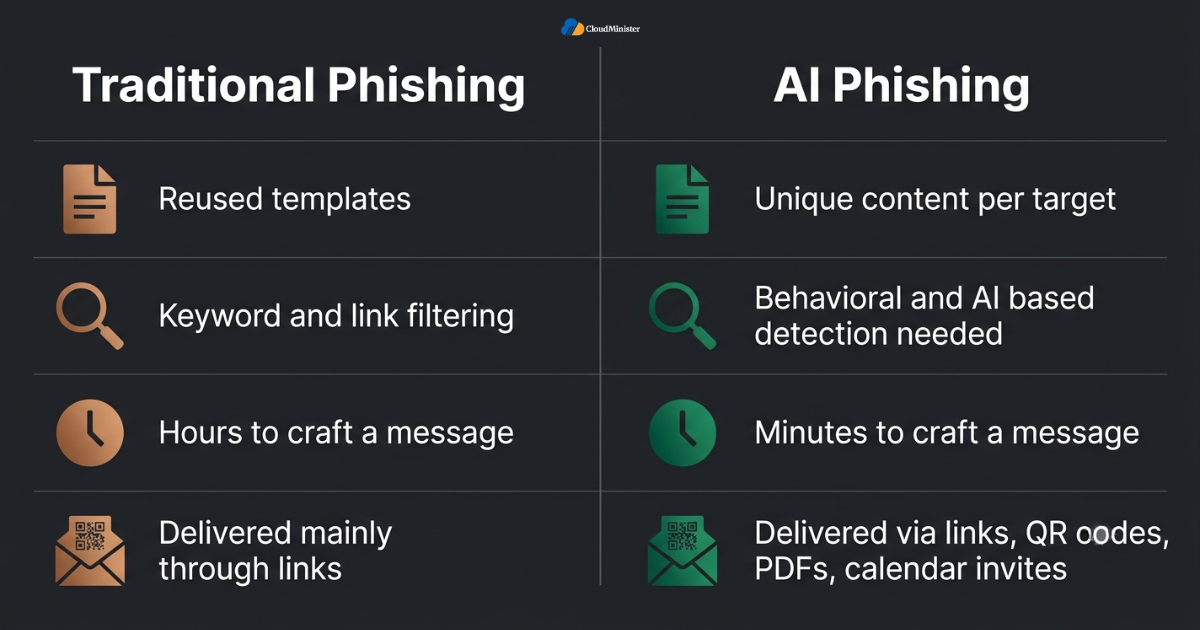
- A defining trait of this threat is speed, since a lure that once took an attacker most of a working day to draft can now be generated, tested, and sent within minutes.
- These campaigns are frequently rewritten on the fly, meaning two employees at the same company may receive messages with completely different wording even though both are part of the same attack.
- Security teams evaluating Cyber Security services should specifically ask whether a vendor’s detection approach accounts for AI Phishing, since many legacy filters were never built to catch machine generated language patterns.
- The rise of AI-Generated Phishing has also lowered the skill barrier for attackers considerably, since a threat actor no longer needs fluent English or deep social engineering experience to produce a convincing message.
- The businesses most exposed to AI Phishing in 2026 are the ones still relying on static filtering rules and awareness training built around outdated warning signs.
AI Phishing is dangerous specifically because it breaks the mental checklist most employees have been trained to run through before clicking a link. Bad grammar, an unfamiliar sender name, a generic greeting, none of these reliably appear anymore. Treat every unexpected request for credentials, payment changes, or sensitive data as suspicious by default, regardless of how polished or personal the message reads, since polish and personalization are now the baseline rather than the exception.
How AI Phishing Is Technically Different From Traditional Phishing
Understanding this shift at a technical level matters because the defenses that worked against older phishing campaigns are often built around assumptions that no longer hold.
- Traditional phishing relied on template reuse across thousands of targets, while AI Phishing generates a fresh version of the message for each recipient, which defeats detection systems built around matching known templates.
- AI-Generated Phishing tools can analyze a target’s actual writing style from previous public emails, forum posts, or leaked data, then mimic that tone closely enough to pass a casual read.
- This content is often assembled dynamically at send time, meaning the exact wording, subject line, and even sender display name can differ from message to message inside the same campaign.
- Legacy spam filters that lean heavily on keyword matching and known malicious link databases struggle against AI Phishing because wording changes constantly and links are frequently hosted on newly registered, unflagged domains, though modern email security has moved well beyond that approach by layering in sender reputation, authentication protocols, behavioral analysis, and machine-learning-based detection.
- Many campaigns now avoid raw hyperlinks altogether, instead hiding malicious payloads inside PDF attachments, calendar invites, and QR codes that many email scanners are not configured to fully inspect.
- A growing share of AI-Generated Phishing traffic uses AI generated voice cloning for callback style scams, where the initial email simply asks the target to call a number rather than click anything at all.
- Kits sold on underground forums now include self correcting logic, meaning an AI Phishing campaign can automatically adjust its wording or sending pattern if early messages start getting flagged or reported.
- Because content is generated per target, AI Phishing also tends to pass automated writing quality checks that older filters used as a secondary signal of legitimacy.
- Businesses relying purely on Server Management Services without a dedicated layer of email and endpoint security are especially exposed, since server level uptime and patching do not address phishing delivered through the inbox.
- Modern attacks have also started incorporating real time context, referencing an actual meeting on a target’s public calendar or a real recent company announcement to increase believability within seconds of that information becoming public.
Run a controlled internal test using a realistic AI Phishing simulation rather than a generic phishing awareness template. Because the content is personalized and grammatically clean, a simulation built the old fashioned way will not accurately measure how employees actually perform against what a real campaign looks like in 2026.
Related Reading: cPanel and WHM CVE-2026-41940 authentication bypass
Why These Attacks Are So Much Harder to Spot in 2026
The core challenge with AI Phishing is not that attackers found one clever new trick, it is that generative tools removed nearly every reliable warning sign employees were trained to look for.
- AI Phishing emails are grammatically correct by default, since the underlying language models are specifically optimized to produce natural, fluent, error free writing.
- These messages can replicate an organization’s actual internal tone and terminology when attackers have access to even a small sample of leaked or scraped internal communication.
- Deepfake audio used in modern vishing calls has become convincing enough that voice alone is no longer a reliable way to confirm someone’s identity over the phone.
- AI Phishing landing pages are frequently generated to pixel perfectly match a real login page, including dynamic elements that used to give away a fake page, such as broken layouts or outdated branding.
- Because AI-Generated Phishing tools can produce hundreds of unique message variants instantly, security teams cannot rely on spotting a single repeated phrase across multiple reported incidents the way they once could.
- Attackers increasingly use adversary in the middle techniques, where a live proxy sits between the victim and the real website, capturing session tokens that let them bypass multi factor authentication entirely.
- Employees frequently overestimate their own ability to detect AI Phishing, which creates a dangerous gap between perceived readiness and actual click through behavior during a real incident.
- Messages timed around real events, such as a tax filing deadline or a company wide announcement, exploit genuine urgency rather than manufacturing an obviously fake one.
- Because campaigns are cheap to run, AI Phishing operators can afford to send far more targeted, well researched attempts instead of relying on volume alone to get a handful of clicks.
- A message crafted through AI-Generated Phishing techniques can reference a real vendor relationship, a real invoice number pattern, or a real project name pulled directly from public tender documents or press releases.
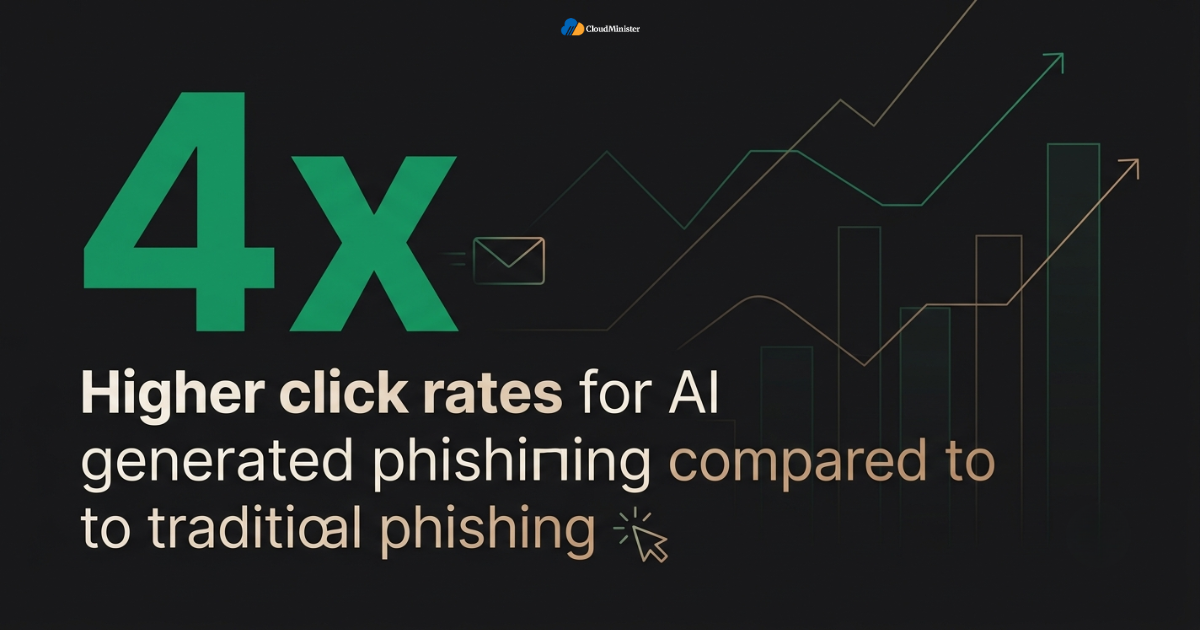
According to a 2026 industry analysis of phishing telemetry, AI generated phishing messages now achieve click rates roughly four times higher than traditional phishing content, a gap that has continued to widen as detection researchers have documented throughout the year.
Related Reading: Zero trust security guide for Indian businesses
The Most Common Attack Formats in 2026
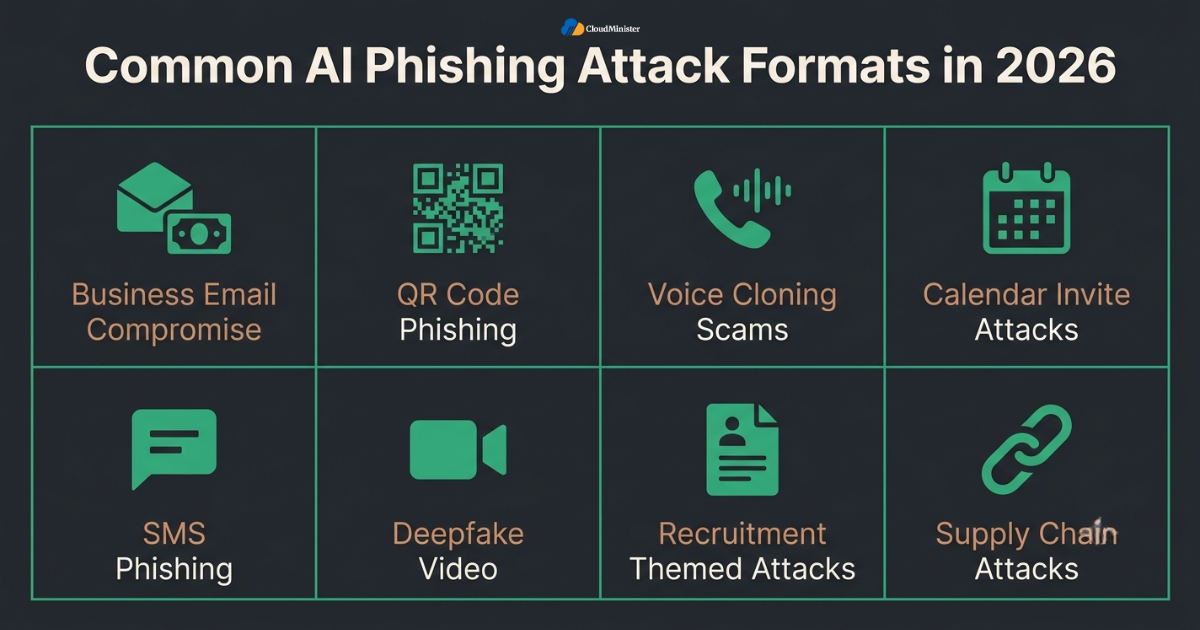
AI Phishing is no longer a single format problem confined to a suspicious email in an inbox, and businesses need to plan defenses across each of the following delivery methods.
- Business email compromise remains one of the costliest forms of AI Phishing, where an attacker impersonates a vendor or executive to redirect a real payment to a fraudulent account.
- QR code based attacks, sometimes called quishing, have grown sharply because scanning a code bypasses most link scanning tools built into corporate email gateways.
- Voice based scams, powered by cloned executive voices, have been used to authorize fraudulent wire transfers by convincing finance staff they are speaking directly with a real decision maker.
- Calendar invite based AI Phishing hides malicious links inside meeting invitations, a format many spam filters treat with less scrutiny than a standard email body.
- SMS based attacks, commonly called smishing, have surged as attackers shift toward channels with fewer built in security layers than corporate email.
- Deepfake video is an emerging AI Phishing format, used primarily in high value business email compromise attempts targeting senior executives during live video calls.
- Recruitment themed AI Phishing targets HR teams with convincing fake job applications carrying malicious attachments disguised as resumes or portfolios.
- Supply chain attacks compromise a trusted vendor or partner first, then use that legitimate relationship to deliver a convincing AI Phishing follow up against the primary target.
- Attacks delivered through collaboration tools like shared documents or chat platforms are increasingly common, since employees tend to trust internal platform notifications more than external email.
- Multi channel AI Phishing campaigns combine two or more of the above formats in sequence, such as an email followed by a callback phone number, specifically to add legitimacy at each stage.
Related Reading: Data residency requirements in India
Why Indian Businesses Are a Growing Target
Indian businesses sit at a specific intersection of rapid digital growth and expanding attack surface that has made them an increasingly attractive target for AI Phishing operators.
- India’s fast growing digital economy means more employees now handle sensitive financial and customer data online, giving attackers a larger pool of valuable targets than in previous years.
- Businesses migrating workloads to a Web Hosting Company in India often expand their public facing digital footprint at the same time, which inadvertently gives attackers more material to scrape for personalization, so choosing the right Web Hosting Company in India from the outset genuinely matters.
- Remote and hybrid work arrangements common across Indian mid sized businesses increase reliance on email and messaging platforms, both prime channels for this kind of attack.
- Regulatory frameworks such as the Digital Personal Data Protection Act raise the stakes of a successful breach considerably, since exposed personal data can trigger compliance obligations and penalties.
- Smaller Indian businesses often assume AI Phishing is a large enterprise problem, when in reality attackers frequently target smaller organizations specifically because their defenses tend to be lighter.
- A reliable Web Hosting Company in India that also offers layered security can meaningfully reduce the practical impact of a successful attempt by limiting what an attacker can actually reach after the initial compromise.
- Indian finance and healthcare businesses face amplified risk given the sensitivity of the data they hold and the regulatory scrutiny that follows any breach involving that data.
- Vendor and supply chain relationships common in Indian manufacturing and export businesses create additional entry points, since a single compromised partner can open access to several connected organizations at once.
- Businesses that have not reviewed their Cyber Security services posture specifically against AI Phishing in the past twelve months are very likely operating with outdated assumptions about what a phishing attempt actually looks like today, and pairing that review with an audit of current Server Management Services in India is equally worthwhile.
- Choosing a Web Hosting Company in India that understands both technical infrastructure and the current threat landscape gives Indian businesses a genuine advantage over a purely DIY security approach.
Conversations with Indian security teams that have handled a real AI Phishing incident consistently point to the same lesson, the initial email or message was rarely the point of failure. The real damage happened in the minutes after a credential was entered, when a lack of monitoring, alerting, or session control allowed the attacker to move freely inside the account. A strong defense has to assume some messages will get through and focus equally hard on limiting what happens next.
Building a Defense Strategy
A credible defense against AI Phishing has to combine technology, process, and training, since no single control on its own is enough to stop a threat this adaptive.
- Multi factor authentication remains essential, though businesses should specifically choose phishing resistant methods, since adversary in the middle techniques can bypass basic one time password based MFA.
- Investing in modern Cyber Security services that specifically include AI driven detection is one of the most effective ways to counter AI Phishing, since machine generated content requires machine assisted detection to catch reliably.
- Regular, realistic simulations help employees build genuine pattern recognition rather than false confidence based on outdated red flags that no longer apply.
- Businesses should implement out of band verification for any request involving payment changes, credential resets, or sensitive data, meaning a phone call to a known number rather than a reply to the original message.
- Cybersecurity solutions that include behavioral analysis and anomaly detection can catch attempts that pass traditional content based filtering entirely.
- Server Management Services in India that include proactive patching and hardening reduce the blast radius of a successful AI Phishing attempt by closing off the lateral movement paths attackers rely on after initial access.
- A clear, well communicated incident reporting process shortens the window between a successful click and a security team response, which directly limits potential damage.
- Email authentication protocols such as DMARC, SPF, and DKIM remain foundational, since properly configured records make it considerably harder for AI Phishing campaigns to spoof a trusted domain convincingly.
- Cybersecurity solutions built around zero trust principles limit what a compromised account can actually access, which matters enormously once an attacker succeeds in stealing a single set of credentials.
- Working with a Web Hosting Company in India that bundles Cyber Security services and Server Management Services together gives businesses a single accountable partner rather than fragmented coverage across multiple vendors during an active incident.
Build a short, memorable verification habit across the organization, something as simple as calling a known number before acting on any financial request, regardless of how convincing the email or voice message sounds. AI Phishing depends on skipping this exact step, and a single consistent habit stops far more attacks than a lengthy policy document nobody reads.
Related Reading: encryption in transit
Technology Layers That Actually Counter This Threat
Since these attacks are generated and delivered using automated tooling, countering them effectively requires technology that can operate at a similar speed and scale.
- AI powered email security platforms that analyze intent and behavior, rather than just keywords and known bad links, are considerably more effective than legacy rule based filters.
- Endpoint detection and response tools help catch the second stage of an attack, specifically the malware or credential theft activity that follows a successful initial click.
- Cybersecurity solutions offering real time domain reputation checks are important against AI Phishing, since attackers now frequently register lookalike domains only hours before a campaign launches.
- Cybersecurity solutions with session token monitoring can detect the adversary in the middle pattern common in advanced attempts, even after multi factor authentication has technically succeeded.
- Server Management Services in India covering patch management directly reduce risk, since many successful attacks ultimately rely on an unpatched system to escalate access after the initial compromise.
- Browser isolation technology can neutralize malicious links delivered through email by rendering the destination page in a sandboxed environment rather than the user’s actual browser.
- Server Management Services in India that include continuous monitoring and log review help security teams catch unusual account activity quickly following a successful attempt.
- Cloud access security tools help detect abnormal login patterns, such as impossible travel or unfamiliar devices, that frequently follow a successful credential theft.
- Choosing Cyber Security services with dedicated incident response capability ensures a fast, coordinated reaction the moment an AI Phishing attempt is confirmed rather than a slow, improvised one.
- Regularly testing detection tools against current samples, rather than assuming last year’s configuration is still effective, keeps defenses aligned with how fast this threat continues to evolve.
According to IBM X-Force’s 2026 research, generative AI has cut the average time needed to draft a convincing phishing email from roughly sixteen hours down to about five minutes, a shift that has been widely cited as evidence of just how industrialized modern phishing operations have become.
No single technology layer stops AI Phishing on its own, and businesses that rely on just one control, whether that is a spam filter, MFA, or employee training, are building a defense with a single point of failure. Layered Cyber Security services, paired with disciplined Server Management Services, give an organization multiple chances to catch an attempt before it results in real damage.
A Practical Readiness Framework
Rather than treating readiness as a single project with a defined end date, it helps to work through it as an ongoing set of questions a security team should be able to answer confidently at any point in the year.
- Has the organization run a realistic AI Phishing simulation within the last six months, rather than relying on outdated awareness material built around older attack patterns.
- Are phishing resistant multi factor authentication methods in place for every account with access to financial systems or sensitive customer data.
- Does the current email security stack include cybersecurity solutions capable of catching AI-Generated Phishing content that passes traditional keyword and link based filtering, and are those cybersecurity solutions reviewed on a regular schedule.
- Is there a documented, tested out of band verification process for financial requests, credential resets, and any change to vendor payment details.
- Have Server Management Services in India been reviewed recently to confirm patching cadence is fast enough to close the gaps attackers rely on after an initial compromise.
- Does the organization have a clear, fast incident reporting path that employees actually know how to use the moment they suspect an AI-Generated Phishing attempt.
- Have DMARC, SPF, and DKIM records been properly configured and verified, rather than assumed to already be correctly set up.
- Is there a vendor and supply chain review process in place that accounts for AI-Generated Phishing entering through a trusted third party relationship rather than a direct attack.
- Has leadership specifically budgeted for Cyber Security services that address this evolving threat, rather than treating general IT spend as sufficient coverage.
- Has the business confirmed whether its Web Hosting Company in India offers integrated cybersecurity solutions, or whether hosting and security are being managed as two completely disconnected functions.
Readiness Checklist
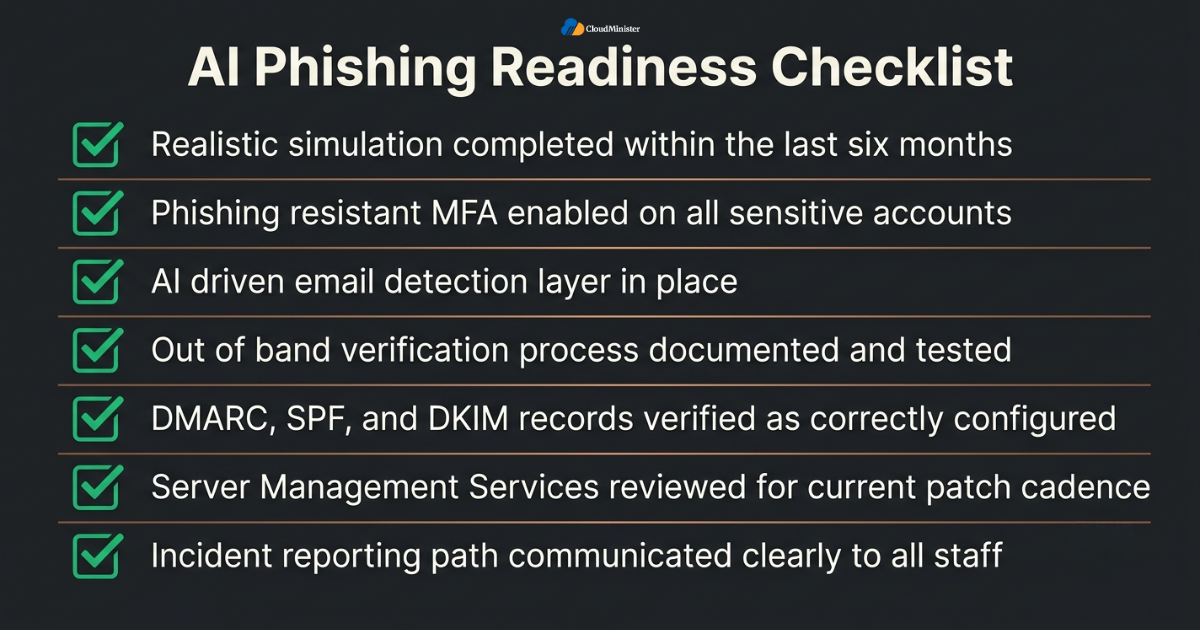
- Realistic simulation completed within the last six months
- Phishing resistant MFA enabled on all sensitive accounts
- AI driven email detection layer in place through proven cybersecurity solutions
- Out of band verification process documented and tested
- DMARC, SPF, and DKIM records verified as correctly configured
- Server Management Services in India reviewed for current patch cadence
- Incident reporting path communicated clearly to all staff
Stop Guessing, Start Defending Against AI Phishing
Legacy filters and outdated training are not enough anymore. Get layered Cyber Security services built to catch AI generated phishing before it reaches your team.
Where This Threat Is Headed Next
The pace at which AI-Generated Phishing has evolved over the past two years suggests the threat is nowhere close to leveling off, and planning ahead matters as much as reacting to what is already happening.
- Ready made attack kits are becoming more accessible on underground marketplaces, lowering the cost and technical skill required to launch a convincing AI-Generated Phishing campaign even further.
- Voice cloning technology behind modern vishing attacks continues to improve, making phone based identity verification an increasingly unreliable standalone control.
- Attackers are expected to increasingly target AI assistants and automated inbox triage tools directly, embedding hidden instructions designed to manipulate automated systems rather than human readers alone.
- Multi channel campaigns combining email, SMS, and voice within a single coordinated AI-Generated Phishing attempt are expected to become the norm rather than the exception over the next few years.
- Regulatory pressure around data protection is likely to increase scrutiny on how Indian businesses respond to and disclose breaches involving personal data.
- Providers of cybersecurity solutions are racing to build detection specifically tuned to AI-Generated Phishing patterns, though attackers are iterating on generation techniques at a comparable pace.
- Server Management Services in India providers are increasingly expected to bundle security hardening as a default rather than an optional add on, given how directly infrastructure hygiene affects outcomes after a breach.
- Businesses that build awareness into standard onboarding, rather than treating it as an annual training exercise, are likely to see meaningfully better outcomes over time.
- A growing share of Cyber Security services providers are expected to offer dedicated simulation and detection packages as AI-Generated Phishing becomes a standard line item in security budgets.
- Regardless of how the threat continues to evolve, the businesses best positioned will remain the ones treating readiness as a continuous discipline rather than a one time fix.
Choosing the Right Partner for Ongoing Protection
Closing the gap this threat exploits is rarely a one time purchase, it is an ongoing relationship with a provider that treats hosting, infrastructure, and detection as connected parts of the same system.
- A dependable Web Hosting Company in India should be able to explain, in plain terms, exactly how its Cyber Security services and Server Management Services work together rather than describing them as separate add ons.
- Businesses evaluating a Web Hosting Company in India should ask for specifics on patch cadence, monitoring frequency, and how quickly their Server Management Services team responds once unusual activity is flagged.
- Server Management Services that bundle proactive hardening, backup verification, and continuous monitoring reduce the day to day workload on internal IT teams considerably.
- Server Management Services in India priced transparently, without vague bundled line items, make it far easier for a business to budget accurately for the coming year.
- A Web Hosting Company in India offering tiered Server Management Services in India gives growing businesses room to scale coverage up as their infrastructure and risk profile expand, and a Web Hosting Company in India with a proven security track record makes that scaling decision considerably easier to trust.
- Providers that combine Cyber Security services with Server Management Services in India under one contract simplify support escalation during a genuine incident, when speed matters most.
- Businesses should confirm their chosen cybersecurity solutions are updated regularly against current attack patterns, rather than running on a configuration set once and never revisited.
- Cyber Security services worth paying for should include clear reporting, so leadership can see exactly what threats were blocked and where remaining gaps still exist.
- A Web Hosting Company in India with in country data centers and proven Server Management Services in India gives compliance conscious businesses one less variable to manage during an audit.
- Ultimately, the businesses that fare best treat their Cyber Security services, Server Management Services in India, and broader cybersecurity solutions as one coordinated system rather than three unrelated purchases made at different times for different reasons.
Choosing cybersecurity solutions that are actively maintained, paired with Server Management Services in India that keep the underlying servers patched and monitored, gives a business the strongest realistic chance of catching a well crafted attempt before it causes lasting damage. A Web Hosting Company in India that offers all of this under one roof, rather than forcing a business to coordinate multiple disconnected vendors, tends to close gaps faster and communicate more clearly the moment something looks wrong. Cybersecurity solutions alone are not enough without the underlying infrastructure discipline that Server Management Services in India provides, and neither is complete without genuinely responsive Cyber Security services standing behind them both.
A Final Note on Getting Started
Businesses unsure where to begin do not need to solve everything at once. Start by confirming your Web Hosting Company in India can speak clearly about its cyber defense posture, then layer in cybersecurity solutions that specifically address AI generated attack patterns rather than only older, static threats. A Web Hosting Company in India like Cloudminister that pairs cybersecurity solutions with dependable Server Management Services and responsive Cyber Security services gives Indian businesses a genuinely coordinated starting point. From there, a Web Hosting Company in India worth keeping long term should keep refining its Server Management Services in India and cybersecurity solutions as the threat landscape continues shifting through the rest of 2026 and beyond, so businesses are never left comparing today’s defenses against yesterday’s version of this problem.
Key Takeaways
- AI Phishing now accounts for the large majority of detected phishing emails, making it the default threat rather than a rare edge case.
- AI-Generated Phishing defeats traditional detection because it removes grammar errors, generates unique content per target, and increasingly avoids raw links altogether.
- Indian businesses face growing exposure due to rapid digital adoption, remote work, and expanding public facing footprints, which makes a reliable Web Hosting Company in India an important part of the defense picture.
- A layered defense combining phishing resistant MFA, cybersecurity solutions with behavioral detection, and out of band verification is essential.
- Server Management Services in India and Cyber Security services working together close the gaps that attackers rely on after an initial compromise.
- Readiness against AI Phishing is a continuous discipline, not a single project with a fixed end date.
Not Sure Where Your Defenses Stand
Talk to our team about a practical readiness review covering AI Phishing detection, hosting, and server security, tailored to your actual risk.
Conclusion
AI Phishing has fundamentally changed what a suspicious message looks like, and businesses that continue relying on outdated warning signs are operating with a false sense of security. The grammar mistakes, generic greetings, and obviously fake sender names that employees were trained to spot for nearly two decades rarely show up anymore, which means readiness now depends far more on verification habits and layered technology than on pattern recognition alone. Indian businesses that combine tested processes, updated training, and multiple overlapping security controls consistently see fewer successful incidents than those depending on any single control to catch everything.
Working with an established web hosting company in India that genuinely understands both infrastructure and the current threat landscape gives any business a real head start against AI Phishing. This threat should never be treated as solved the moment a filter or training program is put in place, since the techniques behind AI Phishing continue evolving month over month, often faster than internal policies get updated. Choosing the right mix of cyber security services and server management services in India, matched to actual risk rather than assumptions carried over from previous years, remains the most reliable path to reducing exposure over time.
Whether a business is just beginning to formalize its defenses or refining an already mature program, the discipline behind stopping AI Phishing stays the same. Verify before trusting, monitor continuously, and never assume last year’s playbook still applies to what is landing in inboxes today. Treating readiness as an ongoing habit rather than a project with a fixed end date is ultimately what separates businesses that catch an AI Phishing attempt early from those that only discover the damage after it has already spread.
Frequently Asked Questions
What exactly is AI Phishing and how is it different from regular phishing?
AI Phishing refers to phishing attacks created or automated using generative AI tools, which produce grammatically clean, highly personalized messages at a scale and speed no human attacker could match manually. Regular phishing typically relied on reused templates and was easier to catch through obvious errors, while AI-Generated Phishing produces unique content per target and often passes basic quality checks that used to reveal a scam.
Why is this threat harder for employees to spot in 2026?
It removes most of the traditional red flags employees were trained to notice, including poor grammar, generic greetings, and obviously fake sender details. It can also mimic an organization’s actual tone, reference real events, and arrive through formats like QR codes or calendar invites that receive less scrutiny than a standard email link.
Can traditional spam filters actually stop AI-Generated Phishing?
Traditional spam filters built around keyword matching and known bad link databases struggle against this threat because the wording changes with every message and malicious links are often hosted on newly registered domains. Effective protection generally requires cybersecurity solutions capable of analyzing intent and behavior rather than static content alone, backed by a security minded Web Hosting Company in India that keeps the underlying infrastructure current.
What role do Server Management Services in India play in reducing this risk?
Server Management Services in India that include proactive patching, hardening, and continuous log review reduce the practical damage of a successful attempt by closing the paths attackers rely on to move deeper into a network after an initial compromise. Pairing Server Management Services with Cyber Security services gives a business a single accountable partner rather than fragmented coverage.
How can Indian businesses reduce their exposure overall?
Indian businesses can reduce exposure by implementing phishing resistant multi factor authentication, running realistic simulations, verifying financial requests out of band, and working with a Web Hosting Company in India that offers integrated Cyber Security services and Server Management Services rather than treating hosting and security as separate concerns. Layering multiple cybersecurity solutions, rather than depending on one tool, also meaningfully improves outcomes.
Is AI Phishing only a large enterprise problem?
No, it frequently targets smaller and mid sized businesses specifically because their defenses tend to be lighter and easier to breach. Any Indian business handling financial transactions, customer data, or vendor relationships, whether hosted through a large Web Hosting Company in India or a smaller regional provider, should treat this as a direct and current risk rather than a concern limited to large enterprises.
What should a business look for when comparing Cyber Security services providers?
A strong Cyber Security services provider should offer AI driven detection, phishing simulation, incident response, and visibility into how their cybersecurity solutions specifically address AI-Generated Phishing rather than generic spam filtering. It also helps when that provider can coordinate closely with whoever delivers Server Management Services in India, since infrastructure hardening and inbox level defense work best when managed together rather than as separate, disconnected contracts.