Choosing the Best Node.js Hosting in 2026 means picking between three very different models, serverless, VPS, and dedicated servers, each suited to a different traffic pattern and team capacity. This guide breaks down how each model works, what real 2026 performance data shows, and how Indian businesses can match their choice to their specific application instead of copying a competitor’s setup.
Node.js has moved well past its early reputation as a niche backend runtime. It now powers API gateways, real-time chat systems, microservices, and the orchestration layer behind many AI-driven applications. As its footprint has grown, so has the complexity of the hosting decision behind it. Finding the Best Node.js Hosting setup is no longer about picking between “shared hosting” and “a real server”; it’s about matching an application’s actual behavior to an infrastructure model built for it.
That match matters because the three dominant hosting models, serverless, VPS, and dedicated servers, are not interchangeable for upgrades of one another. Each is built around a different assumption about traffic: serverless assumes unpredictability, VPS assumes steady growth, and dedicated hardware assumes sustained, high-volume demand. Choosing the Best Node.js Hosting option without first understanding your own traffic shape often means paying for flexibility you don’t need, or control you’re not equipped to manage.
For Indian businesses specifically, this decision carries additional weight. Data center proximity, local support responsiveness, and cost predictability all shift the calculus in ways that global benchmarks don’t always capture. The rest of this guide walks through each hosting model in detail, compares them against real 2026 performance data, and lays out a practical framework for identifying the Best Node.js Hosting environment for your application, whether you’re a five-person startup or a scaling enterprise.
1. Why the Node.js Hosting Decision Matters More in 2026
Node.js is not a niche runtime anymore. It sits inside API gateways, real-time chat systems, microservices, and increasingly, the orchestration layer for AI-powered applications. Because it is used everywhere, the definition of “Best Node.js Hosting” has also broadened, a setup that is excellent for a small internal tool can be a poor fit for a customer-facing application with unpredictable traffic spikes.
- Node.js adoption in serverless environments has now crossed the halfway mark across major cloud platforms, reflecting how much deployment behaviour has shifted toward event-driven infrastructure.
- A large share of companies with small technical teams rely on Node.js specifically because it lets developers write JavaScript across the entire stack, reducing the need for separate frontend and backend specialists.
- Enterprises with heavy transaction volumes continue to run Node.js in core production systems because of its non-blocking, event-driven architecture.
- The hosting decision is no longer just about uptime — it now directly affects deployment speed, cold-start behaviour, scaling cost, and how quickly a team can ship new features.
- Businesses searching for the Best Node.js Hosting in 2026 are increasingly comparing three distinct models side by side: serverless, VPS, and dedicated servers, rather than defaulting to one option out of habit.
- Businesses that also run a React frontend often research Node.js Hosting in India and ReactJS Hosting Plans together, since the two decisions influence each other more than most teams initially expect.
- A growing number of Indian founders now treat the Web Hosting Company in India relationship as strategic infrastructure planning rather than a one-time purchase decision made in a hurry.
Before comparing specific providers, map your application’s traffic pattern first, steady and predictable, spiky and seasonal, or unpredictable and viral. The Best Node.js Hosting environment is decided by that traffic shape far more than by brand reputation.
2. What Is Serverless Node.js Hosting? Understanding the Model
Serverless hosting does not mean there is no server. It means the provider manages the server entirely, and your Node.js code runs only when a request or event triggers it.
- Functions spin up on demand, execute the requested Node.js code, and shut down again once the request is handled. Execution time is the primary cost driver, but most platforms also bill separately for factors like request volume, data transfer, and any storage resources the function relies on.
- Platforms such as AWS Lambda, Google Cloud Functions, Azure Functions, and Vercel Edge Functions all support Node.js natively, making serverless one of the most accessible entry points into the Best Node.js Hosting conversation for smaller teams.
- Because infrastructure scales automatically, serverless is often the Best Node.js Hosting option for workloads with unpredictable or spiky traffic, since there is no need to pre-provision capacity for a traffic spike that may never come.
- The trade-off is cold starts, the delay that occurs when a function has been idle and needs to initialize before it can process a request.
- Node.js is one of the fastest-initializing runtimes for serverless functions, which is one reason it remains a strong choice even as cold-start concerns are discussed across the industry.
Serverless functions inherit the identity and access permissions configured at the platform level, not at the operating system level, because there is no persistent operating system for your team to manage. This shifts security responsibility toward correctly scoping IAM roles and environment variables rather than patching servers, a meaningful difference Indian businesses need to document when evaluating the Best Node.js Hosting option under data protection compliance requirements.
3. What Is VPS Hosting for Node.js? Understanding the Model
A Virtual Private Server sits in the middle of the spectrum. It gives you a dedicated slice of a physical server’s resources — CPU, RAM, and storage, without the cost of renting an entire machine.
- You get root or administrator access, meaning your team installs and configures Node.js, a process manager, and a reverse proxy exactly the way the application needs.
- Because resources are reserved rather than shared unpredictably, VPS hosting tends to deliver more consistent performance than basic shared hosting, while remaining far more affordable than a dedicated server.
- Many businesses evaluating the Best Node.js Hosting option for a growing application choose VPS hosting specifically because it balances cost, control, and performance without the operational overhead of managing bare-metal hardware.
- Scaling on a VPS is typically vertical first (adding more CPU and RAM to the same instance) before it becomes horizontal (adding more instances behind a load balancer).
- A properly configured VPS running Node.js behind a process manager and reverse proxy can comfortably serve a mid-sized production application, which is why VPS remains one of the most commonly recommended paths to the Best Node.js Hosting setup for growing Indian businesses.
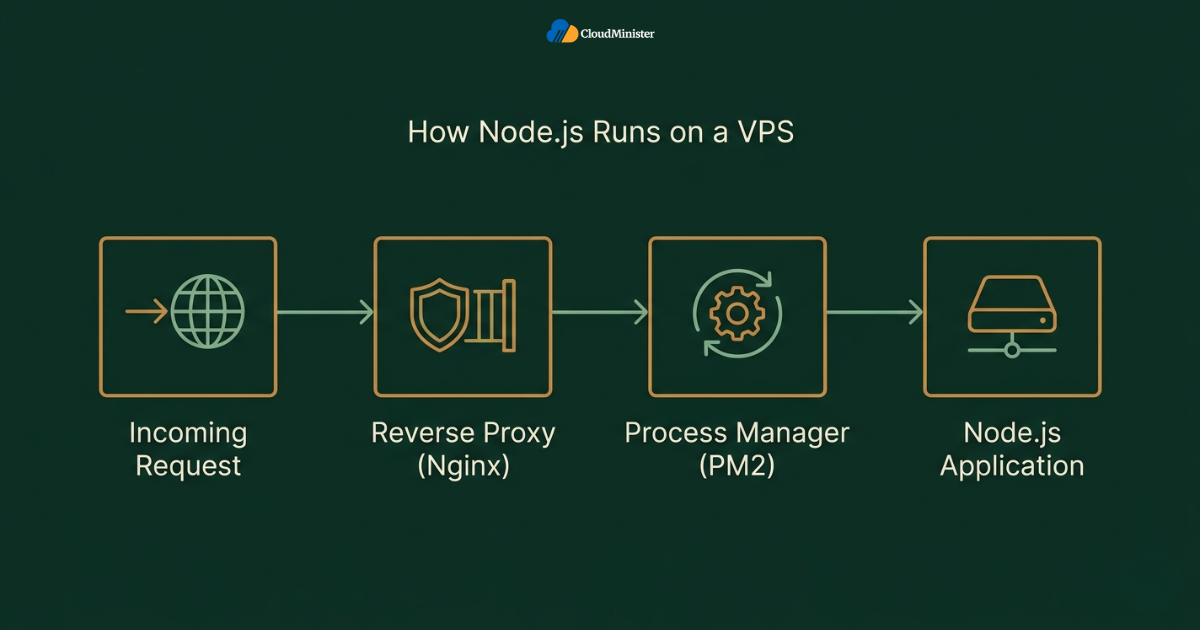
On a VPS, always run your Node.js application through a process manager rather than directly with “node app.js”. This keeps the application running after a crash, enables zero-downtime restarts, and is one of the most overlooked steps businesses skip when trying to reach the Best Node.js Hosting configuration on their own server.
Related Reading: PM2 and Nginx Node.js deployment
- Teams researching Node.js Hosting in India for a VPS deployment specifically should also confirm that the provider offers root access, since limited-access shared plans rarely qualify as genuine VPS hosting.
- A dependable Web Hosting Company in India can usually pre-configure the process manager and reverse proxy during onboarding, which removes one of the more error-prone steps from a first-time VPS deployment.
4. What Is Dedicated Server Hosting for Node.js? Understanding the Model
A dedicated server hands over an entire physical machine to a single customer. Nothing is shared, not the CPU, not the RAM, not the disk I/O.
- This is the model large enterprises reach for when an application has high, sustained, and predictable traffic that justifies the cost of full hardware ownership.
- Because there is no resource contention with other tenants, dedicated servers deliver the most consistent latency and throughput of the three models discussed here.
- Teams running data-intensive Node.js applications, real-time analytics pipelines, large WebSocket deployments, or high-frequency trading-adjacent systems, often find that a dedicated server is genuinely the Best Node.js Hosting option once traffic reaches a certain scale.
- The downside is cost and operational responsibility: your team (or your hosting partner) is fully responsible for OS patching, security hardening, and hardware failure recovery.
- Dedicated hosting is rarely the starting point for a new application, but it is frequently the destination once an application has proven its traffic pattern and needs guaranteed resources around the clock.
- Businesses that eventually outgrow shared or VPS-based Node.js Hosting in India setups often move their backend to a dedicated server while keeping their ReactJS Hosting Plans unchanged on the frontend side.
The core trade-off across all three hosting models is the same one that shows up throughout infrastructure decisions: control versus convenience. Serverless offers maximum convenience with the least control. Dedicated servers offer maximum control with the least convenience. VPS hosting sits deliberately in between, which is exactly why it remains the most commonly chosen Best Node.js Hosting model for growing businesses that are past the prototype stage but not yet at enterprise scale.
Ready for Reliable Node.js Hosting?
Get root-access VPS hosting built for Node.js, process manager and reverse proxy pre-configured, with 24×7 support that actually understands your stack.
5. Serverless vs VPS vs Dedicated: A Side-by-Side Comparison
Businesses researching the Best Node.js Hosting environment often want the trade-offs laid out plainly rather than buried in marketing language.
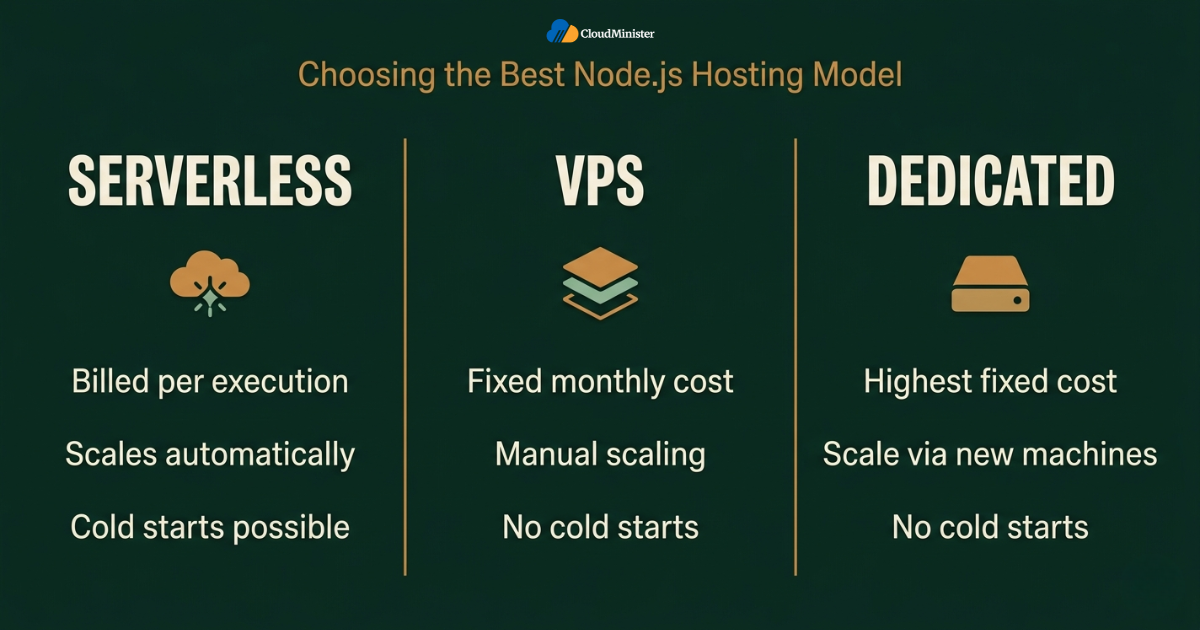
- Cost structure: Serverless bills per execution and can be extremely cheap at low traffic, but costs can spike unpredictably at high, sustained traffic. VPS hosting has a predictable monthly cost regardless of usage within its resource limits. Dedicated servers have the highest fixed monthly cost but the lowest cost per request at very high scale.
- Scaling behaviour: Serverless scales automatically and near-instantly. VPS scaling requires manual resizing or load balancer configuration. Dedicated servers require adding entirely new machines to scale horizontally.
- Cold starts: Serverless functions can experience meaningful cold-start delay after periods of inactivity. VPS and dedicated servers, where the Node.js process stays running continuously, do not have this issue at all.
- Operational overhead: Serverless requires almost no server management. VPS requires moderate DevOps knowledge. Dedicated servers require the most hands-on infrastructure management.
- Best fit: Serverless suits spiky, unpredictable, or event-driven workloads. VPS suits steady-growth applications that need control without full infrastructure ownership. Dedicated servers suit high-traffic, latency-sensitive, or compliance-heavy applications.
- For most small and mid-sized businesses in India comparing the Best Node.js Hosting options available to them, VPS hosting continues to offer the strongest balance of predictable cost and genuine control.
- When comparing Node.js Hosting in India providers side by side, ask each one to walk through exactly how they handle traffic spikes, since marketing pages rarely explain the difference between automatic and manual scaling.
- Businesses that already rely on a trusted Web Hosting Company in India for email and websites frequently extend that same relationship to backend Node.js infrastructure, simply because coordination between vendors becomes one less thing to manage.
CHECKLIST – WHAT TO EVALUATE BEFORE CHOOSING
- Expected average requests per second and expected peak requests per second
- Tolerance for occasional cold-start latency versus a strict low-latency requirement
- In-house DevOps capacity to manage a VPS or dedicated server
- Monthly budget predictability requirements from finance stakeholders
- Compliance or data residency requirements affecting where the application can run
- Growth trajectory over the next 12 to 24 months
Related Reading: deploy your Node.js app on Linux
- Once the checklist above is complete, it becomes much easier to see why nodejs hosting India comparisons should always start with traffic pattern rather than price alone.
- A short internal review comparing nodejs hosting India options against your actual growth projections consistently produces a more defensible infrastructure decision than choosing based on a single feature list.
6. Real Performance Data: What 2026 Numbers Actually Show
Businesses evaluating the Best Node.js Hosting option deserve real numbers, not just architectural theory.
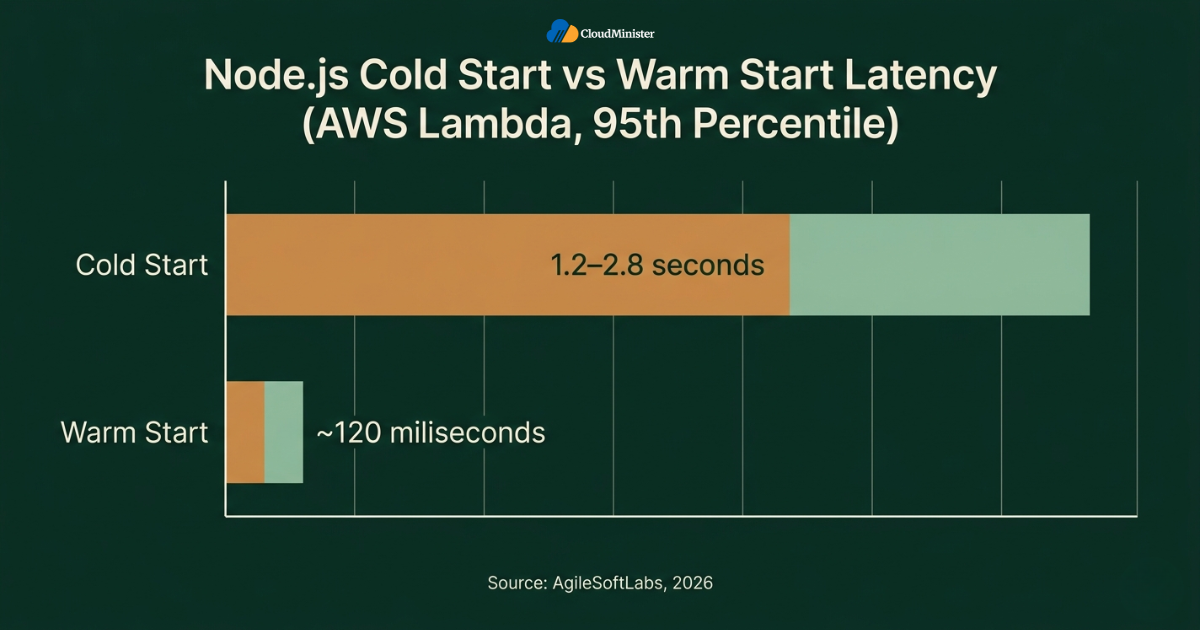
- Independent 2026 cold-start benchmarking has found that Node.js functions on AWS Lambda can range roughly between 1.2 and 2.8 seconds at the 95th percentile when cold, compared to around 120 milliseconds when warm (AgileSoftLabs, 2026).
- Traditional server deployments are commonly over-provisioned, running at an average utilisation far below their actual capacity, which is one of the core cost arguments in favour of serverless for the right workload (SNS Insider, 2026).
- For workloads with genuinely variable traffic, the cost savings from serverless compared to equivalent always-on server deployments can be substantial, which explains why serverless is frequently recommended as the Best Node.js Hosting option for early-stage or unpredictable applications specifically.
- Enterprises continue to report strong developer productivity gains when Node.js is paired with the right hosting environment, since less time is spent on infrastructure firefighting and more time on shipping product features.
- None of these numbers suggest one model is universally the Best Node.js Hosting choice — they show that cold-start-sensitive, latency-critical applications should think carefully before defaulting to serverless, while steady, predictable workloads should think carefully before over-paying for dedicated hardware they do not yet need.
If cold starts are a concern on a serverless platform, look into provisioned concurrency or scheduled warming pings before ruling out serverless entirely. This can preserve most of the cost benefit of serverless while significantly reducing the chance a real user experiences a cold-start delay.
- These benchmarks are a useful reference point regardless of which nodejs hosting India provider a business eventually selects, since cold-start behaviour is largely a function of the underlying platform rather than the specific vendor reselling it.
- Businesses running latency-sensitive applications through nodejs hosting India setups should benchmark their own workload rather than relying purely on industry-wide averages, since real application code and dependency size both affect actual cold-start duration.
- A Web Hosting Company in India offering managed VPS plans can often pre-tune Node.js process settings in ways that meaningfully reduce request latency compared to a default, unoptimized server configuration.
- Keeping a running note of measured latency across shortlisted nodejs hosting India candidates makes the final decision far more objective than relying on impressions from a single demo call.
7. Node.js Hosting for Indian Businesses: What Changes Locally
The calculation for choosing the Best Node.js Hosting environment looks somewhat different for a business operating primarily out of India compared to a global enterprise with unlimited infrastructure budget.
- Latency to Indian end users matters significantly, which makes data center location a genuine factor in the Best Node.js Hosting decision, not an afterthought.
- Businesses looking specifically for Node.js Hosting in India should confirm that the provider’s data centers are geographically close to their actual user base rather than assuming any global provider will perform equally well for Indian traffic.
- Cost sensitivity is real for Indian startups and SMBs, which is why VPS hosting is frequently the practical middle ground rather than jumping straight to a dedicated server on day one.
- Indian businesses evaluating nodejs hosting India options should also factor in local support availability, since time-zone-aligned support can meaningfully reduce downtime during an incident.
- A dependable Web Hosting Company in India that understands both server infrastructure and Node.js-specific configuration gives growing businesses a single point of accountability instead of juggling multiple vendors.
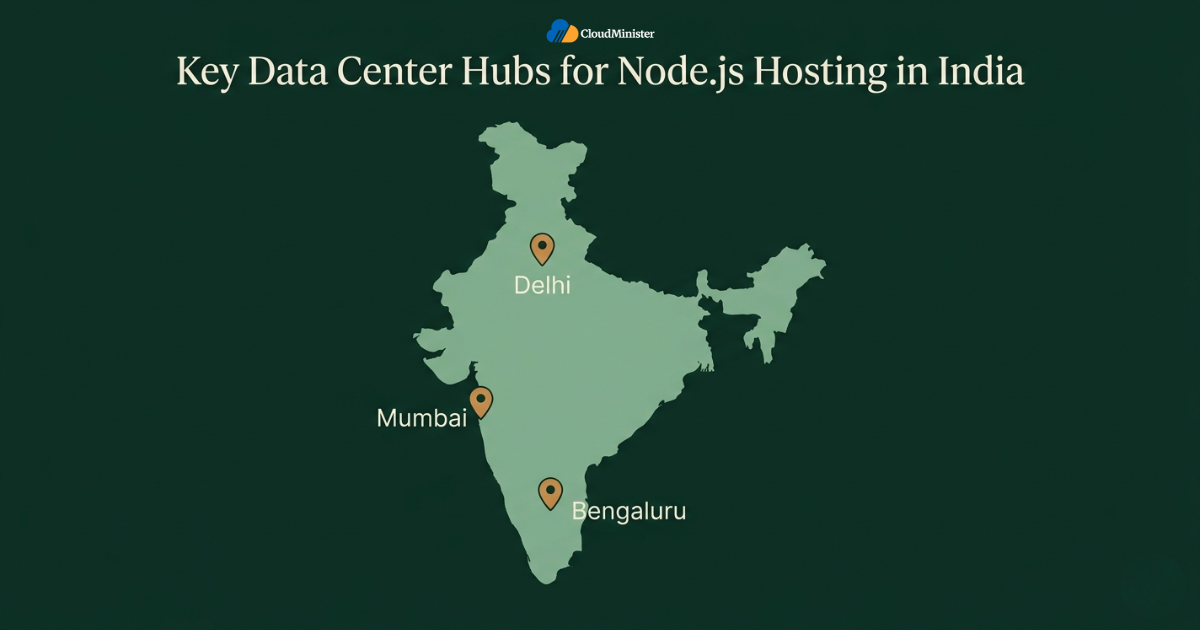
- Founders comparing Node.js Hosting in India providers should ask for real latency numbers from Mumbai, Delhi, and Bengaluru specifically, since national averages can hide regional performance gaps.
- Support quality varies widely across nodejs hosting India providers, and a quick test ticket during the evaluation phase often reveals more than any feature comparison page.
- A Web Hosting Company in India that offers transparent server-level monitoring dashboards makes it far easier for a lean internal team to catch performance issues before customers notice them.
- Businesses that have already evaluated Node.js Hosting in India for their backend should apply the same due diligence when comparing ReactJS Hosting Plans for the frontend layer.
- Choosing a Web Hosting Company in India with data centers physically located within the country remains one of the simplest ways to reduce latency for a predominantly domestic user base.
- Reviews and case studies specific to nodejs hosting India are generally more useful than global benchmarks, since network conditions and peering arrangements differ meaningfully by region.
Related Reading: how to deploy your Node.js hosting on Linux
- Startups comparing early-stage nodejs hosting India plans should specifically ask whether pricing scales gradually with usage or jumps sharply once a plan’s resource ceiling is reached.
- Reviewing nodejs hosting India options at the same time as ReactJS Hosting Plans, rather than months apart, tends to surface compatibility considerations that are easy to miss when the two decisions are made in isolation.
- A genuinely transparent Web Hosting Company in India will publish its scaling tiers clearly rather than requiring a sales call just to understand what the next pricing bracket looks like.
- Businesses that have already selected their Node.js Hosting in India provider for the backend should still independently evaluate ReactJS Web Hosting options for the frontend, rather than assuming the same vendor is automatically the right fit for both.
- A Web Hosting Company in India with a proven track record supporting both Node.js Hosting in India and ReactJS Web Hosting deployments can meaningfully shorten the evaluation process for a team building a full-stack JavaScript application from scratch.
8. Choosing Between Node.js and Frontend Hosting Needs
Most real applications are not backend-only. A Node.js API is frequently paired with a modern JavaScript frontend, and the hosting decision for each layer does not have to be identical.
- Teams running a React frontend alongside a Node.js backend often ask whether both layers need the same hosting model, and the honest answer is: not necessarily.
- ReactJS Web Hosting frequently benefits from static-asset-optimized delivery and CDN distribution, while the Node.js backend behind it may be better served by a VPS or dedicated environment built for continuous processes.
- Businesses comparing ReactJS Hosting Plans alongside their backend hosting should confirm that both environments can communicate with low latency, particularly if they are hosted with different providers.
- Splitting frontend and backend hosting is common practice in 2026, and it does not conflict with choosing the Best Node.js Hosting environment for the API layer specifically.
- What matters most is that whichever ReactJS Hosting Plans a team selects, the network path between frontend and backend stays short enough that the user never notices the split.
- Teams evaluating ReactJS Web Hosting for a customer-facing dashboard should also check whether the provider supports modern build pipelines out of the box, since manual build configuration is a common source of deployment delays.
- Choosing between different ReactJS Hosting Plans becomes easier once the backend hosting decision is locked in, since the two together determine the realistic performance ceiling of the application.
- A well-optimized ReactJS Web Hosting setup can noticeably improve perceived application speed even when the underlying Best Node.js Hosting environment on the backend has not changed at all.
- Some providers bundle ReactJS Hosting Plans with backend Node.js Hosting in India packages, which can simplify billing but should still be evaluated on technical merit rather than convenience alone.
- Frontend teams choosing ReactJS Web Hosting independently of the backend team should still loop in whoever manages the Best Node.js Hosting environment, since CORS and API routing decisions affect both sides.
- Reviewing ReactJS Hosting Plans annually alongside backend hosting ensures neither layer quietly becomes the bottleneck as traffic and feature complexity grow over time.
- A mismatch between a fast ReactJS Web Hosting setup and a slow, under-resourced backend is one of the most common reasons a technically sound frontend still feels sluggish to end users.
- When evaluating ReactJS Hosting Plans for a new product launch, factor in expected traffic from marketing campaigns, since frontend hosting can be just as prone to spikes as the backend.
- Agencies managing multiple client projects often standardize on one ReactJS Web Hosting provider and one Best Node.js Hosting provider to simplify support and reduce operational overhead across accounts.
When frontend and backend are hosted separately, CORS configuration on the Node.js side becomes a genuine security control, not a formality. Misconfigured CORS policies are one of the more common gaps found during infrastructure audits of split-hosting setups, so this should be reviewed explicitly whenever ReactJS Hosting Plans and backend hosting live on different providers.
8.1 Picking an Infrastructure Partner: Local Support Meets Global Standards
Whichever hosting model a business lands on, the provider relationship behind it matters just as much as the architecture chosen.
- Businesses evaluating Node.js Hosting in India should treat provider selection as a long-term partnership decision, not a one-time transaction driven purely by the lowest listed price.
- A Web Hosting Company in India that offers 24×7 support with genuine technical depth — not just ticket triage — makes a measurable difference during an actual incident at 2 a.m.
- Teams that have standardized on a single Web Hosting Company in India for both their Node.js backend and their ReactJS Web Hosting frontend often report fewer coordination issues during deployments.
- When shortlisting nodejs hosting India providers, ask specifically about backup frequency, restore testing, and whether backups are stored in a geographically separate location from the primary server.
- A Web Hosting Company in India that can clearly explain its scaling process — not just claim “unlimited scalability” — is generally a safer long-term bet for a growing Node.js application.
- Founders comparing Node.js Hosting in India options side by side should also request a sample invoice, since renewal pricing after an introductory period is one of the most common sources of budget surprises.
- A reliable Web Hosting Company in India will typically offer a staging environment alongside production, which matters more once a team is actively iterating on a live Best Node.js Hosting deployment.
- Businesses that already trust a particular Web Hosting Company in India for email and DNS often find it operationally simpler to consolidate Node.js Hosting in India needs with the same vendor.
- It is worth directly asking any shortlisted nodejs hosting India provider how they handle a sudden, unexpected traffic spike, since the answer reveals more about real infrastructure than any marketing page.
- The strongest Web Hosting Company in India partnerships tend to combine transparent pricing, responsive support, and infrastructure that has been genuinely tested under real production load rather than only in a demo environment.
9. Common Mistakes That Undermine Node.js Hosting Performance
Even with the right hosting model selected, poor configuration choices routinely undercut what should have been the Best Node.js Hosting setup for a given application.
- Running Node.js directly in production without a process manager, so a single unhandled crash takes the entire application offline until someone notices manually.
- Choosing serverless for a workload that needs to hold persistent WebSocket connections, which fundamentally does not fit the request-response, scale-to-zero model serverless is built around.
- Over-provisioning a dedicated server for an application that has not yet proven it needs that scale, tying up budget that could fund actual product development.
- Ignoring environment-specific configuration, such as setting NODE_ENV=production, which affects logging verbosity, caching behaviour, and performance-related defaults across common frameworks.
- Failing to separate the frontend and backend scaling conversation, assuming that whatever hosting works for a React frontend will automatically be the Best Node.js Hosting choice for the API behind it.
- Not load testing before going live, so the first real indication that the chosen hosting model was wrong arrives during an actual traffic spike rather than during planning.
Across enterprise-scale deployments, the gap between applications that perform well and applications that struggle in production is rarely about which of the three hosting models was chosen. It is almost always about configuration discipline, process management, environment variables, monitoring, and realistic load testing, applied consistently regardless of whether the underlying environment is serverless, VPS, or dedicated.
Related Reading: choose the best Node.js hosting provider
9.1 Frontend and Backend Together: A Practical Checklist
Since so many teams manage Node.js Hosting in India and ReactJS Hosting Plans as a combined decision, it helps to have a single checklist covering both layers.
- Confirm the ReactJS Web Hosting environment supports the build tooling your frontend framework version actually requires, rather than assuming compatibility.
- Verify that whichever Node.js Hosting in India provider you choose supports the Node.js version your application and its dependencies were built against.
- Test the full request path from ReactJS Web Hosting frontend to backend API under realistic load, not just in isolation.
- If comparing multiple ReactJS Hosting Plans, check whether each one includes automatic HTTPS and CDN distribution by default or as a paid add-on.
- Ask any Web Hosting Company in India you shortlist whether they support both the frontend and backend layers, or only one, so expectations are clear from day one.
- Document which team owns ReactJS Web Hosting decisions and which team owns Node.js Hosting in India decisions, since unclear ownership is a common source of delayed incident response.
- Re-evaluate both ReactJS Hosting Plans and backend hosting together whenever a major traffic milestone is reached, rather than optimizing one layer while ignoring the other.
- A Web Hosting Company in India that provides a unified support channel for both frontend and backend issues reduces the time it takes to diagnose problems that could originate on either side.
- Teams switching Node.js Hosting in India providers should test ReactJS Web Hosting connectivity to the new backend thoroughly in staging before cutting over production traffic.
- Ultimately, ReactJS Hosting Plans and the Best Node.js Hosting environment behind them should be reviewed as one system, not two unrelated purchases sitting on separate invoices.
10. Security and Compliance Considerations Across Hosting Models
Each hosting model shifts the security responsibility line in a different place, and Indian businesses in particular need to understand exactly where that line sits before committing to a specific setup.
- On serverless platforms, the cloud provider manages the underlying operating system, but your team remains fully responsible for application-level security, secrets management, and least-privilege IAM configuration.
- On a VPS, security responsibility shifts almost entirely to your team or your hosting partner, covering OS patching, firewall configuration, and keeping Node.js and its dependencies updated.
- Dedicated servers place full responsibility for hardware security, network isolation, and OS hardening on whoever manages the machine, which is why enterprises pursuing this model typically pair it with a dedicated security or DevOps function.
- Regardless of the model chosen, dependency vulnerabilities inside npm packages remain one of the most common real-world attack surfaces for Node.js applications, making regular dependency audits non-negotiable.
- Businesses handling customer personal data through any of these hosting models should document exactly where data is processed and stored, since this directly affects Indian data protection compliance obligations.
PRE-DEPLOYMENT SECURITY CHECKLIST
- Run npm audit (or an equivalent dependency scanner) before every production deployment
- Confirm environment variables and secrets are never committed to source control
- Set up automated OS patching if running VPS or dedicated infrastructure
- Configure rate limiting and basic DDoS protection at the reverse proxy or platform level
- Review IAM roles and permissions if running on a serverless platform
- Enable centralized logging and monitoring regardless of which hosting model is chosen
11. How to Actually Choose the Best Node.js Hosting for Your Application
There is no single Best Node.js Hosting answer that applies to every business, but there is a reliable process for arriving at the right one for a specific application.
- Start with your traffic pattern. Spiky and unpredictable traffic points toward serverless. Steady, growing traffic points toward VPS. High, sustained, latency-critical traffic points toward dedicated.
- Factor in your team’s actual DevOps capacity honestly, not aspirationally. A two-person engineering team is rarely well served by a dedicated server they do not have time to maintain properly.
- Model your costs at three different traffic levels, current, 6-month projection, and 12-month projection, because the Best Node.js Hosting choice at your current scale may not remain the best choice as the application grows.
- Consider hybrid approaches. It is increasingly common to run core APIs on a VPS while offloading specific event-driven tasks, image processing, scheduled jobs, webhooks, to serverless functions.
- Revisit the decision periodically. The Best Node.js Hosting environment for a one-year-old application is not necessarily the same one that made sense at launch, and treating hosting as a one-time decision is a common long-term mistake.
When in doubt between VPS and dedicated, start with VPS and monitor real usage metrics for 60 to 90 days before committing to dedicated hardware. Actual usage data consistently makes for a stronger infrastructure decision than a projection made before the application has real traffic.
- Businesses that skip this step and jump straight to comparing nodejs hosting India vendors on price alone frequently end up migrating again within a year once real usage patterns emerge.
- A structured comparison of nodejs hosting India providers against your traffic model, rather than against each other’s marketing claims, remains the single most reliable way to land on the Best Node.js Hosting setup the first time.
- For teams that also manage a customer-facing React application, it is worth running the same exercise for ReactJS Hosting Plans in parallel, since frontend and backend growth rarely happen in perfect sync.
- Two nodejs hosting India providers can list nearly identical specifications on paper and still perform very differently in practice, which is why real-world testing during a trial period matters more than spec sheets.
- Founders who have already gone through this exercise once for nodejs hosting India often find the second round, when re-evaluating ReactJS Web Hosting separately, considerably faster since the underlying decision framework stays the same.
- A short internal document summarizing why a specific nodejs hosting India provider and a specific ReactJS Web Hosting provider were chosen also proves genuinely useful the next time a new engineer joins the team and asks how the infrastructure decisions were made.
- Any Web Hosting Company in India worth a long-term contract should be comfortable walking through this exact decision process with you rather than simply recommending their most expensive plan.
- Revisiting nodejs hosting India options every 12 months, even without an active problem, is a healthy habit that catches pricing changes and better-fit plans before they become urgent.
Not Sure Which Hosting Model Fits Your App?
Talk to our infrastructure team and get a straight answer based on your actual traffic pattern — not a sales pitch for the most expensive plan.
Conclusion
The search for the Best Node.js Hosting environment in 2026 does not end with a single winner among serverless, VPS, and dedicated hosting. It ends with a clear-eyed match between an application’s actual traffic pattern, a team’s operational capacity, and a business’s budget predictability requirements.
Serverless remains an excellent fit for event-driven and unpredictable workloads. VPS hosting continues to be the practical middle ground for growing Indian businesses that want genuine control without full infrastructure ownership. Dedicated servers remain the right call once an application has proven sustained, high-volume, latency-sensitive traffic that justifies the investment. Businesses that treat this as an ongoing evaluation — revisiting their setup as traffic and team capacity change — consistently end up with infrastructure that actually supports growth instead of quietly working against it.
KEY TAKEAWAYS
- Serverless, VPS, and dedicated hosting solve fundamentally different problems, and the Best Node.js Hosting choice depends on traffic pattern more than brand reputation.
- Node.js adoption in serverless environments has crossed the halfway mark across major cloud platforms, reflecting a genuine shift in deployment behaviour industry-wide.
- Cold-start latency remains a real, measurable trade-off for serverless Node.js functions and should be tested before going live, not discovered afterward.
- VPS hosting remains the most commonly recommended Best Node.js Hosting model for growing Indian businesses balancing cost, control, and operational simplicity.
- Frontend and backend hosting decisions do not need to match, and ReactJS Hosting Plans can reasonably differ from the Node.js hosting environment powering the API behind them.
- Security responsibility shifts depending on the hosting model chosen, and dependency audits remain essential regardless of which environment is selected.
Frequently Asked Questions
Is serverless always cheaper than VPS hosting for Node.js applications?
Not always. Serverless is typically cheaper at low or highly variable traffic, but at steady, high-volume traffic, an always-on VPS or dedicated server frequently becomes more cost-effective than paying per execution.
Do I need DevOps expertise to use VPS hosting for Node.js?
Basic Linux administration knowledge is genuinely required, covering process management, reverse proxy configuration, and routine security updates. Many providers offering the Best Node.js Hosting plans for VPS include managed support to reduce this burden.
Can I switch hosting models later without rebuilding my application?
In most well-architected Node.js applications, yes. Keeping application logic decoupled from infrastructure-specific code makes it realistic to move between serverless, VPS, and dedicated hosting as traffic and requirements change.
Is dedicated hosting overkill for a small business?
For most small businesses just starting out, yes. Dedicated hosting is generally reserved for applications with proven, sustained, high-volume traffic, and starting there before validating real usage is a common and avoidable overspend.
How do I know if my hosting is the reason my Node.js app feels slow?
Load testing and monitoring are the only reliable way to know. Cold starts point toward a serverless bottleneck, sustained high CPU usage points toward under-provisioned VPS resources, and consistent latency under normal load may point toward network distance between your hosting provider and your actual users.
Should Node.js Hosting in India and ReactJS Web Hosting always come from the same provider?
Not necessarily, but it does simplify support and reduce coordination overhead. Many growing businesses start with separate providers for Node.js Hosting in India and ReactJS Web Hosting, then consolidate once they find a Web Hosting Company in India that reliably handles both layers well.
Are ReactJS Hosting Plans affected by backend hosting choices?
Indirectly, yes. Even the fastest ReactJS Hosting Plans cannot compensate for a slow or under-resourced Node.js backend, since the frontend still has to wait on API responses. Reviewing ReactJS Web Hosting and backend hosting together tends to produce a noticeably better real-world experience for end users.
What should I look for in nodejs hosting India providers specifically?
Look for data center proximity to your actual user base, transparent renewal pricing, responsive local support, and clear documentation of backup and scaling processes. Comparing a shortlist of nodejs hosting India providers against your specific traffic pattern will consistently produce a better outcome than choosing based on price alone.
Do ReactJS Web Hosting requirements change if the backend is serverless instead of VPS?
Slightly. A serverless backend can introduce occasional cold-start delay that a well-configured ReactJS Web Hosting frontend should handle gracefully with loading states, whereas a VPS-backed API typically responds consistently regardless of frontend design choices.
Is it worth negotiating pricing with a Web Hosting Company in India?
For annual commitments and multi-service bundles covering both Node.js Hosting in India and ReactJS Hosting Plans, many providers do have room to negotiate, particularly for growing businesses that can demonstrate a clear growth trajectory.