


CI/CD Cost Optimization is no longer a side conversation for platform teams, it is a board-level line item once AI model training enters the pipeline. This guide breaks down exactly where AI training budgets leak inside a CI/CD system, and how disciplined CI/CD Cost Optimization turns unpredictable GPU bills into a controlled, forecastable spend. From queue design to caching strategy to right-sizing GPU Server for AI capacity, every section below ties back to one goal, a training pipeline that survives contact with real production workloads in 2026.
Every engineering team that has scaled an AI training pipeline eventually runs into the same uncomfortable moment: the monthly cloud invoice arrives, and the GPU line item has quietly become larger than the rest of the infrastructure budget combined. Unlike a traditional software pipeline where a wasted build costs a few minutes of compute, a training pipeline multiplies every inefficiency by GPU-hour pricing, turning small oversights like idle runners, unnecessary retries, or oversized instances into costs that compound fast and are hard to walk back once they’re baked into how a team works.
This playbook exists because CI/CD Cost Optimization is rarely a single fix. It’s a set of decisions made across trigger strategy, caching, infrastructure sizing, and governance, each one small on its own but significant when combined across dozens of pipeline runs a week. Teams that get this right don’t do so by negotiating a better GPU rate; they do it by building a pipeline that simply never provisions compute it doesn’t need in the first place, and by treating that discipline as an ongoing practice rather than a project with an end date.
What follows is a practical, section-by-section breakdown of where training budgets actually leak, and what to do about it, from the first commit trigger all the way through infrastructure partner selection and quarterly governance review. Whether you’re standing up your first training pipeline or trying to rein in years of accumulated pipeline sprawl across multiple teams, the goal of this guide is the same: turn unpredictable GPU spend into something forecastable, defensible, and sustainable well into 2026 and beyond.
1. Why CI/CD Cost Optimization Matters More Than Ever for AI Training in 2026
AI model training has quietly become the single most expensive workload running through most engineering pipelines, and CI/CD Cost Optimization has become the difference between a sustainable AI program and a budget crisis. Training costs for large models continue climbing sharply, with frontier training runs already priced at tens of millions of dollars in compute alone and projected to keep growing at more than double per year even as the cost per unit of compute keeps falling. Recent industry analysis shows total training spend growing at roughly 2.4 times annually in absolute terms, which means a pipeline wasting even a small percentage of GPU-hours on retries, idle runners, or unnecessary retraining compounds into a very large number by year end, which is exactly the waste CI/CD Cost Optimization is designed to catch.
This is exactly why CI/CD Cost Optimization has moved from a nice-to-have engineering habit into a board-level financial control. A pipeline that silently reruns a full training job because of a flaky test, or that keeps a GPU runner warm and billing while waiting on a manual approval, is not a minor inefficiency, it is a recurring tax on the AI budget. Teams that treat this discipline as an afterthought typically discover the problem only when the monthly cloud invoice arrives, by which point months of avoidable spend have already accumulated, and by then streamlining CI/CD pipelines feels like a much bigger project than it needed to be.
For a startup running its first few training pipelines, CI/CD Cost Optimization usually means picking the right trigger strategy and avoiding GPU idle time. For an enterprise running dozens of models across multiple teams, this same discipline becomes a governance question, covering shared runner pools, quota enforcement, and chargeback reporting across business units. Either way, the fundamentals are the same, and getting cost control right early avoids both under-provisioning that slows delivery and over-provisioning that quietly drains budget every single month.
Do not treat CI/CD Cost Optimization as a one-time cleanup project. The training workloads that make it into your pipeline next quarter will look nothing like the ones running today, so this needs to be a standing review item, not a box checked once and forgotten.
This guide organizes CI/CD Cost Optimization into five practical areas:
- Pipeline architecture decisions that prevent wasted GPU-hours before they happen
- Caching and artifact strategies that cut redundant compute out of every run
- Right-sizing infrastructure so training jobs are neither starved nor over-provisioned
- Governance and monitoring practices that keep CI/CD Cost Optimization sustainable at scale
- Infrastructure partner decisions, including choosing a reliable Web Hosting Company in India offering DevOps Services & Solutions, that make CI/CD Cost Optimization achievable in practice
2. Where AI Training Jobs Actually Burn Pipeline Budget
Before any cost control effort can succeed, it helps to understand exactly where the money goes inside a typical AI training pipeline. Unlike a standard software build that finishes in minutes, a training job can run for hours or days, which means every inefficiency in the pipeline is multiplied by GPU-hour pricing rather than absorbed as a rounding error.
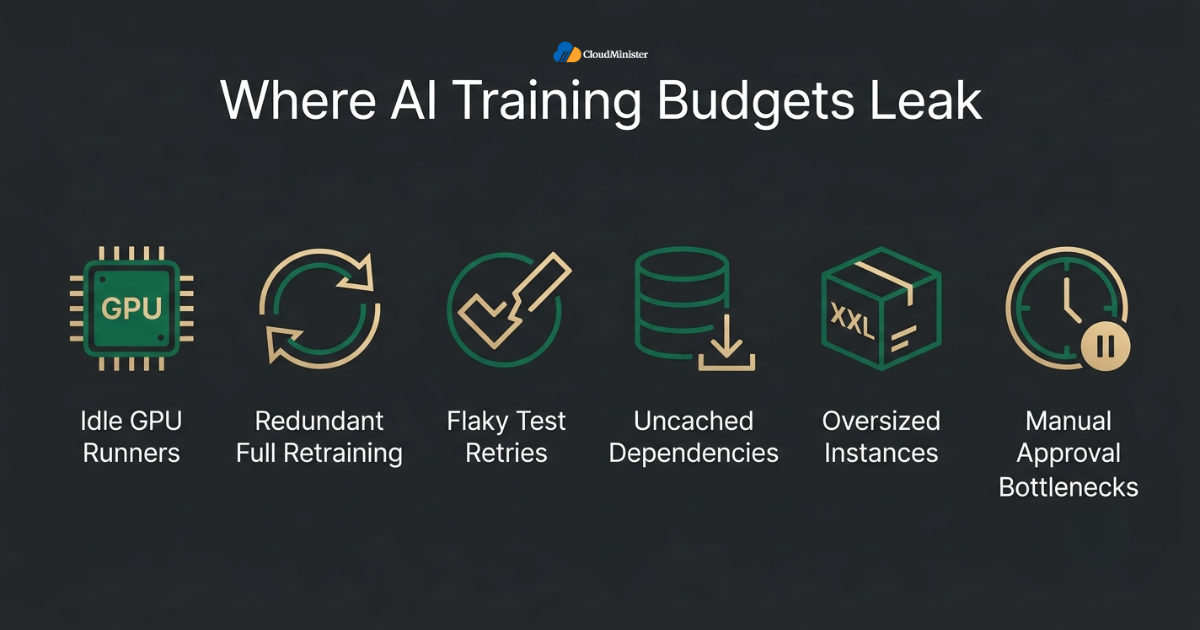
| Cost Driver | What It Looks Like | Impact on Pipeline Spend |
| Idle GPU runners | Provisioned GPU nodes sitting between jobs waiting for the next trigger | Directly billed compute time with zero training output |
| Redundant full retraining | Every commit triggers a full retrain instead of an incremental run | Multiplies GPU-hours for changes that touch a small fraction of the pipeline |
| Flaky test retries | Pipeline reruns an entire training stage because of an unrelated flaky step | Wastes an entire training cycle to recover from a false failure |
| Uncached dependencies and datasets | Every run re-downloads container images, datasets, or model weights from scratch | Adds significant wall-clock time and egress cost to every single job |
| Oversized instance selection | Jobs default to the largest available GPU tier regardless of actual workload size | Pays a premium for compute the job never fully utilizes |
| Manual approval bottlenecks | GPU runners stay reserved and billing while waiting on a human sign-off | Converts idle waiting time directly into wasted spend |
According to a peer-reviewed 2026 analysis of pipeline reliability, flaky tests and pipeline noise remain a persistent operational problem, with reported test flakiness rates ranging between 11 and 27 percent and noise-induced build failures adding another 5 to 16 percent on top. For a standard software pipeline that failure rate is an annoyance, but for an AI training pipeline where each rerun consumes GPU-hours, that same failure rate becomes a direct and measurable line item, which is precisely why streamlining CI/CD pipelines has to treat reliability as a cost problem, not just an engineering quality problem.
Idle GPU runners left provisioned between training jobs are not just a cost problem, they are also an expanded attack surface. Any cost control effort should pair aggressive auto-scaling down of idle runners with strict access controls, so that reducing spend and reducing risk happen together rather than as separate initiatives.
3. Pipeline Architecture Decisions That Drive CI/CD Cost Optimization
3.1 Trigger Strategy Is the First Lever
The single biggest lever in this whole discipline is deciding what actually triggers a training run. Many teams default to retraining on every commit to the model repository, which sounds thorough but is rarely necessary and almost always expensive.
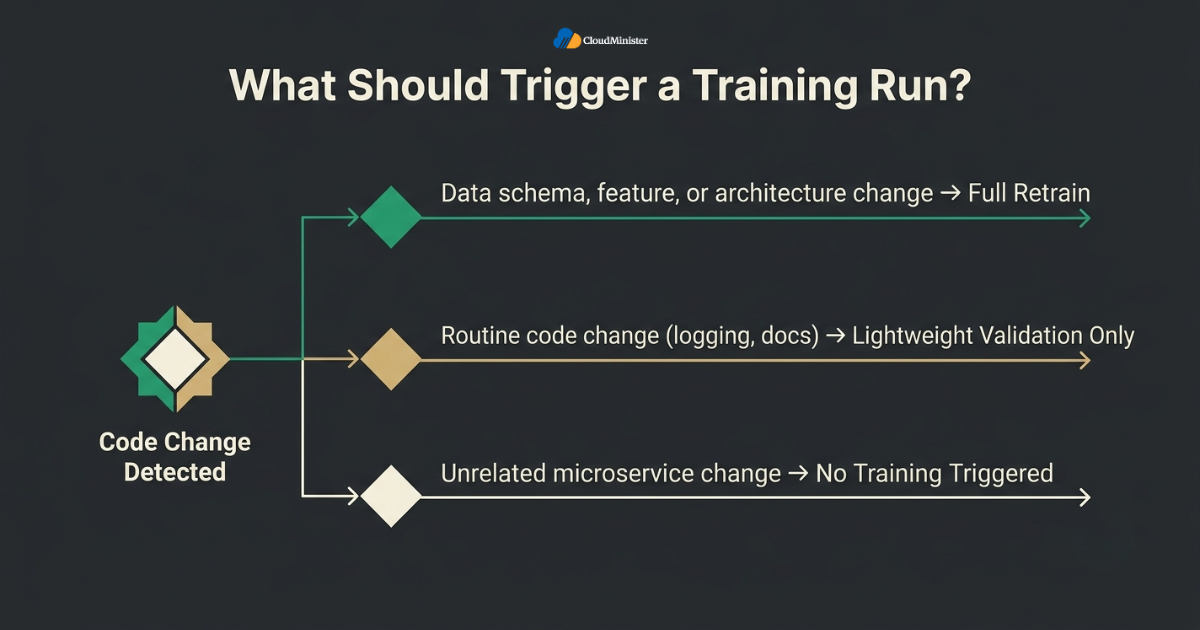
- Trigger full retraining only on changes to data schemas, feature definitions, or core model architecture
- Trigger lightweight validation runs, not full training, on routine code changes like logging or documentation updates
- Use path-based filters so a change to an unrelated microservice never accidentally kicks off a multi-hour training job
- Schedule full retraining on a fixed cadence, such as nightly or weekly, rather than on every push, when data drift is gradual
- Allow manual override triggers for cases where a team genuinely needs an off-cycle retrain
Getting trigger strategy right is consistently the fastest win available in CI/CD Cost Optimization, because it removes wasted GPU-hours before a single dollar of compute is even provisioned.
3.2 Staged Pipelines Prevent Expensive Failures Late
- Run cheap validation stages first, such as data schema checks and unit tests on the training code
- Run a small-scale smoke test of the training job on a tiny data sample before committing to the full run
- Gate the expensive full-scale training stage behind the outcome of the smoke test
- Fail fast on any stage that touches the actual GPU compute, since that is where CI/CD Cost Optimization has the most to protect
- Only promote a run to full-scale, multi-GPU training once every cheaper gate has passed cleanly
This staged approach is one of the most consistently effective techniques for controlling spend, because it concentrates budget only on runs that have already proven themselves worth the compute.
3.3 Parallelization Without Overspending
- Parallelize independent stages, such as data validation and code linting, so they do not sit in a serial queue burning wall-clock time
- Avoid parallelizing GPU-bound training stages unless the workload is genuinely distributed and benefits from multiple nodes
- Use job dependencies carefully so a downstream GPU stage never starts before its cheaper prerequisite stage has passed
- Cap concurrent GPU runners with a hard quota so a burst of commits cannot silently multiply the active GPU bill
CI/CD Cost Optimization is not about running everything faster, it is about running the expensive parts only when they are worth running. A pipeline that finishes ten minutes slower but skips an unnecessary GPU stage is still a win on the budget line even though the total pipeline duration went up.
Related reading from Cloudminister: CI/CD Pipeline on AWS walks through building a staged pipeline architecture on AWS infrastructure, a useful companion piece for teams mapping the trigger and staging strategies above onto a specific cloud environment, especially teams already working with a DevOps Services & Solutions partner on the rest of their delivery pipeline.
4. Caching and Artifact Strategy for CI/CD Cost Optimization
4.1 What to Cache in an AI Training Pipeline
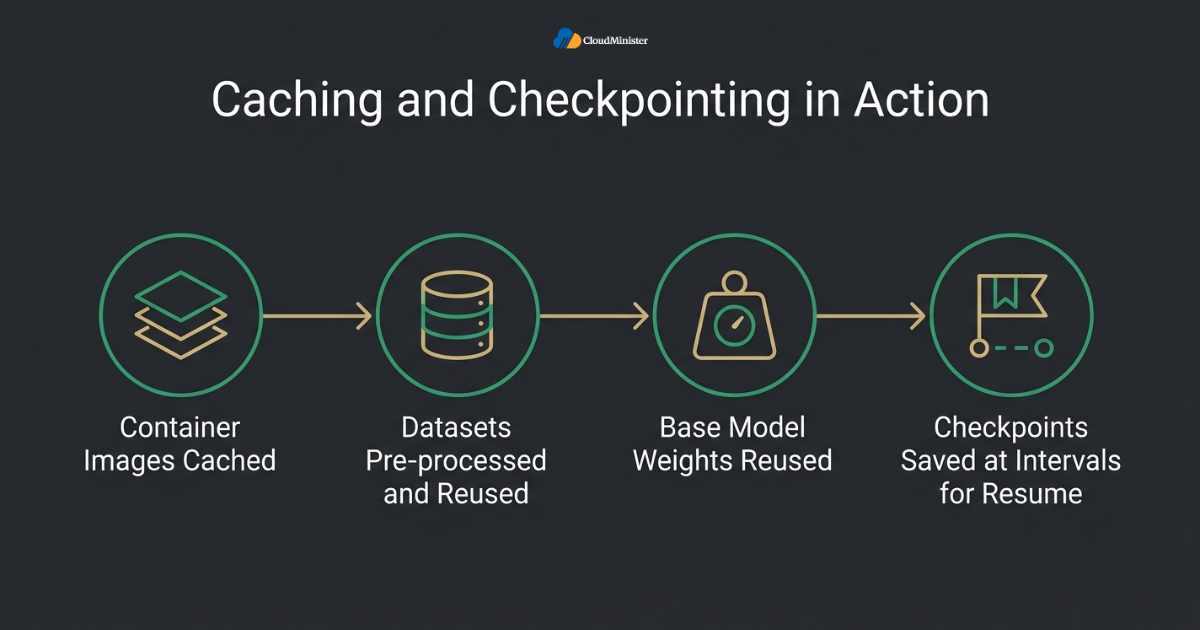
Caching is one of the highest-leverage techniques for controlling training spend, because AI training pipelines repeatedly pull the same large assets, container images, base model weights, and preprocessed datasets, unless the pipeline is explicitly told to reuse what it already has.
- Container base images and dependency layers, so every job does not rebuild an identical environment from scratch
- Preprocessed and tokenized datasets, so repeated runs skip redundant data preparation compute
- Pretrained base model weights, so fine-tuning jobs do not re-download multi-gigabyte checkpoints on every run
- Intermediate training checkpoints, so a failed late-stage run can resume instead of restarting from step zero
- Package manager caches for common ML libraries, since dependency installation time adds up across hundreds of runs
4.2 Checkpointing as a Cost Control, Not Just a Safety Net
- Save checkpoints at regular intervals so an interrupted run can resume close to where it stopped
- Store checkpoints on fast local storage attached to the training node rather than routing every checkpoint over slower network storage
- Set a checkpoint retention policy so storage costs do not quietly grow alongside training frequency
- Use checkpoint resumption specifically to avoid restarting a multi-hour job from scratch after a transient failure
Checkpointing sits at the center of this practice for any training job long enough to be vulnerable to spot instance interruptions or transient infrastructure failures, since resuming from a recent checkpoint can save the majority of the GPU-hours a full restart would otherwise consume.
4.3 Artifact Versioning Without Storage Bloat
- Version datasets, model weights, and configuration together so any run is fully reproducible
- Apply a tiered storage policy, keeping recent artifacts on fast storage and aging older ones to cheaper cold storage
- Deduplicate identical artifacts across branches instead of storing redundant copies per pipeline run
- Set automatic expiry on experimental branch artifacts that were never promoted to a production model
SECURITY NOTE
Cached datasets and model weights often contain sensitive or proprietary data. Any strategy built around aggressive caching needs matching access controls on the cache layer itself, otherwise the same caching that saves compute cost can quietly become a data exposure risk.
Related reading from Cloudminister: DevOps Consulting Cost in India breaks down how caching and artifact strategy decisions typically show up in a DevOps consulting engagement budget, which is useful context when a business is weighing whether to build this expertise in-house or bring in outside help from a dedicated DevOps Services & Solutions provider, especially one already familiar with GPU-heavy DevOps Services & Solutions work.
5. Right-Sizing Infrastructure for CI/CD Cost Optimization
5.1 Matching GPU Tier to Actual Workload
- Profile a representative training job before committing to a GPU tier, rather than defaulting to the largest available option
- Match GPU memory capacity to model size and batch size, since an oversized GPU sitting underutilized is pure waste
- Use smaller, cheaper GPU instances for hyperparameter search and experimentation, reserving larger tiers for confirmed full training runs
- Reassess GPU tier selection every quarter, since model sizes and dataset scale tend to grow over time
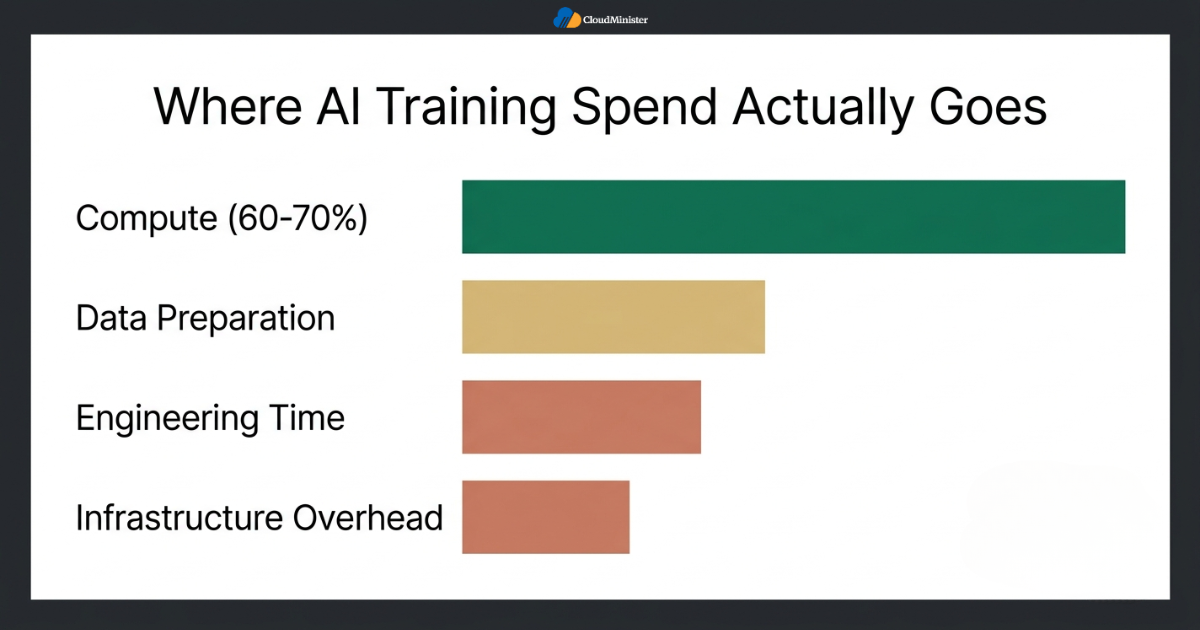
Compute accounts for the majority of total AI training cost, with industry breakdowns placing compute alone at roughly 60 to 70 percent of total training spend, ahead of data preparation, engineering time, and infrastructure overhead combined, which makes GPU tier selection the single highest-impact decision inside any training budget plan.
5.2 Shared vs Dedicated Infrastructure for Training Pipelines
- Shared, multi-tenant GPU instances introduce noisy-neighbour contention that can silently slow down training jobs and extend billed run time
- A Dedicated NVIDIA GPU Server removes that contention, giving CI/CD Cost Optimization efforts a predictable, measurable baseline to optimize against
- Dedicated infrastructure also gives full control over driver and framework versions, avoiding compatibility failures that waste an entire pipeline run
- Predictable monthly costs on dedicated infrastructure make budget forecasting dramatically more reliable than usage-based shared billing
5.3 Spot and Preemptible Capacity, Used Carefully
- Use spot or preemptible GPU capacity for fault-tolerant stages like hyperparameter search where interruption is cheap to recover from
- Pair spot capacity with the checkpointing strategy from Section 4.2, so interruptions do not force a full restart
- Avoid spot capacity for time-sensitive final training runs where an interruption near the finish line would waste the most GPU-hours
- Treat spot savings as a supplement to your overall training budget strategy, not a replacement for right-sized dedicated capacity on critical runs
The cheapest GPU-hour is the one you never provision. Before reaching for spot instances or larger reserved capacity as a cost-saving tactic, confirm that trigger strategy, caching, and staged pipelines from earlier sections are already squeezing out unnecessary runs first.
5.4 Autoscaling Runners to Match Real Demand
- Scale GPU runner pools down to zero during periods with no active training jobs, rather than keeping a warm pool billing continuously
- Scale up only in response to actual queued jobs, not a fixed schedule that assumes constant demand
- Set maximum concurrency limits so autoscaling cannot silently balloon costs during a burst of simultaneous commits
- Monitor scale-up and scale-down events over time to catch autoscaling misconfigurations before they become a recurring cost
Autoscaling done correctly is one of the more technical levers available, since it requires accurate queue depth signals and realistic cooldown windows, but it consistently delivers some of the largest savings once tuned properly, because idle billed capacity is eliminated almost entirely, another reason streamlining CI/CD pipelines pays off over time.
Related Reading: SRE vs DevOps
6. Streamlining CI/CD Pipelines for AI Workloads
Streamlining CI/CD pipelines is not a separate initiative from CI/CD Cost Optimization, it is the operational discipline that makes cost control repeatable rather than a one-time cleanup. A pipeline that has been properly streamlined tends to cost less by default, because unnecessary steps, redundant stages, and unclear ownership are exactly what drive both wasted time and wasted GPU spend.
- Remove redundant validation stages that duplicate checks already performed earlier in the pipeline
- Consolidate overlapping jobs that were added incrementally by different teams without a shared review
- Standardize pipeline templates across teams so every new training pipeline inherits cost-aware defaults automatically
- Document pipeline ownership clearly, since an orphaned pipeline nobody actively maintains is where cost inefficiencies quietly accumulate
Streamlining CI/CD pipelines also has a direct effect on developer experience, since a pipeline littered with legacy stages and unclear failure points is slower to debug and easier to accidentally misconfigure into an expensive state. Teams that invest time in this recurring cleanup, rather than only when something breaks, tend to sustain lower training costs over the long run because the pipeline never accumulates the kind of technical debt that quietly reintroduces the same waste this discipline was meant to eliminate.
- Review pipeline definitions quarterly as part of the same cadence used for training budget reviews
- Retire pipeline stages tied to deprecated model architectures or discontinued datasets
- Keep pipeline configuration in version control alongside the model code, so streamlining CI/CD pipelines is itself auditable
- Involve the engineers who actually run the pipeline daily in any streamlining CI/CD pipelines initiative, since they know which stages are genuinely load-bearing
- Track the outcomes of each streamlining CI/CD pipelines pass in the same dashboard used for cost metrics, so the two efforts stay visibly connected
Streamlining CI/CD pipelines and disciplined cost control reinforce each other in both directions. A leaner pipeline is cheaper to run, and a pipeline optimized for cost tends to shed the redundant stages that made it slow and hard to maintain in the first place.
7. Governance, Monitoring, and Chargeback for CI/CD Cost Optimization
7.1 Visibility Is the Foundation of Governance
- Track GPU-hours consumed per pipeline, per team, and per model, not just an aggregate monthly total
- Set up dashboards showing cost per completed training run alongside the usual latency and success rate metrics
- Alert on anomalous spend, such as a pipeline suddenly consuming far more GPU-hours than its historical baseline
- Break down cost by pipeline stage, so it is immediately clear whether the spend is coming from training, validation, or idle time
Without this level of visibility, any cost optimization effort is guesswork, since teams end up optimizing the stages that are easiest to change rather than the ones actually driving the bill.
7.2 Quota Enforcement and Chargeback
- Set hard GPU quota limits per team so one group’s experimentation cannot silently consume the shared training budget
- Implement chargeback reporting so each team sees the actual cost of the training pipelines they own
- Require budget approval for any pipeline change that would meaningfully increase GPU-hour consumption
- Review quota allocations quarterly, adjusting them based on which teams are delivering measurable model performance gains against their spend
Quota enforcement is also a security control. Uncapped pipelines with unrestricted access to GPU capacity are a common vector for runaway cost incidents, whether from a misconfigured loop, a compromised credential, or simple human error, so hard limits protect both budget and infrastructure integrity as part of a complete cost governance program.
7.3 Continuous Retraining Governance
- Define clear criteria for when retraining is actually justified, based on measured data drift rather than a fixed calendar assumption
- Require a documented business case for any model that retrains more frequently than weekly
- Compare the cost of retraining against the measurable performance gain it delivers, and retire retraining schedules that no longer pay for themselves
- Route continuous retraining decisions through the same governance review used for other training budget decisions, so retraining frequency is never set once and forgotten
Related Reading: Managed DevOps Services for Startups vs Enterprises
8. Infrastructure Partner Decisions Behind CI/CD Cost Optimization
8.1 Why Infrastructure Choice Is a CI/CD Cost Optimization Decision, Not Just a Hosting Decision
- Shared, generic hosting environments often lack the framework and driver control that AI training pipelines depend on, forcing workarounds that add cost and fragility
- Inconsistent networking between pipeline stages and storage slows down every run, which directly undermines cost control efforts elsewhere in the stack
- Unclear data residency terms on anonymous shared infrastructure create compliance risk that has nothing to do with the pipeline itself but still affects the overall program
- A trusted DevOps Services & Solutions partner can help translate the practices covered in this guide into an actual pipeline architecture rather than leaving them as theory, which is exactly the kind of hands-on DevOps Services & Solutions engagement most growing teams need
- Businesses evaluating a DevOps Services & Solutions provider should confirm that the team understands GPU-specific pipeline needs, not just standard web application deployment pipelines
- A DevOps Services & Solutions engagement scoped specifically around training pipelines, rather than generic application delivery, tends to surface cost issues that a general-purpose review would miss
8.2 Dedicated GPU Infrastructure as the Foundation
A Dedicated NVIDIA GPU Server, available through the best GPU cloud hosting in India offering from a reliable Web Hosting Company in India, gives training pipelines a stable foundation to build on rather than fighting shared-tenancy variability every single run.
- Guaranteed GPU allocation means training run duration becomes predictable, which makes cost forecasting far more accurate
- Full control over framework and CUDA driver versions avoids the compatibility failures that silently waste entire pipeline runs
- High-speed local storage speeds up checkpoint loading and dataset access, directly supporting the caching strategy covered in Section 4
- Predictable monthly billing from an established Web Hosting Company in India removes the surprise spend spikes that make CI/CD Cost Optimization difficult to plan around on pure usage-based pricing
8.3 24×7 Server Management as an Operational Multiplier
Even a well-architected pipeline needs consistent operational support behind it, and this is where 24×7 server management becomes directly relevant to CI/CD Cost Optimization rather than a separate operational concern.
- Continuous monitoring under 24×7 server management catches runaway jobs or misconfigured autoscaling before they turn into a large unexpected bill
- Round-the-clock incident response, a core part of any 24×7 server management offering, means a failed pipeline stage in off-hours does not sit consuming reserved GPU capacity until someone notices the next morning
- Proactive patching and maintenance under 24×7 server management reduces the compatibility failures that otherwise force wasted reruns
- Having 24×7 server management in place means a business does not need to staff its own around-the-clock infrastructure team just to keep training pipelines protected outside business hours
- A provider offering both dedicated GPU infrastructure and 24×7 server management under one contract removes the coordination gap that shows up when monitoring and hosting sit with different vendors, and teams should confirm response-time SLAs are actually written into the 24×7 server management contract, not just implied
24×7 server management pays for itself specifically through avoided incidents, not through direct cost savings on GPU pricing. A single runaway training job caught at 2 AM instead of 9 AM the next morning can offset months of the management fee on its own, which is why 24×7 server management belongs in the same conversation as CI/CD Cost Optimization rather than treated as an unrelated line item. Teams comparing providers should ask specifically what 24×7 server management covers, since the term means very different things across vendors.
8.4 Choosing a Web Hosting Company in India for AI Training Infrastructure
Indian businesses building out AI training pipelines have specific reasons to prefer a domestic Web Hosting Company in India over routing every training job through an overseas region.
- Lower latency between pipeline orchestration and GPU compute when both sit within the same domestic region
- Simpler compliance posture for training data involving Indian citizens, since a Web Hosting Company in India operating local data centres can commit contractually to in-country residency and support alignment with India’s Digital Personal Data Protection Act (DPDPA), 2023
- INR-denominated billing removes currency volatility from GPU budget planning, a genuine benefit for cost forecasting at any established Web Hosting Company in India
- Local support teams from a Web Hosting Company in India who understand India-specific compliance requirements that an overseas provider frequently cannot match
- A Web Hosting Company in India that also offers DevOps Services & Solutions alongside dedicated GPU infrastructure gives a business a single vendor relationship instead of splitting responsibility across multiple overseas providers, which simplifies both cost governance and day-to-day support
- When comparing a Web Hosting Company in India against an overseas alternative, ask specifically whether DevOps Services & Solutions and 24×7 server management are bundled or billed as separate add-ons, since that materially changes total cost of ownership
- A Web Hosting Company in India billing everything in rupees also simplifies procurement approvals for growing businesses evaluating multiple training pipelines at once
Cloudminister, as a Web Hosting Company in India, combines dedicated GPU infrastructure, DevOps Services & Solutions, and 24×7 server management under one roof, which is precisely the combination that makes sustained cost control realistic rather than aspirational for growing Indian businesses. Working with a single Web Hosting Company in India for infrastructure, DevOps Services & Solutions, and ongoing operations also means fewer handoffs when something needs to be diagnosed quickly under 24×7 server management.
Need Help Building a Cost-Optimized CI/CD Pipeline?
Cloudminister’s DevOps Services & Solutions team helps you design trigger strategies, staged pipelines, and right-sized GPU infrastructure that cut wasted spend without slowing down delivery.
9. A Step-by-Step Framework for CI/CD Cost Optimization
Phase 1: Audit Current Spend (Week 1)
- Pull GPU-hour consumption by pipeline, team, and model for the last full billing cycle
- Identify the top three cost drivers from Section 2 that apply most directly to the current setup
- Establish a cost-per-completed-training-run baseline before changing anything, so future savings are measurable
- If the audit is unfamiliar territory internally, a short DevOps Services & Solutions engagement at this stage can shorten the ramp-up considerably
Phase 2: Fix Trigger Strategy and Staging (Weeks 2-3)
- Apply the trigger filtering and staged pipeline changes covered in Section 3
- Introduce smoke tests ahead of every full-scale training run
- Measure the reduction in unnecessary full retrains after the change
Phase 3: Implement Caching and Checkpointing (Weeks 3-4)
- Add container image, dataset, and model weight caching per Section 4.1
- Roll out checkpoint-based resumption for any training job running longer than an hour
- Set artifact retention and expiry policies to prevent storage costs from offsetting the compute savings
Phase 4: Right-Size and Move to Dedicated Infrastructure (Weeks 4-6)
- Profile actual GPU utilization and match instance tiers accordingly, per Section 5.1
- Evaluate moving critical training pipelines onto a Dedicated NVIDIA GPU Server through a trusted Web Hosting Company in India for predictable performance
- Configure autoscaling with realistic minimums and maximums based on real queue depth data
- Confirm the Web Hosting Company in India handling the migration also offers 24×7 server management, so the cutover itself is monitored around the clock
Phase 5: Establish Governance and Review Cadence (Ongoing)
- Deploy the dashboards and alerting described in Section 7.1
- Set quota limits and chargeback reporting per Section 7.2
- Revisit the entire CI/CD Cost Optimization plan every quarter, since model sizes, team headcount, and training frequency all shift over time
EXPERT NOTE
Businesses that treat this framework as a one-time project rather than a recurring cycle tend to see savings erode within two or three quarters, as new pipelines get added without inheriting the cost-aware defaults established during the original rollout. Building streamlining CI/CD pipelines reviews into the same quarterly cadence keeps both efforts from drifting apart.
10. Common Mistakes That Undermine CI/CD Cost Optimization
- Retraining on every commit regardless of whether the change actually affects model behavior, which multiplies GPU-hours for no measurable benefit
- Leaving GPU runners warm between jobs instead of scaling them down, treating idle capacity as a convenience rather than a direct cost
- Skipping the smoke-test stage and sending every change straight to full-scale training, which turns a five-minute mistake into an hour of wasted compute
- Ignoring checkpointing on long-running jobs, so a single transient failure forces a complete restart from step zero
- Treating training cost control as purely an engineering exercise, without involving finance or team leads in quota and chargeback decisions
- Choosing shared, unpredictable infrastructure for production training pipelines where consistent performance actually matters more than marginal savings per hour
- Failing to revisit the plan on a recurring schedule, so it quietly goes stale as workloads and team structures change, undoing months of streamlining CI/CD pipelines work in the process
11. Readiness Checklist for CI/CD Cost Optimization
Streamlining CI/CD pipelines and tightening spend controls go hand in hand, so use this checklist to confirm both are actually in place before calling the rollout complete.
- Spend visibility in place: GPU-hours tracked per pipeline, team, and model with a clear cost-per-run baseline
- Trigger strategy reviewed: Full retraining limited to changes that genuinely warrant it, with lightweight validation for everything else
- Staged pipeline architecture confirmed: Cheap checks and smoke tests gate every expensive full-scale training run, a direct result of streamlining CI/CD pipelines earlier in the rollout
- Caching implemented: Container images, datasets, and model weights reused rather than rebuilt or re-downloaded on every run
- Checkpointing enabled: Long-running jobs can resume from a recent checkpoint instead of restarting from scratch
- Infrastructure right-sized: GPU tier matched to actual workload profile, with dedicated capacity from a reliable Web Hosting Company in India for critical production training
- Autoscaling configured: Runner pools scale to zero when idle and respond to real queue depth rather than a fixed schedule
- Governance active: Quotas, chargeback reporting, and budget approval gates in place for meaningful pipeline changes, ideally reviewed alongside the team’s DevOps Services & Solutions partner
- 24×7 server management confirmed: Operational coverage in place, ideally from the same Web Hosting Company in India managing the GPU infrastructure, so off-hours incidents do not silently consume budget
- Review cadence set: A recurring quarterly review scheduled to reassess the entire CI/CD Cost Optimization plan against current workloads
Key Takeaways
- CI/CD Cost Optimization for AI training pipelines is fundamentally about eliminating wasted GPU-hours, not simply negotiating lower per-hour pricing, and streamlining CI/CD pipelines is the operational habit that keeps that waste from creeping back in
- Trigger strategy and staged pipelines are consistently the fastest wins available, since they prevent unnecessary compute before it is ever provisioned
- Caching, checkpointing, and artifact versioning cut redundant compute out of every run and protect against the cost of transient failures
- Right-sizing GPU tiers and choosing dedicated infrastructure over noisy shared environments makes CI/CD Cost Optimization both cheaper and more predictable
- Streamlining CI/CD pipelines and CI/CD Cost Optimization reinforce each other, a leaner pipeline is naturally a cheaper one to operate
- Governance, quota enforcement, and chargeback reporting turn CI/CD Cost Optimization from a one-time project into a sustained organizational discipline
- 24×7 server management materially protects CI/CD Cost Optimization gains by catching runaway spend outside business hours
- A trusted Web Hosting Company in India offering DevOps Services & Solutions, dedicated GPU infrastructure, and 24×7 server management gives Indian businesses a single accountable partner for the entire effort, removing the coordination overhead of a multi-vendor setup
- This is a continuous review cycle, not a one-time fix, and teams that revisit their CI/CD Cost Optimization plan quarterly consistently outperform those that set it once and move on
Ready to Take Control of Your Training Pipeline Costs?
Talk to our team about dedicated GPU infrastructure, 24×7 server management, and a CI/CD Cost Optimization plan built around your actual workloads.
Conclusion
CI/CD Cost Optimization for AI model training jobs is no longer optional groundwork, it is one of the clearest levers a business has to keep its AI roadmap financially sustainable through 2026 and beyond. As training runs grow longer, models grow larger, and GPU pricing remains a significant line item on every engineering budget, the businesses that treat CI/CD Cost Optimization as a continuous discipline rather than a one-time cleanup will consistently outspend competitors on results while spending less on waste. Getting trigger strategy, caching, right-sizing, and governance right early saves far more over a year than any single infrastructure negotiation ever could.
The path forward follows the same framework outlined above. Audit current spend honestly before changing anything, fix the trigger and staging decisions that create the most obvious waste, implement caching and checkpointing so redundant compute never gets re-run, right-size infrastructure once real utilization data is available, and build a governance cadence that revisits the plan every quarter rather than locking it in once. Streamlining CI/CD pipelines on that same cadence keeps the technical debt from piling back up between reviews. Businesses that build this discipline into their standing operating rhythm, the same way they already review cloud spend or application performance, consistently get more model performance per dollar than those still treating every training run as an unavoidable cost of doing business.
Cloudminister supports this entire journey with DevOps Services & Solutions, dedicated GPU infrastructure, and 24×7 server management, all delivered as a single Web Hosting Company in India relationship rather than a fragmented multi-vendor setup. Whether a business needs help redesigning its trigger strategy through a DevOps Services & Solutions engagement, right-sizing its GPU fleet with a trusted Web Hosting Company in India, or simply wants a partner that keeps training pipelines protected around the clock under 24×7 server management, working with one accountable partner for infrastructure, DevOps Services & Solutions, and operations keeps the entire effort simpler to execute and easier to sustain. As AI training budgets continue climbing through 2026, the teams that master CI/CD Cost Optimization now will be the ones still scaling confidently a year from now, while everyone else is still reworking pipelines that were never built with cost in mind.
Frequently Asked Questions
What is CI/CD Cost Optimization in the context of AI model training?
CI/CD Cost Optimization for AI model training refers to the practices, architecture decisions, and governance controls that reduce wasted GPU-hours and infrastructure spend across a training pipeline, without compromising model quality or delivery speed. It covers trigger strategy, caching, right-sizing, and ongoing monitoring rather than any single fix.
Why has CI/CD Cost Optimization become more urgent in 2026?
Training costs continue to grow sharply year over year even as the cost per unit of compute falls, which means pipelines that waste GPU-hours through retries, idle runners, or unnecessary retraining compound that waste into a significant number by year end. As AI training becomes a larger share of overall engineering spend, CI/CD Cost Optimization has shifted from a technical nice-to-have into a financial necessity.
What is the fastest way to start CI/CD Cost Optimization on an existing pipeline?
Reviewing trigger strategy is typically the fastest win, since limiting full retraining to changes that genuinely warrant it, and gating expensive training stages behind cheap smoke tests, removes wasted GPU-hours before any infrastructure change is even needed.
Does CI/CD Cost Optimization require moving to dedicated GPU infrastructure?
Not immediately, but it helps significantly for production-critical training pipelines. Shared infrastructure introduces noisy-neighbour contention that makes both performance and cost unpredictable, while a Dedicated NVIDIA GPU Server gives CI/CD Cost Optimization efforts a stable, measurable baseline to optimize against.
How does streamlining CI/CD pipelines relate to cost optimization specifically?
Streamlining CI/CD pipelines removes redundant stages, unclear ownership, and accumulated technical debt that quietly drive both slower delivery and higher spend. A pipeline that has been properly streamlined tends to cost less by default, which is why the two efforts, streamlining CI/CD pipelines and CI/CD Cost Optimization, are best treated as reinforcing parts of the same initiative rather than separate projects.
How often should a business revisit its CI/CD Cost Optimization plan?
Quarterly, at minimum, and whenever training frequency, model size, or team headcount changes materially. Treating CI/CD Cost Optimization as a one-time project rather than a recurring review is one of the most common reasons early savings erode within a year.

Pritam Kumar is a DevOps Engineer at CloudMinister Technologies, where he manages a multi-datacenter fleet of 100+ servers and architects end-to-end CI/CD pipelines and infrastructure automation using Kubernetes, Terraform, and Ansible. He holds an AWS Certified DevOps Engineer Professional certification and has served as a Google Cloud Mentor, reflecting both hands-on cloud expertise and a track record of mentoring others in the field. His work spans disaster recovery architecture, security incident response, and hosting infrastructure across Proxmox, cPanel/WHM, and Linux systems. Notably, Pritam led the design of Cloud Kavach, a self-hosted DC/DR SaaS portal, and directed remediation efforts for large-scale hosting security incidents involving webshells and command-and-control malware. He brings this depth of real-world infrastructure and security experience to the technical content he writes.
Related posts:
 CI/CD Pipeline: What It Is & Why Your Business Needs It
 Infrastructure as Code (IaC) Explained : Benefits & Tools
 Managed DevOps Services for Startups vs Enterprises: The 2026 Decision Guide Every Business Owner Needs
 What Is Site Reliability Engineering? A Complete Guide to SRE vs DevOps and Their Key Differences
