Picking a Domain Extension is no longer a five-minute afterthought squeezed into the end of a naming brainstorm. For an AI or SaaS company in 2026, the Domain Extension you choose sits right alongside your logo and product name in shaping first impressions, influencing everything from developer trust to investor perception. This guide walks founders, marketers, and developers through how to choose the right Domain Extension for AI/SaaS products, covering brand fit, technical SEO, trust signals, and long-term scalability.
Every AI or SaaS founder eventually faces a moment where a great product name is ready, but the address it will live at is still undecided. That decision, choosing the right Domain Extension, carries more weight in 2026 than it did even a few years ago. Buyers, investors, and search engines all form quick impressions based on the suffix attached to a brand, and for companies competing in a crowded AI landscape, that first impression can shape whether a visitor trusts the product enough to sign up or request a demo.
Many founders assume this is a simple step tucked inside the broader domain registration process, something to finalize quickly so the “real work” of building the product can begin. In practice, the Domain Extension chosen at domain registration becomes a permanent part of the brand’s identity, referenced in pitch decks, printed on business cards, and typed by every customer who wants to find the product again. Treating it as an afterthought often means revisiting the decision later, at a much higher cost.
This guide breaks the process into practical stages: understanding why the Domain Extension matters specifically for AI and SaaS positioning, evaluating the core factors that should drive the decision, comparing the extension categories founders rely on most, and building a broader domain strategy that scales alongside the company. Whether this is a brand-new AI startup’s first domain or an established SaaS product weighing a rebrand ahead of a funding round, the same fundamentals apply throughout.
1. Why the Domain Extension Matters More for AI/SaaS
A Domain Extension is the suffix at the end of a web address, such as .com, .ai, .io, .app, or .tech, and it tells visitors, search engines, and even AI answer engines something about a website before a single page loads. For an AI or SaaS company, this is not cosmetic. It shapes how quickly a visitor trusts the brand, how the address performs in search, and how investors or enterprise buyers perceive the company during due diligence.
There are three practical reasons AI/SaaS founders cannot treat this choice as an afterthought:
- Brand signaling: an AI product on a .ai extension or a developer tool on a .io extension instantly communicates category and technical positioning
- Trust and conversion: enterprise buyers and developers alike hesitate on unfamiliar extension choices, and that hesitation shows up directly in signup and trial conversion rates
- Long-term scalability: a suffix chosen without considering renewal costs, regional availability, or brand protection can force a costly rebrand later
Recent industry data on the domain market confirms that AI-first branding is now a measurable trend, since a growing share of new technology companies are actively choosing a Domain Extension that signals their category rather than defaulting to .com out of habit. This shift is visible even at the domain registration stage, where more founders now search for a .ai or .io option before checking whether the matching .com is available.
2. Core Factors Every AI/SaaS Founder Should Evaluate
Choosing the right suffix only becomes useful once you know which factors actually matter. The considerations below form the foundation of any naming decision, whether you are a solo founder or a funded team preparing to launch through a Web Hosting Company in India.
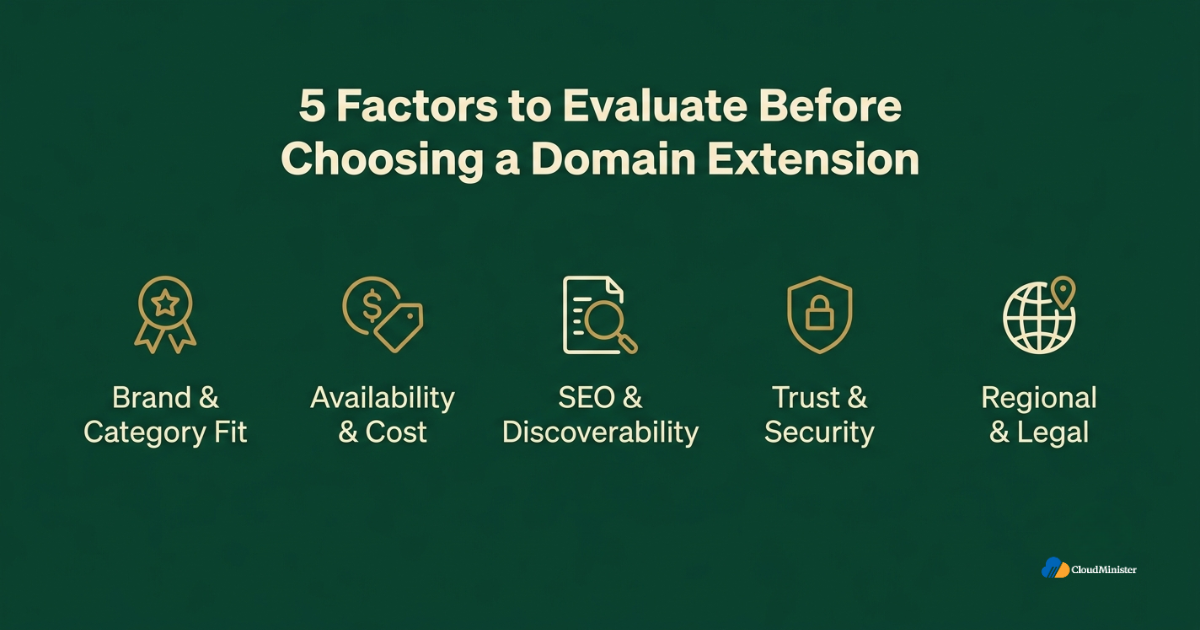
2.1 Brand and Category Fit
- The Domain Extension should match how your product is categorized in the mind of your buyer, since a mismatch creates unnecessary friction
- An AI product marketed with a .ai suffix reinforces category positioning every time the address is shared, printed, or spoken aloud
- Choosing an extension that requires explanation every time you say it out loud is a quiet tax on every conversation your sales team has
2.2 Availability and Registration Cost
- Cost varies enormously across Domain Extension options, and a founder evaluating .ai, .io, or .com should compare domain registration renewal pricing, not just the first-year discount
- Some extension categories require a minimum multi-year domain registration term, which affects cash flow planning for an early-stage AI/SaaS company
- Checking availability across several extension options at once, rather than fixating on one, gives founders more room to find a name that is both brandable and available at a reasonable domain registration price
2.3 SEO and Discoverability
- A Domain Extension has very little direct effect on organic ranking today, since modern search engines evaluate content quality and relevance far more heavily than the suffix itself
- What an extension does affect is click-through rate, since a widely recognized suffix often earns more trust in a results page than an unfamiliar one
- For AI answer engines and large language model based search tools, a Domain Extension paired with clear, structured content still matters more for discoverability than the extension alone
2.4 Trust Signals and Security
- HTTPS, a valid SSL certificate, and consistent branding across the site matter more to visitor trust than the specific extension chosen
- A suffix historically associated with spam or low-quality sites can quietly undermine trust even when a legitimate SaaS company is using it correctly
- Completing domain registration through an accredited registrar, paired with WHOIS privacy protection, reduces the risk of a legitimate Domain Extension being flagged incorrectly by security filters
2.5 Regional and Legal Considerations
- Some extension categories, particularly country-code options, come with local presence requirements that AI/SaaS founders need to verify before committing
- Trademark conflicts differ by registry, so a name cleared for .com may still face a dispute under a different extension
- Founders expanding internationally should budget for securing multiple relevant extension options to protect the brand in each target market
An extension decision made without checking trademark availability across every relevant registry is a decision made with incomplete information. Always run a trademark check and an extension availability check together, not separately.
3. Domain Extension Options for AI Startups
Before locking in a name, most AI founders compare a short list of extension categories that have become associated with technology and AI branding specifically.
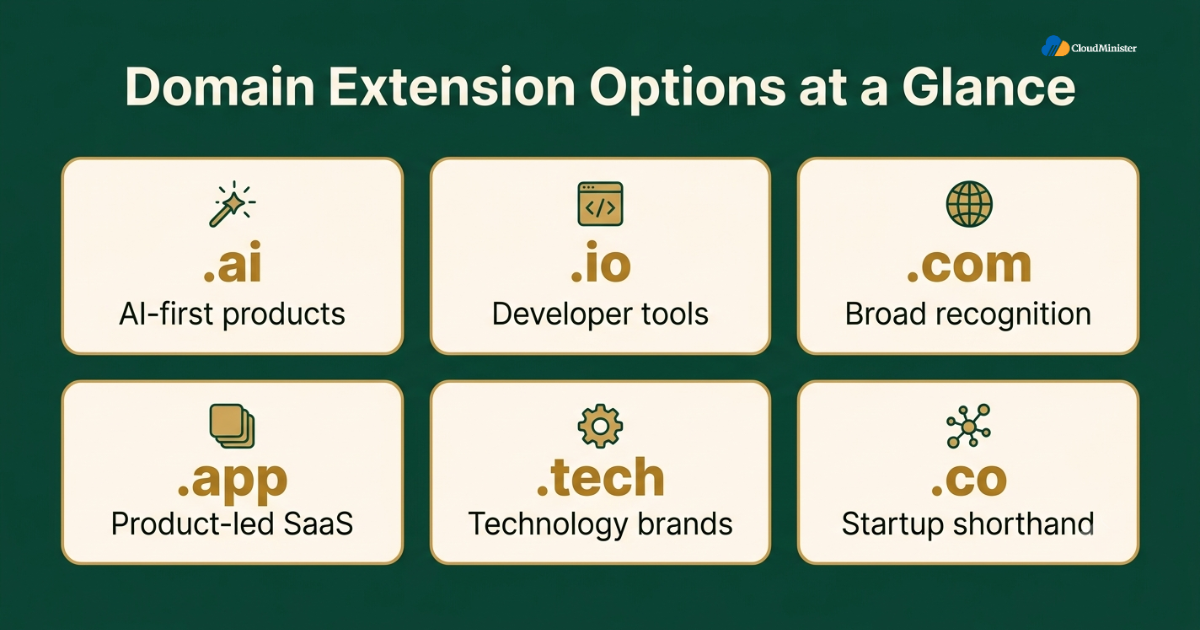
- .ai: the most category-specific Domain Extension for artificial intelligence products, now firmly established as shorthand for AI-first companies
- .io: an extension long associated with developer tools and technical SaaS products, popular for its short, technical feel
- .com: the default extension for broad brand recognition, still the most universally trusted option across markets and demographics
- .app: a suffix well suited to product-led SaaS tools with a strong mobile or web-app component
- .tech: an extension that signals a technology company broadly, useful when a product spans more than one category
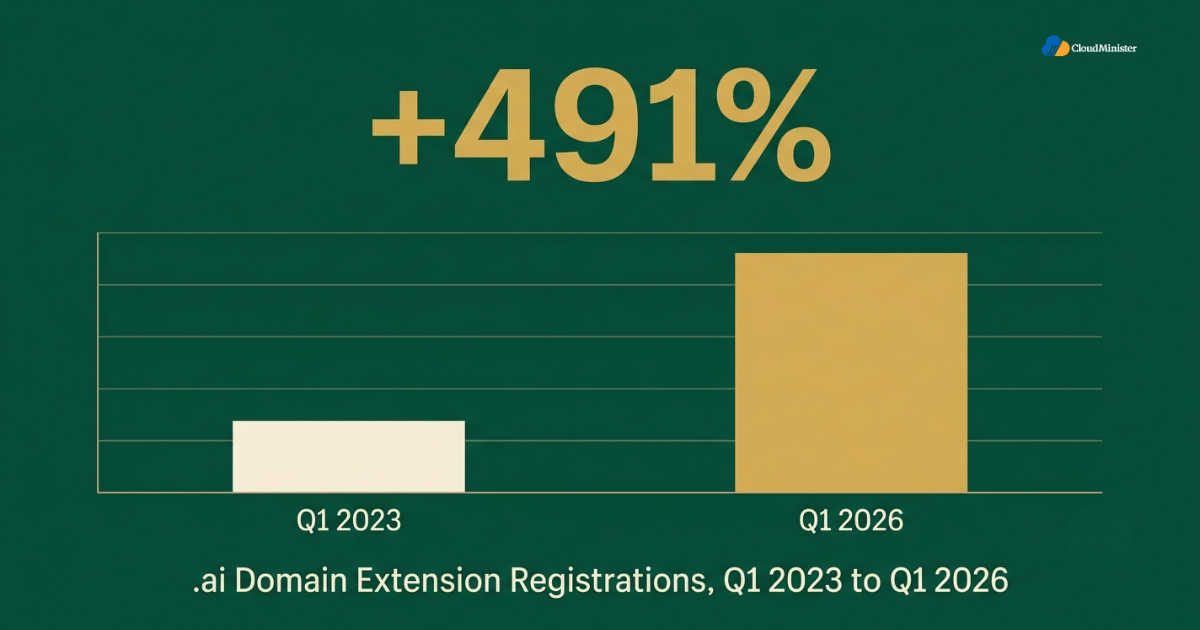
According to a detailed 2026 analysis of the global domain market, the .ai extension has grown dramatically, with registrations up 491 percent between the first quarter of 2023 and the first quarter of 2026, reflecting how strongly AI-first companies are gravitating toward this specific category.
If your product name is available on both .ai and .com, complete domain registration for both and redirect the less critical one to your primary address, rather than choosing only one and losing the other to a competitor later.
4. Building a Domain Strategy for a Growing SaaS Company
Picking one Domain Extension for launch is only the first step. A growing SaaS company needs a broader strategy that protects the brand, supports regional expansion, and keeps the domain portfolio organized as the company scales.
4.1 Primary Domain Selection
- The primary extension should be the one used on business cards, in pitch decks, and on every piece of marketing material, so consistency matters more than experimenting with several at once
- A Web Hosting Company in India that also offers reliable setup support makes it easier to manage DNS, email, and the extension itself from a single account
- Founders should confirm that their chosen suffix supports the DNS records, subdomain structure, and email routing their product will eventually need at scale, and that their domain registration plan allows those changes
Deploying a React-Based AI/SaaS Product?
Get fast, reliable hosting built for modern JavaScript frameworks, optimized for speed and scale.
4.2 Defensive Registration
- Registering close variations of a primary Domain Extension choice, such as both .ai and .com, protects the brand from copycat sites and phishing attempts
- Defensive coverage across common misspellings and adjacent extension options is a low-cost insurance policy against brand confusion
- Companies that skip this step often find a squatter has completed domain registration on the matching extension shortly after a funding announcement generates press attention
4.3 Regional Expansion Planning
- Expanding into a new market sometimes requires a country-specific extension to satisfy local hosting or business registration rules
- An extension tied to a specific country can also improve local search relevance and build trust with in-market customers evaluating a SaaS product
- Coordinating rollout timelines across regions avoids a gap where a competitor claims the matching extension in a market you plan to enter later
Domain portfolios often expose ownership details, renewal dates, and DNS configuration to anyone who checks WHOIS records or scans public DNS. Use WHOIS privacy protection and restrict DNS management access with role-based permissions, especially once more than one team member manages the account.
5. Domain Extension Choices for Different Business Stages
5.1 Early-Stage Startups
- At the earliest stage, founders should prioritize an extension that is available and affordable through standard domain registration over one that is theoretically perfect but tied up in a costly aftermarket sale
- A short, memorable address on a recognizable extension beats a longer, keyword-stuffed name on a less familiar one, even at the earliest stage
- For a technical audience, a .ai or .io suffix often earns immediate credibility during early product demos and investor conversations
5.2 Funded Growth-Stage Companies
- Once funded, a growth-stage SaaS company should revisit its extension strategy and consider defensive coverage across additional relevant options
- Enterprise buyers evaluating a growth-stage vendor often check whether the extension matches the polish expected of a company at that funding stage
- A mismatched or unfamiliar suffix can become a minor but real friction point during enterprise procurement and security review
5.3 Enterprise and Established SaaS Brands
- Established SaaS brands typically consolidate around a single primary extension while maintaining defensive coverage for related options and misspellings
- Migrating a mature brand to a new extension carries significant SEO and trust risk, so this decision should be made rarely and carefully
- Enterprise SaaS companies often need domain registration support that includes SSO-friendly account management as more employees interact with domain administration
Related Reading: choosing a catchy new domain name
6. Domain Extension Comparison Table
| Extension | Best For | Brand Signal |
| .ai | AI-first products and platforms | Strong AI category signal |
| .io | Developer tools, technical SaaS | Technical, startup-friendly |
| .com | Broad brand recognition | Universally trusted |
| .app | Product-led, app-centric SaaS | Modern, product-focused |
| .tech | Technology companies broadly | General technology signal |
| .co | Short alternative to .com | Startup-friendly shorthand |
A number of the mistakes below are more common when founders rush this decision under time pressure than when they take a structured approach to comparing extension options first.
7. Common Domain Extension Mistakes AI/SaaS Founders Make
- Choosing an extension purely for novelty: an unusual Domain Extension might feel clever at launch, but if customers cannot remember or correctly type it, direct traffic suffers permanently
- Ignoring renewal costs: some extension categories carry renewal prices far higher than their promotional first-year rate, which catches founders off guard at year two
- Skipping trademark checks: securing a suffix without checking trademark conflicts can lead to a forced rebrand after significant marketing spend
- No defensive coverage: founders who register only one extension often watch a competitor or squatter claim the matching Domain Extension later
- Treating the choice as permanent without a migration plan: even a well-chosen suffix may need revisiting as a company’s market or positioning evolves
In short, price alone is a poor proxy for a good extension decision, and long-term brand fit is a much better signal of a choice worth committing to.
8. Setting Up Your Domain: A Step-by-Step Founder Roadmap
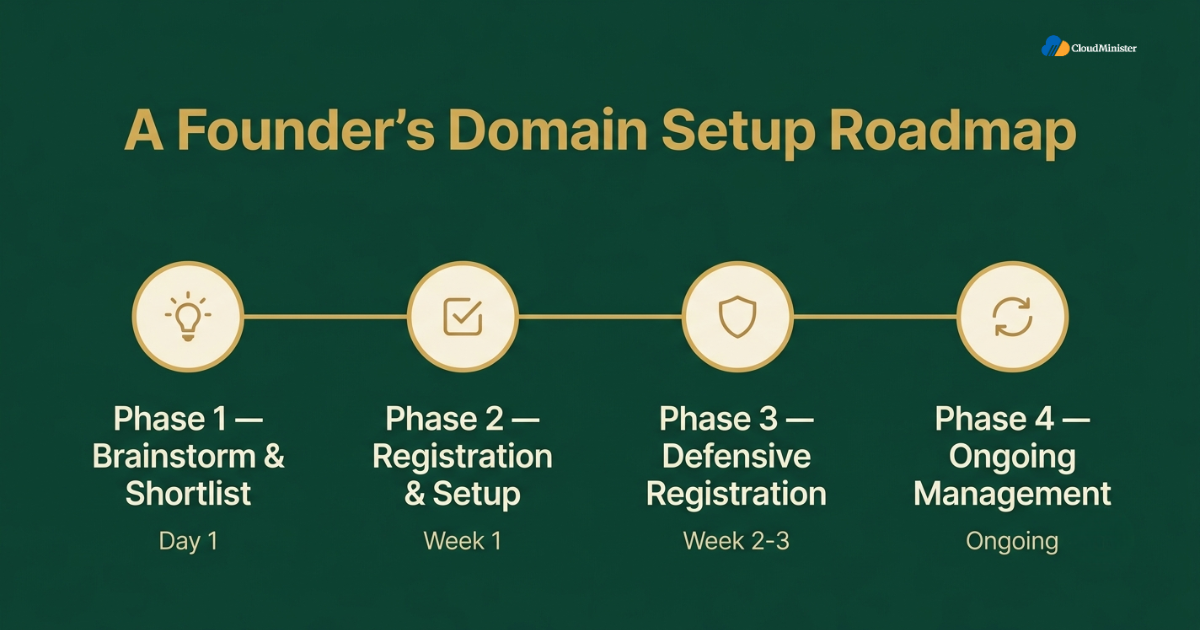
Phase 1: Brainstorm and Shortlist (Day 1)
- List three to five Domain Extension options that genuinely fit your product category, rather than defaulting to whichever is cheapest
- Test each shortlisted name and extension combination out loud with colleagues unfamiliar with the product
- Check trademark availability alongside extension availability before falling in love with any single option
Phase 2: Registration and Setup (Week 1)
- Complete domain registration through an accredited registrar and confirm the extension is correctly configured with DNS and email records
- Enable WHOIS privacy protection immediately after signup to reduce spam and reduce the risk of social engineering attempts
- Set up auto-renewal so the chosen extension does not lapse accidentally during a busy launch period
Related Reading: configuring a mail server account in MS Outlook
Phase 3: Defensive Registration and Brand Protection (Week 2-3)
- Register close variations and additional relevant extension options through the same provider for easier management
- Point secondary addresses and extension variations to the primary domain using redirects rather than leaving them unused
- Document your full domain portfolio internally so the whole team knows what the company owns
Phase 4: Ongoing Domain and Infrastructure Management (Ongoing)
- Review renewal dates and costs annually across every extension in the portfolio as part of routine infrastructure maintenance
- Revisit whether your extension still matches your product positioning as the company evolves from early-stage to growth-stage
- Coordinate domain decisions with the infrastructure team, since an extension change can affect SSL certificates and reverse proxy configuration
Related Reading: configuring an Nginx reverse proxy on Plesk
9. Domain Extension, Domain Transfer, and Ownership Considerations
Founders rarely plan for it at launch, but ownership of a domain sometimes needs to move, whether due to a company restructuring, a change of registrar, or a founder departure.
- A domain transfer moves a Domain Extension and its associated account from one registrar or owner to another, and the process differs slightly by registry
- Planning ahead of time to transfer your domain before a funding round or acquisition avoids last-minute ownership disputes that can delay a deal
- A reliable domain registration partner makes it considerably smoother when you need to transfer your domain, including unlocking the address and obtaining an authorization code
- Choosing a domain registration partner that supports fast requests to transfer your domain matters most in the weeks before a deal closes, when timing is tight
- Before you transfer your domain, confirm the extension is unlocked and that WHOIS details are current with your domain registration partner
- A request to transfer your domain between two accounts under the same domain registration partner is typically faster than moving to an entirely new registrar
- Founders working with a single domain registration partner across their whole portfolio find it far less stressful to transfer your domain when ownership needs to change
- Any decision to transfer your domain should be logged internally alongside the domain registration partner’s confirmation email for audit purposes
- An domain transfer attempted without registry unlock in place will fail, so confirm this step with your registrar first
- Delays during a domain transfer are usually caused by an unresponsive losing registrar rather than the gaining registrar receiving the account
- A domain transfer typically completes within five to seven days once both the losing and gaining registrar confirm the request
- Keeping contact details updated with your domain registration partner avoids a stall when you transfer your domain, such as a verification email that never arrives
- For a founder managing several brands, a single domain registration partner handling every request to transfer your domain keeps the process consistent
- A plan to transfer your domain too close to a renewal date can be rejected, so timing this with your domain registration partner in advance avoids the problem
- A well-organized domain transfer checklist, shared by your domain registration partner, prevents most delays before a domain transfer even begins
Related Reading: the secrets of domain name ownership transfer
Before any funding round, acquisition, or founder transition, confirm exactly who has administrative access to the account and DNS for every extension the company owns. A domain transfer discovered too late can delay a closing by weeks.
10. Domain Extension and Infrastructure Decisions
A well-chosen Domain Extension does more than shape first impressions. Over the life of a company, it becomes part of the evidence base for infrastructure and hosting decisions that support the product behind it.
- A Domain Extension paired with unreliable hosting undermines the trust the extension itself was chosen to build, so infrastructure quality matters just as much as the suffix
- Choosing a Web Hosting Company in India that understands both domain setup and the hosting stack behind an AI or SaaS product simplifies technical support during scaling
- Teams building GPU-heavy AI products should evaluate whether their domain registration partner and hosting provider can be managed under one relationship, since split vendor relationships slow down troubleshooting
- A Web Hosting Company in India that also acts as your domain registration partner reduces the number of support tickets needed when DNS and hosting issues overlap
For Indian founders sourcing infrastructure end to end, working with a Web Hosting Company in India that offers domain setup and hosting under one roof makes coordinating DNS, SSL, and the Domain Extension itself considerably easier than juggling separate vendors.
Treat your extension choice and hosting provider relationship as a single infrastructure decision, not two separate ones. Misalignment between the two is a common source of downtime during DNS propagation after any domain transfer.
11. Domain Extension, Branding, and the Broader 2026 Market Context
Domain Extension decisions do not happen in isolation. They sit inside a much larger 2026 domain market story, where global registrations and AI-specific naming trends are both accelerating.
According to the Domain Name Industry Brief Q1 2026 Quarterly Report, global domain name registrations reached 392.5 million by the end of the first quarter of 2026, an increase of 24.1 million registrations compared to the same quarter a year earlier, underscoring just how competitive extension availability has become for a distinctive brand name.
At the same time, AI-specific naming has become its own visible trend within that broader growth, with the .ai suffix in particular becoming shorthand for artificial intelligence companies across pitch decks, product demos, and investor conversations alike.
These trends reinforce the same conclusion from a founder’s chair as from a brand strategist’s chair: the Domain Extension is not a minor technical detail buried in a checklist. It is the first signal a visitor, an investor, or a search engine receives about what a company does and how seriously it takes its own brand, and founders who treat this decision with care save both rebranding costs and credibility later.
Choosing the right domain registration partner for the ongoing management of your extension is a separate decision from the naming exercise itself, but the two should be evaluated together for long-term reliability and support quality. A domain registration partner that also understands hosting, DNS, and email routing removes a layer of coordination that founders otherwise have to manage themselves. When comparing a domain registration partner, ask directly about domain transfer turnaround times, since this becomes relevant faster than most founders expect. A slow domain registration partner can turn a routine domain transfer into a multi-week delay during a critical business moment. The right domain registration partner treats a domain transfer request as routine account administration rather than a lengthy manual process.
As a final note on strategy, founders who treat their Domain Extension choice as a one-time decision often regret it. Revisiting whether the current extension still fits the company, as the product and market mature, keeps brand identity aligned with actual positioning. The right suffix for a two-person AI prototype is rarely the right Domain Extension for the same company a year later raising a Series A. Letting product-market fit drive that conversation, rather than habit or inertia, is the more disciplined approach.
12. Domain Extension and Registration Checklist for AI/SaaS Founders
- Product category and target audience clearly defined before shortlisting an extension
- Three to five extension options shortlisted and tested out loud for memorability
- Trademark availability checked across every relevant registry
- Domain registration completed through an accredited registrar with WHOIS privacy protection enabled
- Defensive coverage completed for close variations and adjacent extension options
- DNS, SSL, and email records configured correctly for the chosen suffix
- Auto-renewal enabled so the extension does not lapse unexpectedly
- Administrative access to the account and DNS documented internally
- A domain transfer process understood in advance, with a trusted domain registration partner identified, in case ownership needs to move later
- Domain Extension and hosting provider relationship reviewed together for reliability
Key Takeaways
- The Domain Extension is one of the earliest brand and trust signals an AI or SaaS company sends to visitors, investors, and search engines alike
- Brand fit, cost, SEO impact, trust signals, and regional legal considerations form the core factors every founder should evaluate
- .ai, .io, .com, .app, and .tech are the extension categories most closely associated with AI and SaaS positioning today
- Defensive registration and a documented domain transfer process, backed by a reliable domain registration partner, protect a brand as it scales from early-stage to enterprise
- Weeks of careful comparison across Domain Extension options is a stronger foundation for a naming decision than choosing under launch-day time pressure
- AI-specific naming, particularly around the .ai extension, has become a measurable and accelerating trend in the broader 2026 domain market
Need Help Choosing the Right Domain and Hosting Setup?
Talk to our team for guidance on domain registration, DNS configuration, and infrastructure built for AI/SaaS founders.
Conclusion
Choosing a Domain Extension is one of the highest-leverage decisions an AI or SaaS founder makes early in a company’s life. It shapes first impressions, supports or undermines search visibility, and becomes part of the brand equity a company builds over years. A suffix chosen carelessly under launch-day pressure can quietly cost credibility with developers, friction with enterprise buyers, or a forced rebrand once the company has already invested heavily in its identity. Starting with a structured evaluation of brand fit, cost, and trust signals, then growing into a full domain and DNS strategy as the company scales, is the most reliable path forward.
Completing domain registration correctly from day one, with the right extension, WHOIS privacy protection, and defensive coverage across close variations, saves founders from the far more expensive process of untangling a mismatched brand identity later. Just as important is planning ahead for ownership changes: a founder transition, acquisition, or company restructuring can require a smooth domain transfer, and having that process understood in advance, with a trusted registration partner already in place, prevents last-minute delays during moments when timing matters most.
Every phase of this process, from the initial shortlist to defensive registration to eventual ownership changes, pays for itself in avoided rebrands and stronger brand recognition. CloudMinister provides domain registration, hosting, and infrastructure built for Indian AI and SaaS founders who need a reliable Domain Extension strategy behind every product they launch, backed by dependable domain transfer support whenever ownership needs to move.
13. Working With a Web Hosting Company in India for Your Domain and Hosting Needs
Many AI and SaaS founders in India eventually consolidate their domain and hosting relationship with a single vendor rather than juggling several accounts.
- A Web Hosting Company in India that offers both hosting and domain support in one dashboard reduces the number of logins and support tickets a small team has to manage
- When comparing a Web Hosting Company in India, ask specifically whether they support fast domain registration, easy DNS changes, and a smooth process if you ever need to transfer your domain
- A Web Hosting Company in India with local support hours matters more than founders expect once a DNS issue needs to be resolved quickly during business hours
- Founders who choose a Web Hosting Company in India early often find it easier to bundle SSL, email, and domain registration under a single invoice
- A Web Hosting Company in India that also offers GPU and AI infrastructure can support a growing SaaS product without a separate infrastructure vendor
- Before signing up with a Web Hosting Company in India, confirm whether their support team can help you transfer your domain if you later switch registrars
- A Web Hosting Company in India that documents its domain registration process clearly saves a founder from guessing during a time-sensitive launch
- Reviews of a Web Hosting Company in India rarely mention how smooth it is to transfer your domain into their system, so this is worth asking support directly
- A Web Hosting Company in India offering managed domain registration alongside hosting is generally easier for a non-technical founder to manage long term
- Teams that later transfer your domain away from a prior provider should confirm unlock and authorization code policies before committing
- Founders switching providers should always confirm they can transfer your domain without losing existing DNS records or email routing
- If you decide to transfer your domain to a new provider, back up your DNS records first so nothing breaks during propagation
- A trustworthy provider will never make it difficult to transfer your domain elsewhere if you decide to switch later
- Ultimately, the right Web Hosting Company in India treats both domain registration and any future request to transfer your domain as routine, well-documented processes rather than friction points
Ask any prospective Web Hosting Company in India for a written outline of their domain registration and domain transfer process before you sign a contract, not after. A good Web Hosting Company in India will happily explain, in writing, exactly how you can transfer your domain out later if you ever need to.
Frequently Asked Questions
What is a Domain Extension and why does it matter for AI/SaaS companies?
A Domain Extension is the suffix at the end of a web address, such as .com, .ai, or .io, and it shapes brand perception, trust, and category signaling for a technology company from the very first impression.
Which Domain Extension should an AI startup choose first?
Most AI startups evaluate .ai for direct category signaling, then compare it against .com for broader recognition and .io for a more developer-focused audience before completing registration.
Does the Domain Extension affect SEO ranking directly?
Not significantly. A Domain Extension has minimal direct effect on ranking today, though it can influence click-through rate and trust, which indirectly support SEO performance over time.
What is the safest way to protect a brand across multiple extension options?
Defensive registration across close variations, combined with WHOIS privacy protection and a dependable domain registration partner, is the most reliable way to protect a growing brand.
What should a founder check before a domain transfer?
Confirm the domain is unlocked, obtain the correct authorization code, and verify who has administrative access before a domain transfer begins, since an incomplete domain transfer can delay a funding round or acquisition.