


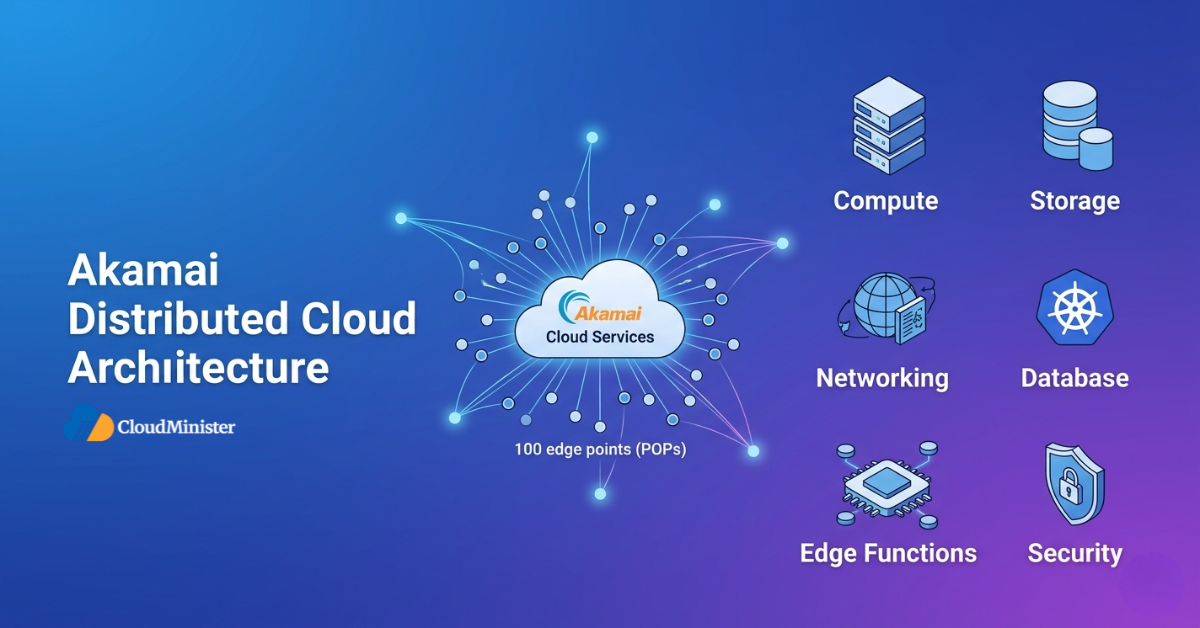
Akamai Cloud Services in 2026 represent one of the fastest-growing distributed cloud platforms in the world — built on Akamai’s 2022 acquisition of Linode and integrated into the company’s 4,300+ edge points-of-presence across 130+ countries. Unlike the centralised hyperscaler model, Akamai Cloud Services place compute, storage, database, security and edge-native functions geographically close to end users, delivering measurably lower latency and a more predictable cost structure for businesses that move beyond static sites into real applications. This guide is a complete, technically accurate breakdown of the full Akamai Cloud Services portfolio in 2026 — covering compute, storage, networking, Kubernetes, managed databases, edge functions, AI inference and security — alongside pricing logic, India-specific considerations and a clear framework for deciding whether Akamai fits your stack. For Indian teams comparing platforms, Akamai Cloud Hosting through CloudMinister combines distributed-cloud architecture with Indian data-centre presence and INR billing.
Choosing a cloud platform in 2026 is no longer a binary AWS-vs-Azure decision. The market has matured into a clear three-tier structure — hyperscalers, distributed clouds and specialised regional providers — and for many Indian businesses, the distributed-cloud model now offers the best combination of price, performance and predictability. This guide is written for founders, CTOs, DevOps engineers, IT managers and agency leads evaluating Akamai Cloud Services in 2026 — those who want a complete technical and commercial breakdown, not a marketing brochure.
Below, we unpack every layer of the Akamai Cloud Services stack that actually matters for production: the compute tiers, the storage architecture, the Kubernetes engine, the managed database options, the edge and serverless layer, the security stack, the Inference Cloud and the pricing model that ties them all together. For teams comparing platforms, CloudMinister is a Web Hosting Provider in India that supports Akamai-backed deployments with managed services and Indian data-centre options.
1. What Are Akamai Cloud Services and Why They Matter in 2026
The single most important context for evaluating Akamai Cloud Services in 2026 is that the platform is not a CDN bolted onto a VPS host — it is a full distributed-cloud stack designed from the ground up to be the production-grade alternative to centralised hyperscaler clouds.
How Akamai got here
- Akamai began as a content delivery network pioneer in 1998 — its core business for over two decades, and still the world’s largest CDN by traffic share.
- In March 2022, Akamai acquired Linode, a developer-focused cloud VPS provider founded in 2003, for approximately USD 900 million.
- The combined platform is marketed as Akamai Connected Cloud, with its public cloud products sold as Akamai Cloud Services.
- In 2025, Akamai’s compute portfolio generated USD 708 million in revenue with 12% year-over-year growth, while its Cloud Infrastructure Services segment specifically grew 45% year-over-year in Q4 2025 — clear signals of accelerating customer adoption.
Why this architecture matters for buyers
- Latency-sensitive workloads — gaming, video, real-time APIs, AI inference, transactional e-commerce — run measurably closer to users by default.
- Egress (outbound data transfer) is priced aggressively low compared to hyperscalers, frequently the single biggest hidden cost on AWS or GCP bills.
- The pricing model is flat-rate and predictable, not consumption-metered in the unpredictable way hyperscaler invoices arrive.
- A focused, opinionated portfolio reduces the cognitive overhead for small and mid-sized engineering teams that cannot specialise across 200+ services.
For Indian buyers, working through a Web Hosting Provider in India that already operates on the Akamai platform turns a cross-border USD-billed cloud account into a GST-compliant, INR-billed managed service — without losing the underlying platform benefits.
2. The Core Akamai Cloud Services Portfolio in 2026
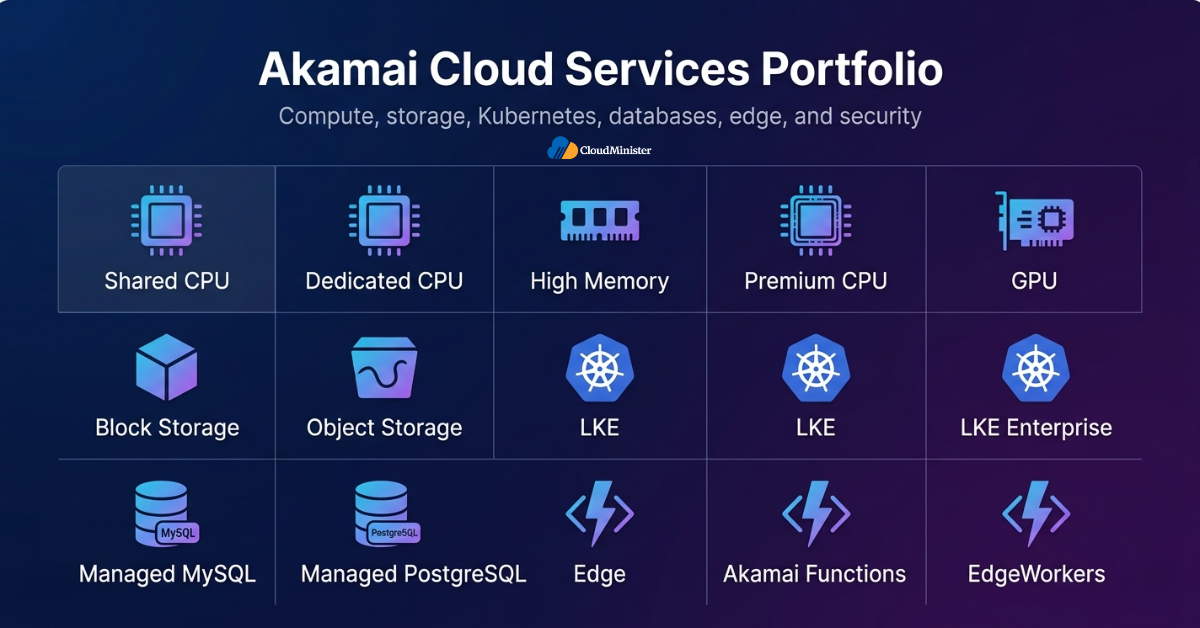
The Akamai Cloud Features that you actually need to know span seven distinct service families, each engineered to be production-grade and individually consumable. The platform portfolio in 2026 is organised as follows.
2.1 Compute Services
- Shared CPU (Linodes): entry-level virtual machines with vCPU shared across tenants, suitable for development, low-traffic websites and staging environments.
- Dedicated CPU: full physical cores allocated to your VM, with predictable performance for production workloads, CI/CD runners and CPU-bound applications.
- High Memory: RAM-heavy plans for in-memory databases (Redis, Memcached) and large caches.
- Premium plans: AMD EPYC-powered Dedicated CPU with stricter performance SLAs, suited to demanding enterprise workloads.
- GPU plans: NVIDIA Blackwell and earlier-generation accelerators for AI training, inference and scientific workloads.
2.2 Storage Services
- Block Storage Volumes: NVMe-backed persistent volumes that attach to VMs and scale independently from the compute tier.
- Object Storage: S3-compatible bucket storage for static assets, backups, media files and data-lake patterns — a key reason teams migrate Cloud hosting India workloads built around AWS S3 to Akamai without changing application code.
- Backups: automated daily backups with point-in-time snapshots for VMs, billable per tier.
2.3 Networking Services
- VPC (Virtual Private Cloud): private networking layer for resource-to-resource communication without exposing traffic to the public internet.
- NodeBalancers: managed Layer-4 and Layer-7 load balancers for distributing traffic across multiple instances.
- Cloud Firewall: stateful firewall rules applied at the platform level, independent of OS-level iptables or nftables configuration.
- DNS Manager: authoritative DNS hosting on Akamai’s global anycast network, with full API control.
- Always-on DDoS protection included on all Akamai Cloud Services instances.
2.4 Container & Orchestration
- Linode Kubernetes Engine (LKE): managed Kubernetes for general-purpose containerised workloads, with a free standard control plane (HA control plane is billed separately per cluster).
- LKE Enterprise: a managed Kubernetes tier with a dedicated, high-availability control plane and tighter enterprise SLAs for large clusters.
- App Platform: a container-based deployment surface for teams that want a managed PaaS experience without operating Kubernetes directly.
- Both LKE tiers integrate natively with Block Storage Volumes, NodeBalancers, VPCs and Cloud Firewalls.
2.5 Database Services
- Managed MySQL and Managed PostgreSQL: production-grade engines with automated backups, multi-node failover, version patching and SSL enforcement included.
- Both options run on dedicated hardware and are billed at a premium over self-managed databases on Linodes — a margin most teams justify by the operational time saved.
2.6 Edge & Serverless Compute
- Akamai Functions: edge-native serverless functions, deployable across the global edge footprint for ultra-low-latency execution close to users.
- EdgeWorkers: JavaScript-based code execution at the edge for request and response manipulation, A/B testing and personalisation.
2.7 Marketplace & Developer Tooling
- One-click application deployments through the Cloud Manager Marketplace (WordPress, Drupal, Magento, observability tools, dev stacks).
- Linode API and Linode CLI for programmatic provisioning, a Terraform provider for Infrastructure-as-Code, and full CI/CD integration.
This combination is what makes Akamai Cloud Hosting a credible production alternative to the hyperscaler stack — not a single hero feature, but a complete portfolio that covers the 90% of workloads most teams actually run.
Before you stand up a single resource, decide which platform services you actually need this quarter — not in twelve months. Over-architecting on day one (Kubernetes for a single container, multi-region replication for a development API) burns budget and operational time. A correctly sized Dedicated CPU Linode with attached Block Storage and a NodeBalancer covers most production workloads at a fraction of the multi-cloud cost.
Related Reading — A Comprehensive Guide to Picking the Best Cloud Hosting Provider in India
3. Akamai Cloud Services vs. Hyperscalers: The 2026 Comparison
The most common platform question in 2026 is no longer “AWS or Azure” — it is “do we need a hyperscaler at all.” Akamai Cloud Services sit in a deliberately different architectural position to AWS, Azure and GCP.
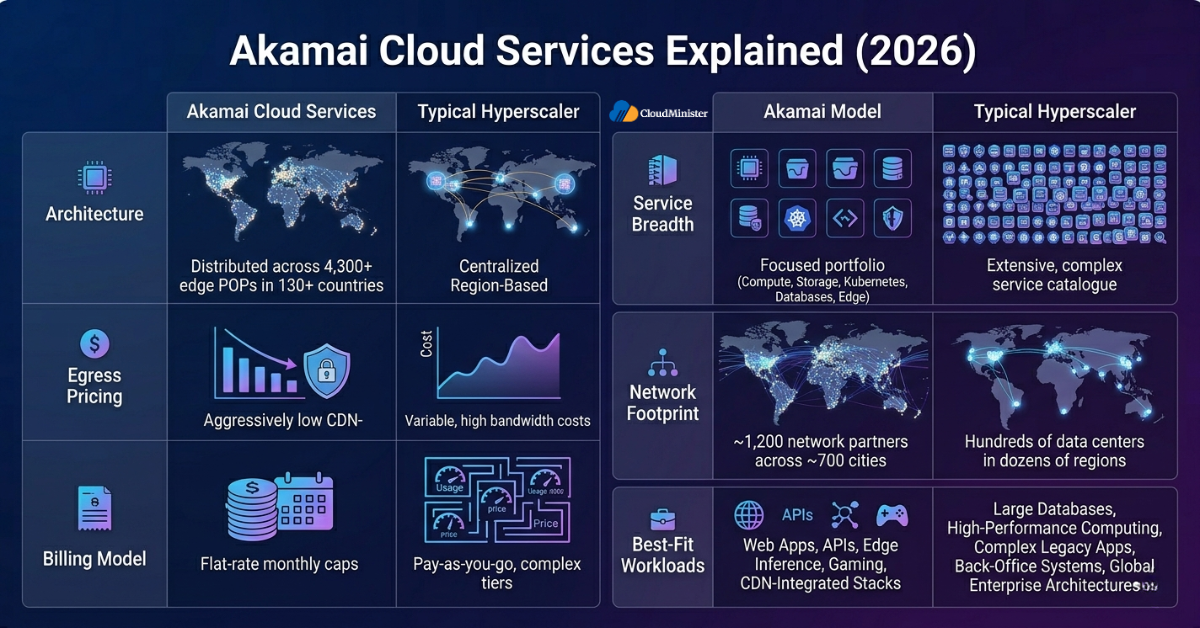
| Dimension | Akamai Cloud Services | Typical Hyperscaler |
| Architecture | Distributed across 4,300+ edge POPs in 130+ countries | Concentrated in 30–70 mega-regions |
| Egress pricing | Aggressively low, CDN-grade economics | Often the largest hidden line item on the bill |
| Billing model | Flat-rate monthly cap per resource | Granular pay-per-second consumption |
| Service breadth | Focused, opinionated portfolio | 200+ services with significant overlap |
| Network footprint | ~1,200 network partners across ~700 cities | Limited transit, premium egress tiers |
| Best-fit workloads | Web apps, APIs, edge inference, gaming, CDN-integrated stacks | Deep proprietary managed services, niche tooling |
Key practical differences
- Egress economics: Akamai Cloud Hosting — built on the same network as the world’s largest CDN — bills outbound transfer at a fraction of hyperscaler rates, frequently saving 60–80% on a media-heavy workload’s transfer bill.
- Architectural placement: hyperscalers ask “which region?”; Akamai Cloud Services ask “where are your users?” and place workloads near them by design across roughly 700 cities.
- Cognitive load: the smaller, sharper portfolio reduces the time engineers spend learning the platform — a real saving for teams without a dedicated cloud architect.
- Billing predictability: flat-rate monthly caps eliminate the per-second consumption surprises that drive the worst hyperscaler horror stories.
Explore High-Performance Akamai Cloud Services
Ready to scale your infrastructure? Discover how Akamai Cloud Services leverage a globally distributed cloud architecture to deliver unmatched speed, sub-30ms latency in India, and up to 80% savings on egress fees compared to traditional hyperscalers.
4. The Akamai Cloud Features That Move the Needle in 2026
Many platform capabilities look competitive on paper; only a few materially change unit economics or developer velocity once you are in production. Here are the Akamai Cloud Features that decide whether a deployment is a success or a slow-bleeding cost centre.
- Distributed edge POPs: workload placement spans far more locations than any single hyperscaler region map — the foundational Akamai Cloud Features advantage.
- Flat-rate billing with bundled transfer: every Linode includes a generous monthly transfer allowance, pooled across the account, so traffic spikes do not generate surprise invoices.
- Integrated DDoS protection: always-on at the platform level, not a paid add-on — a security feature that hyperscalers typically charge separately for.
- NVMe SSD storage by default: both Block Storage Volumes and Object Storage perform at modern IOPS levels without requiring premium tiers to be specified.
- LKE free standard control plane: managed Kubernetes without the per-cluster control-plane fee that AWS EKS and similar services typically charge — a meaningful cost lever for container-heavy teams.
- Native integration with Akamai’s CDN and security stack (App & API Protector, Guardicore Segmentation), letting one vendor handle compute, delivery and protection.
- Mumbai and Chennai core regions for Cloud hosting India workloads — delivering sub-30ms latency to all major Indian metros.
As market context for why this is moving so fast: India’s cloud computing market was valued at USD 37.11 billion in 2025 and is projected to grow at a 24.51% CAGR through 2034, with Infrastructure-as-a-Service capturing roughly 38% of the total — the exact category in which Akamai Cloud Services compete, according to market research published by IMARC Group. That growth rate is what makes a correct platform choice today compound for the next five years.
These Akamai Cloud Features compound when used together — security policies, edge functions and CDN rules declared once propagate globally across the network, which is operationally cheaper than maintaining region-by-region equivalents on a hyperscaler.
Always-on DDoS protection at the platform level does not replace application-layer defences. A modern stack on Akamai Cloud Services still requires Web Application Firewall (WAF) rules, rate limiting and bot management at the application boundary — and for revenue-critical APIs, Akamai’s App & API Protector (AAP) is the right layered defence on top of platform-level mitigation.
Related reading — Top 10 Benefits of Cloud Hosting for Small Businesses
5. Pricing & Cost Architecture of Akamai Cloud Services
The pricing of the platform is built around three principles: flat-rate per-resource billing with hourly accrual and monthly caps, generous bundled transfer allowances, and aggressively low overage egress rates.
Key pricing realities for 2026
- Compute Linodes price by tier (Shared / Dedicated / High Memory / Premium / GPU), with global price parity across most core regions.
- Billing accrues hourly but is capped monthly, so a server running 24×7 never exceeds the published monthly price.
- Bandwidth includes a per-Linode transfer pool that aggregates across your account — a 4 GB Linode typically includes 4 TB monthly transfer, pooled with the rest of the account.
- Object Storage and Block Storage are priced per GB-month, with no charge for ingress.
- Managed Kubernetes (LKE standard) is free at the control plane — you pay only for worker nodes and attached resources, while LKE Enterprise carries a fixed control-plane fee for its dedicated tier.
For Indian buyers, a Web Hosting Provider in India reselling or co-managing Akamai Cloud Services typically bundles INR-denominated invoices, 18% GST treatment, local payment methods and migration assistance — converting USD-denominated platform pricing into a compliant, predictable Indian-currency operating expense.
THE EGRESS LINE ITEM: The largest single cost shock when migrating from a hyperscaler to Akamai Cloud Services is the disappearance of the egress bill. Workloads that were spending more on data transfer than on compute frequently see their total bill drop 40–70% on Akamai because of the CDN-grade egress pricing. Before quoting any migration, pull twelve months of your AWS, GCP or Azure transfer charges separately — that single line item often justifies the entire move on its own.
6. Why Indian Businesses Are Adopting Akamai Cloud Services in 2026
The adoption curve for Akamai Cloud Services in India follows three clear drivers in 2026.
- Mumbai and Chennai core compute regions: sub-30ms latency to all major Indian metros — directly relevant for transactional e-commerce, real-time SaaS and Tier-1 city users.
- Egress economics for media and content businesses: Indian streaming, OTT and publishing workloads benefit most from the low egress rates of Akamai Cloud Hosting.
- Compliance and INR billing: working through an Indian Web Hosting Provider in India gives buyers GST-compliant invoicing and INR payment terms without the foreign-exchange exposure of direct USD card billing.
A practical adoption pattern emerging in 2026
- WordPress and WooCommerce sites consolidate onto Cloud hosting India deployments built on Shared CPU Linodes + managed MySQL.
- Mid-market SaaS teams migrate from AWS to LKE on Akamai to escape EKS control-plane fees and cut egress.
- D2C brands move object storage and media delivery to Akamai’s S3-compatible storage paired with the CDN, collapsing two vendors into one bill.
- AI startups deploy GPU Linodes in Mumbai for inference, paired with managed PostgreSQL for vector and metadata workloads.
Related Reading — A Technical Comparison of DDoS Protection Services: Cloudflare, AWS Shield, Akamai and Azure DDoS Protection
7. Security Across Akamai Cloud Services
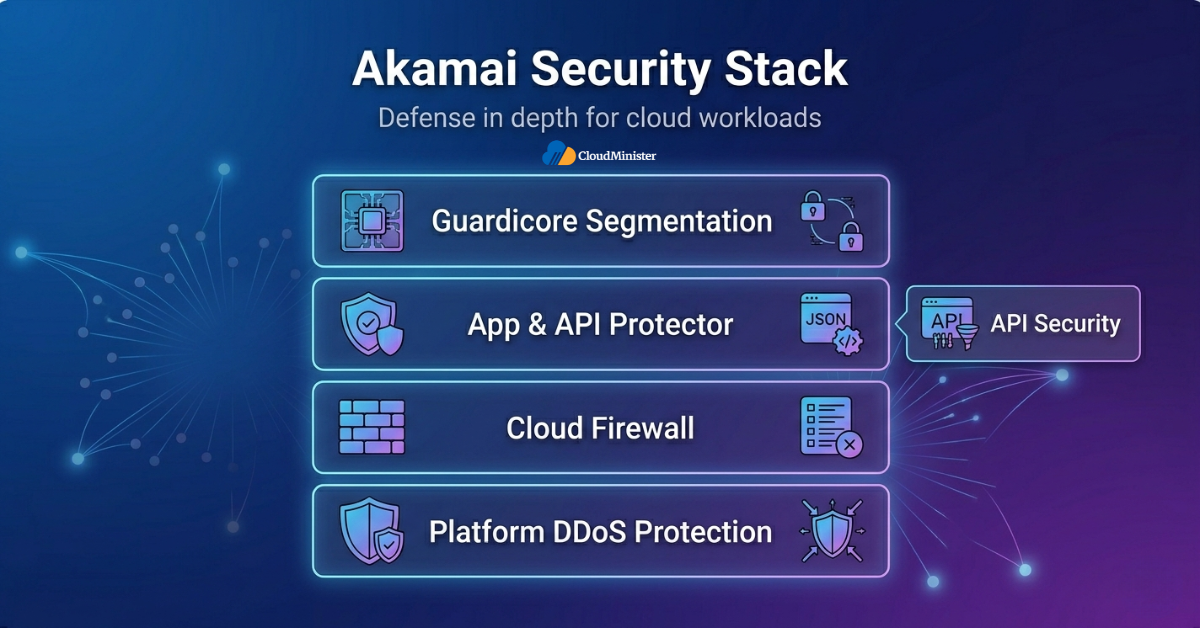
Security is not a separate product line on Akamai — it is a tightly integrated layer running across every deployment on the platform.
The security stack in 2026
- Always-on DDoS protection at the network and application layers (the Prolexic platform and equivalent platform mitigations).
- App & API Protector (AAP): a managed Web Application and API Protection (WAAP) solution covering OWASP Top 10, bot management and API abuse.
- Guardicore Segmentation: micro-segmentation for zero-trust workload isolation across VMs, containers and hybrid environments.
- API Security: dedicated API discovery, posture management and runtime threat detection.
- Cloud Firewall at the platform layer, with LKE-specific control-plane ACLs enabled by default for clusters created from April 2026 onwards.
According to Akamai’s own 2025 financial reporting, Guardicore Segmentation and API Security grew 36% year-over-year in Q4 2025, while Cloud Infrastructure Services revenue grew 45% year-over-year — both directly relevant signals that the security and compute layers of Akamai Cloud Services are scaling rapidly in tandem.
These Akamai Cloud Features deliver their full value only when used together — a security policy declared once at the edge propagates globally across the network footprint, which is operationally cheaper than maintaining region-by-region WAF rules on a hyperscaler.
Map your security posture to a layered model before deploying — platform-level DDoS, network-level Cloud Firewall, application-level WAAP, workload-level micro-segmentation. Skipping any layer because the layer below seems to cover it is the single most common gap we see in production incidents. Defence-in-depth is not a slogan; it is the only architecture that consistently survives a real attack.
8. Akamai Inference Cloud & AI Workloads in 2026
The standout 2026 addition to Akamai Cloud Services is the Akamai Inference Cloud (AIC), purpose-built for distributed AI inference at the edge.
What AIC adds
- Distributed GPU compute (including NVIDIA Blackwell-class accelerators) deployed close to end users rather than centralised in a single mega-region.
- Edge-native Akamai Functions for low-latency model serving without a separate inference orchestration stack.
- Integration with the existing object storage and networking layer, so model artefacts and inference results stay inside one vendor boundary.
Why this matters in production
- Inference latency is the dominant user-experience metric for AI features in production — a 200ms round trip to a centralised endpoint kills any “real-time” claim.
- Running inference at the edge cuts round-trip latency by an order of magnitude for geographically distributed user bases.
- The global edge computing market reached USD 257.76 billion in 2026 and is projected to grow at a 13.24% CAGR through 2031, with Asia-Pacific forecast to grow even faster at 14.21% — driven precisely by the kind of distributed inference workloads AIC is built for, according to industry analysis from Mordor Intelligence.
For Indian AI teams, this lines up directly with the Cloud hosting India requirement: inference workloads serving Indian users from Mumbai-region Akamai POPs deliver materially better p99 latency than inference routed back to Singapore or US-East.
Related Reading — Pay-As-You-Go Cloud Hosting with Akamai: What You Need to Know
9. Real-World Use Cases for Akamai Cloud Services
Different workloads map to different layers of the Akamai portfolio. The patterns below are the most common deployments we see in 2026.
- High-traffic e-commerce: Dedicated CPU Linodes + managed MySQL + Object Storage + Akamai CDN + App & API Protector. The full stack delivers a fast, secure storefront with predictable monthly costs.
- SaaS APIs: LKE clusters with NodeBalancer ingress, managed PostgreSQL and VPC isolation, plus API Security for runtime protection.
- Media and OTT: Object Storage as origin + Akamai CDN delivery + edge transcoding via Akamai Functions, exploiting the platform’s egress economics.
- AI/ML inference: GPU Linodes in regional core POPs running model servers, fronted by NodeBalancers and accelerated through AIC for geographically distributed users.
- WordPress and WooCommerce at scale: Shared or Dedicated CPU with managed MySQL, automated backups and Cloud Firewall — increasingly the default architecture an Indian Web Hosting Provider in India deploys for SMB sites that have outgrown shared hosting.
- Gaming backends: Dedicated CPU for game servers, NodeBalancer for matchmaking, Object Storage for assets, edge POPs for low-latency player routing.
- Internal corporate tools: Shared CPU instances behind Cloud Firewall and VPC, with managed backups — a low-cost, high-reliability alternative to on-premise VMs.
10. Decision Framework: When to Choose Akamai Cloud Services
There is no universal “right cloud” — only the right cloud for a given workload. The framework below is what we apply when advising Indian businesses in 2026.
Choose Akamai Cloud Services when:
- Egress cost is a meaningful or dominant line item on your current cloud bill.
- Your user base is geographically distributed and latency at the edge directly affects user experience or conversions.
- You want predictable, flat-rate billing instead of consumption-metered invoices that surprise on the 1st of the month.
- You operate a focused stack (web apps, APIs, containers, databases) and do not need 200+ niche managed services.
- Indian compliance, INR billing and local presence are buying criteria — making a co-managed Akamai Cloud Hosting plan through a Web Hosting Provider in India operationally cleaner.
Consider a hyperscaler instead when:
- You depend on a proprietary managed service (BigQuery, Cosmos DB, a specific AWS-only SDK) with no portable equivalent.
- You require specific compliance certifications that only the hyperscaler holds in your jurisdiction.
- Your workload genuinely benefits from one of the deep niche services hyperscalers offer (specialised AI training pipelines, particular government regions).
A hybrid approach is increasingly common in 2026: keep one or two workloads on the hyperscaler where they are deeply integrated, and move the rest of the fleet to Akamai for the cost and performance gains. A managed partner makes this hybrid model operationally simple by handling the Akamai side and bridging the integrations.
Never migrate production workloads to any cloud — Akamai included — without a documented and tested rollback plan. The path back must be tested in staging, DNS TTLs must be lowered ahead of cutover, and the old environment must be left running and synced for at least 48 hours after cutover. Migrations fail not from technical incompatibility but from undertested rollback paths.
11. Final Pre-Migration Checklist for Akamai Cloud Services
Use this checklist before committing to any annual cloud deployment on the Akamai platform:
- Workload audit: documented peak CPU, RAM, IOPS and concurrent connections from the last 90 days.
- Egress baseline: monthly outbound transfer in GB and current cost — the line item that most often justifies the move.
- Region selection: confirmed Mumbai or Chennai region for Cloud hosting India workloads to ensure sub-30ms domestic latency.
- Architecture mapped: which compute tier, which storage class, which Kubernetes tier (LKE vs LKE Enterprise) for each component.
- Security layered: platform DDoS + Cloud Firewall + WAAP + segmentation policies declared before traffic is cut over.
- Backup strategy: automated daily backups enabled, off-platform copies for disaster recovery, restore tested at least once.
- Pricing verified: monthly cap per resource confirmed, egress allowance modelled against actual usage.
- Vendor and billing: invoicing in INR through a managed partner, GST-compliant, payment terms agreed in advance.
- Exit path: documented migration-out plan and snapshot-export process, in place before the entry contract is signed.
Seamlessly Migrate to Akamai Cloud Services Today
Don’t let unpredictable cloud bills hold your business back. Get in touch with CloudMinister’s expert team for a free architecture review, seamless migration assistance, and GST-compliant INR billing tailored to your unique requirements.
12. Conclusion
Akamai Cloud Services in 2026 are no longer the underdog alternative to hyperscalers — they are a credible, distributed-cloud platform that wins on egress economics, network footprint, predictable pricing and operational simplicity. The platform is not the right answer for every workload, but for the majority of Indian web applications, APIs, e-commerce stores and emerging AI inference workloads, it represents the best price-to-capability ratio in the market today.
The honest summary for 2026
- Distributed edge wins on latency for any user-facing workload — Akamai’s 4,300+ POPs are an architectural moat that hyperscalers cannot match on geography.
- Egress economics are the single most underrated cost lever — moving off hyperscaler egress alone often justifies the entire migration.
- Flat-rate billing eliminates the worst-case invoice surprises that drag hyperscaler TCO upwards over a 3-year horizon.
- The integrated security stack (DDoS, WAAP, segmentation, API security) means one vendor relationship, not five separate procurement cycles.
- Working through an Indian managed Akamai Cloud Hosting partner converts a global platform into a GST-compliant, INR-billed local service.
Reassess your platform decision every 12 months — pricing, regional expansion, GPU availability and security capabilities all shift, and a stack that was optimal in 2026 may need revisiting in 2027.
Key Takeaways
Akamai Cloud Services is the public cloud platform built on Akamai’s 2022 Linode acquisition, now integrated with 4,300+ edge POPs across 130+ countries.
The portfolio spans compute (Shared / Dedicated / High Memory / Premium / GPU), Object & Block Storage, LKE and LKE Enterprise Kubernetes, managed MySQL and PostgreSQL, Cloud Firewall, NodeBalancers, VPC, DNS, Akamai Functions and EdgeWorkers.
Egress pricing is CDN-grade — frequently 60–80% lower than hyperscalers — making it the single biggest TCO advantage for media-heavy and high-traffic applications.
Always-on DDoS protection, App & API Protector, Guardicore Segmentation and API Security are integrated into the platform, not sold as separate add-on subscriptions.
The Akamai Inference Cloud (AIC), with NVIDIA Blackwell GPUs at the edge, positions the platform for the distributed-AI workloads driving 2026 cloud growth.
For Cloud hosting India workloads, Mumbai and Chennai core regions deliver sub-30ms latency to all Tier-1 metros, and INR-billing through a managed partner removes FX exposure.
Akamai Cloud Services are the right default for most Indian web apps, APIs, e-commerce stores and edge-AI workloads in 2026 — but always verify against your specific workload before locking a contract.
Frequently Asked Questions
Q1. What are Akamai Cloud Services in 2026?
Akamai Cloud Services are Akamai’s distributed public cloud platform — formed by the 2022 acquisition of Linode and integrated with Akamai’s 4,300+ edge POPs in 130+ countries. The portfolio covers compute (Shared / Dedicated / High Memory / Premium / GPU Linodes), Object and Block Storage, managed Kubernetes (LKE and LKE Enterprise), managed MySQL and PostgreSQL, Cloud Firewall, NodeBalancers, VPC networking, DNS Manager, Akamai Functions (serverless), EdgeWorkers and the Akamai Inference Cloud for distributed AI workloads.
Q2. How are Akamai Cloud Services different from AWS or Azure?
Architecturally, Akamai distributes compute across thousands of edge POPs rather than concentrating it in a few mega-regions. Commercially, the most important difference is egress pricing — Akamai bills outbound transfer at CDN-grade rates that are often 60–80% lower than hyperscalers. The portfolio is also intentionally narrower, covering the 90% of workloads most teams need without the 200+ overlapping services AWS and Azure offer. The trade-off is fewer proprietary niche services and fewer compliance certifications than the hyperscalers carry.
Q3. Is the platform genuinely available in India?
Yes. Akamai operates Mumbai and Chennai core compute regions that serve all of India with sub-30ms latency to Tier-1 metros (Delhi NCR, Bangalore, Chennai, Hyderabad, Pune). For Indian buyers, working through a managed Indian hosting partner like CloudMinister converts the USD-denominated platform pricing into INR-billed, GST-compliant invoicing and adds migration and operational support on top.
Q4. How does Akamai Cloud Services pricing actually work?
Pricing is flat-rate per resource, accrued hourly but capped monthly — so a server running 24×7 never exceeds the published monthly price. Each Linode includes a bundled monthly transfer allowance pooled across your account. Object Storage and Block Storage are billed per GB-month. Managed Kubernetes (LKE) has a free standard control plane; HA control planes and LKE Enterprise carry a monthly per-cluster fee. Managed databases are priced higher than self-managed databases on Linodes — the premium pays for automated backups, multi-node failover and patching.
Q5. What is the Akamai Inference Cloud (AIC)?
The Akamai Inference Cloud is Akamai’s distributed AI inference platform launched as part of the 2026 portfolio. It pairs GPU compute (including NVIDIA Blackwell-class accelerators) with edge-native Akamai Functions and the existing Akamai Cloud Services stack, so AI models can be served close to end users at single-digit-millisecond latency. The target workloads are real-time inference for chat, recommendation, fraud detection and personalisation — anywhere round-trip latency to a centralised region would degrade the user experience.
Q6. Should I migrate from a hyperscaler to Akamai?
Run the numbers on three line items first: egress, compute and managed services. If your monthly hyperscaler bill is dominated by egress (a common pattern for media, streaming and content-heavy applications), Akamai’s CDN-grade transfer pricing alone often justifies the move. If you depend heavily on hyperscaler-proprietary managed services (BigQuery, Cosmos DB, a specific AWS-only SDK), migration is harder and a hybrid approach is usually the right answer. For most Indian web apps, APIs, e-commerce stores and SaaS backends, the migration economics favour Akamai Cloud Services.
Q7. How often should I review my Akamai Cloud Services architecture?
Reassess every 12 months. Provider pricing, hardware generations, GPU availability, regional expansion and security capabilities all change over that horizon — and your own traffic and architecture evolve too. A stack that was correctly sized and competitively priced in 2026 may be over-provisioned, under-powered or simply overpriced relative to the market by 2027. A yearly architecture review keeps cost aligned with actual need and prevents technical debt from compounding.

Pritam Kumar is a DevOps Engineer at CloudMinister Technologies, where he manages a multi-datacenter fleet of 100+ servers and architects end-to-end CI/CD pipelines and infrastructure automation using Kubernetes, Terraform, and Ansible. He holds an AWS Certified DevOps Engineer Professional certification and has served as a Google Cloud Mentor, reflecting both hands-on cloud expertise and a track record of mentoring others in the field. His work spans disaster recovery architecture, security incident response, and hosting infrastructure across Proxmox, cPanel/WHM, and Linux systems. Notably, Pritam led the design of Cloud Kavach, a self-hosted DC/DR SaaS portal, and directed remediation efforts for large-scale hosting security incidents involving webshells and command-and-control malware. He brings this depth of real-world infrastructure and security experience to the technical content he writes.
Related posts:
 The Role of CDN in Akamai Cloud Hosting for Faster Website Loading: A Complete 2026 Guide
 Akamai Cloud Wrapper: Reduce Cloud Hosting Costs Without Losing Performance
 Top Cloud Hosting Providers for Scalable VPS & Reliable Cloud Servers
 Amazon EC2 Explained: The Complete Guide to AWS Cloud Hosting (2026)
