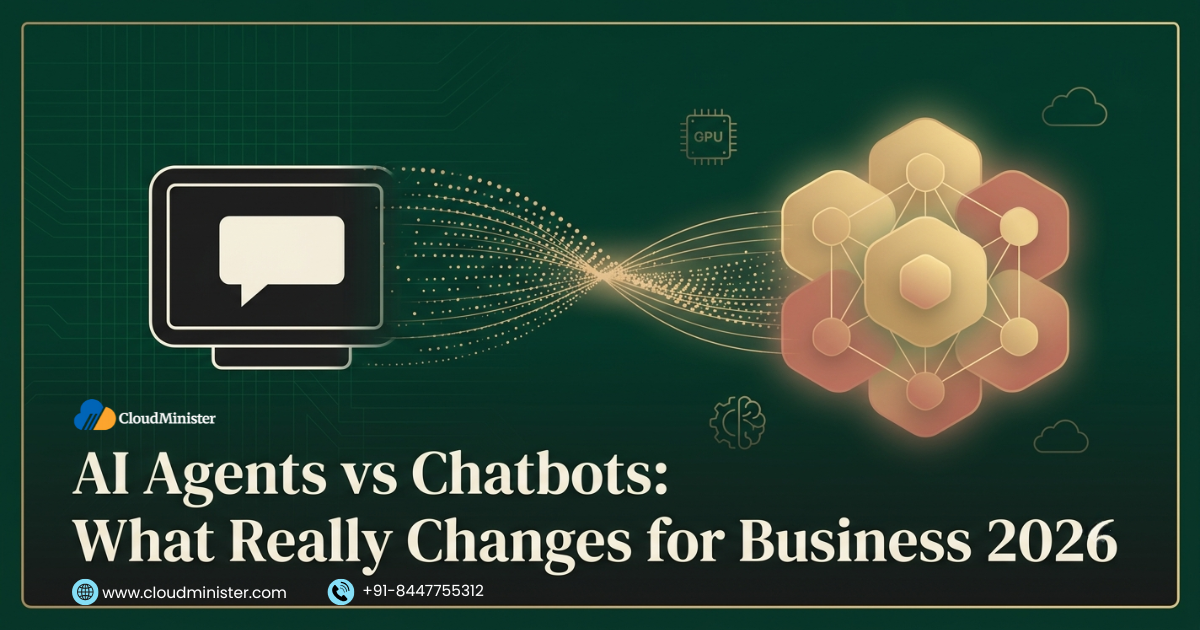
Remember the last time you messaged a support line and got a reply that felt robotic, looping back to the same menu no matter what you typed? You were almost certainly talking to a traditional chatbot. A rule-based, script-driven chatbot follows a predefined decision tree: match a keyword, return a response. Stray from the script, and the interaction breaks down. Fast forward to 2026, and a fundamentally different generation of automated assistant, the AI agent, is replacing the traditional chatbot in businesses that need more than scripted replies.
This shift is not just a technical upgrade. It is a strategic transformation in how businesses automate customer interactions, internal workflows, and multi-system operations. If you are using cloud web hosting or cloud infrastructure for your business, choosing between a chatbot and an AI agent affects everything from customer satisfaction scores to operational efficiency and infrastructure cost. This guide provides a complete capability comparison — what a chatbot does, what an AI agent does differently, when to choose each, the infrastructure each requires, and how to get started building intelligent automation for your business.
What Is a Traditional Chatbot?
A traditional chatbot is a software application designed to simulate conversation with users through a text interface. It operates on a rule-based decision tree: the user inputs a message, the system identifies one or more keywords, and it returns the pre-programmed response that matches those keywords. If no keyword matches, most such systems respond with a fallback message such as “I didn’t understand that” or redirect the user to a human agent.
Characteristics of a traditional chatbot:
- Scripted responses: every answer is written in advance by a developer or content team, there is no dynamic generation of responses
- Decision tree logic: the system follows a branching flowchart, each user input navigates to the next pre-defined branch
- Keyword matching: it identifies keywords in user input and maps them to response categories, not to the meaning of the message
- Stateless: most traditional setups do not remember previous messages within the same conversation unless explicitly programmed to do so
- Informational only: it can tell users information but cannot take actions, it cannot update a record, process a transaction, or retrieve real-time data from a connected system
- Static: it does not improve from user interactions unless a developer manually updates the scripts
Traditional chatbot systems became popular between 2015 and 2022 because they reduced inbound support volume, provided 24/7 availability, and automated frequently asked questions at low cost. For many routine, high-volume, low-complexity interactions, this kind of automation delivered genuine value. However, as user expectations evolved and business processes grew more complex, the limitations of the rule-based approach became the dominant user experience — not the benefit.
What Is an AI Agent – and How Is It Different from a Chatbot?
An AI agent is a fundamentally different technology from a traditional chatbot. Where a scripted system follows a fixed path, an AI agent uses large language models (LLMs) to understand the meaning and intent behind natural language, even when it is phrased ambiguously, contains typos, or uses terminology not explicitly programmed. But the capability difference goes beyond conversation quality. The defining characteristic of an AI agent is its ability to take action.
A rule-based bot tells you how to reset your password. An AI agent verifies your identity through your account system and resets it for you. A scripted assistant provides your order status from a pre-written template. An AI agent retrieves your live order data from the logistics API, cross-references it with the carrier tracking system, and gives you the precise expected delivery window, all within a single conversation.
Core capabilities that distinguish an AI agent from a chatbot:
- Natural language understanding: the AI agent interprets the intent behind messages, not just the keywords, handling colloquial language, typos, complex multi-part queries, and contextual references
- Persistent conversation memory: the AI agent remembers the full context of a conversation across multiple turns, users do not repeat themselves
- Task execution: unlike a scripted system that only provides information, an AI agent can perform actions, booking appointments, updating CRM records, running queries, sending notifications, processing transactions
- Tool use and API integration: AI agents connect to external systems (CRM, ERP, databases, APIs, search engines) and use them to complete tasks, a rule-based system has no equivalent capability
- Continuous learning: AI agents improve over time through feedback loops and RAG (Retrieval-Augmented Generation) knowledge base updates, unlike a static script that only changes when developers manually edit it
- Multi-step reasoning: an AI agent can break a complex request into steps, execute each in sequence, and synthesise a coherent final response, a decision-tree system cannot handle multi-step workflows without explicit branching for every possible path
The development and deployment of AI agents requires significantly more sophisticated infrastructure than a traditional chatbot. Many businesses are building their AI agents using an AI Lab on Cloud, a cloud-based environment that provides the GPU compute, LLM APIs, vector databases, and DevOps tooling needed to develop, train, and deploy AI agents without massive upfront infrastructure investment.
Chatbot vs AI Agent – Complete Capability Comparison (2026)
The following comparison covers the most important capability dimensions between a traditional chatbot and a modern AI agent in 2026:
| Dimension | Chatbot | AI Agent |
| Intelligence Model | Rule-based keyword matching and decision trees | LLM-powered natural language understanding and reasoning |
| Conversation Style | Linear, menu-driven, scripted | Dynamic, free-flowing, contextual, adaptive |
| Context and Memory | Stateless — no conversation history | Persistent context across full conversation and sessions |
| Language Understanding | Keyword matching, rigid, fails on unfamiliar phrasing | Understands intent, handles typos, colloquialisms, and complex queries |
| Task Execution | Informational only — tells users what to do | Action-oriented — can complete tasks in external systems |
| Tool and API Use | None or very limited (single-system) | Multi-system — CRM, ERP, databases, APIs, web search |
| Learning Ability | Static until manually updated | Continuously improves through feedback and RAG updates |
| Multi-Step Workflows | Only if explicitly scripted for every branch | Handles complex multi-step tasks autonomously |
| Error Recovery | Returns fallback message or restarts flow | Reformulates, asks clarifying questions, tries alternative approaches |
| Setup Complexity | Low — script-based, no ML expertise needed | Higher — requires LLM, prompt engineering, API integration |
| Infrastructure Needed | Modest CPU server or SaaS platform | GPU server or cloud GPU for LLM inference |
| Best For | High-volume FAQ, simple 24/7 query handling | Complex queries, multi-step automation, personalisation |
The Core Difference – Scripted Replies vs Independent Action
Think of a traditional chatbot as a very detailed FAQ system with a conversational interface. It follows a pre-written script. If you use the exact keyword it is programmed for, you get the right answer. Stray from the path, and you encounter its fundamental limitation: it cannot understand what it has not been explicitly told.
An AI agent is more like a capable team member who can think through a problem. It uses large language models to understand the intent behind your message – even when it is phrased in an unexpected way. More importantly, it can act. It does not just explain how to do something; it does it. It can pull data from your CRM, update a ticket, generate a document, schedule a meeting, and confirm the result – all within a single conversational interaction that a scripted system could not handle without dozens of pre-programmed branches.
This leap in capability is exactly why the term “chatbot” has become inadequate for describing modern AI-powered business automation – and why the distinction matters for any business evaluating conversational automation in 2026.
Why the Chatbot vs AI Agent Choice Matters for Your Business
The shift from chatbot to AI agent is not just a technology upgrade, it is a strategic business decision with measurable impact on customer satisfaction, operational efficiency, and competitive positioning.
For Customer Support
A traditional chatbot deflects tier-1 support tickets by providing FAQ answers. In practice, deflection rates are limited because customers quickly learn that this kind of system cannot resolve anything that requires looking up their account, checking real-time data, or taking an action.
An AI agent resolves tier-1 tickets end-to-end, not just deflects them. It retrieves account information, processes refund requests through the billing API, updates ticket status in the helpdesk system, and sends confirmation messages, all without human involvement. For businesses running cloud web hosting plans, an AI agent can check server status, retrieve account details, and initiate technical escalations, tasks that a scripted system could not complete.
For Internal Operations
A rule-based bot can answer internal policy FAQs. An AI agent can onboard new cloud hosting clients by automatically setting up accounts, generating welcome documentation, scheduling follow-up calls, and updating the CRM, a complete multi-step workflow that a scripted system would require months of manual work to partially replicate.
For India-Specific Business Contexts
India’s growing AI adoption in 2026 means businesses are increasingly expected to handle customer interactions in regional languages, resolve complex product queries in real time, and maintain 24/7 availability with consistent quality. A basic scripted system can handle only the simplest of these requirements. AI agents, particularly those built on multilingual LLMs with RAG grounding in Indian-language knowledge bases, can genuinely serve Indian customers across languages and complexity levels.
The development of sophisticated AI agents suited to regional Indian business contexts is increasingly happening within AI Lab on Cloud environments, cloud-based AI development platforms that provide the tools, pre-configured frameworks, and governance structures to build and deploy AI agents tailored to Indian languages, business workflows, and compliance requirements.
Real-World Scenarios – When to Choose a Chatbot vs an AI Agent
Choose a Traditional Chatbot When:
- Your use case is genuinely simple and high-volume, answering the same 10–20 questions repeatedly at scale (store hours, return policies, product prices that change infrequently)
- Your processes are straightforward, do not require personalisation, and rarely change, the scripts can remain stable for months without needing updates
- You have strict compliance requirements where every possible response must be pre-approved by legal, compliance, or regulatory teams, this scripted nature makes it auditable
- You have a very tight budget and need 24/7 presence for basic query handling, this approach is significantly cheaper to implement and operate than an AI agent
- You are not yet ready for the implementation complexity that AI agent development requires, a simple scripted system is a valid starting point while your team builds AI capabilities
Choose an AI Agent When:
- Your customer queries are complex, varied, and require personalisation, for example, providing technical support for different cloud web hosting plans where the answer depends on the specific account configuration, not a generic script
- You want to automate entire multi-step processes, a returns workflow from initiation through carrier scheduling; an onboarding flow from account creation through first training call
- You have the data infrastructure to support AI agent integration, CRM, ticketing, ERP systems with APIs that an AI agent can connect to
- You are prepared for an iterative implementation approach, AI agents require testing, feedback loops, and ongoing prompt and knowledge base refinement
- You need the AI agent to handle conversations in multiple languages, including Indian languages that a traditional setup would require separate, manually-scripted versions to support
- You want your automation system to improve over time without manual scripting updates, AI agents learn from interactions, rule-based systems do not
The Infrastructure Backbone – Chatbot vs AI Agent Requirements
Traditional rule-based systems and modern AI agents have very different infrastructure requirements, a distinction that matters for businesses planning their cloud architecture.
Chatbot Infrastructure
A traditional chatbot runs on modest resources. The compute required is minimal, pattern matching and decision tree traversal do not require specialised hardware. Most such deployments use standard SaaS platforms (Intercom, Zendesk Chat, Freshchat) that provide hosting, infrastructure, and management as part of the subscription fee. For businesses building a custom setup, a standard CPU-based VPS hosting environment is typically sufficient. This low infrastructure barrier is one of the reasons rule-based automation adoption was so rapid between 2015 and 2022.
AI Agent Infrastructure
An AI agent has significantly greater infrastructure requirements than a traditional rule-based system. Real-time LLM inference, generating natural language responses from a large model, requires GPU compute that a standard CPU server cannot provide at acceptable latency. The AI agent must also manage conversation context (requiring memory storage), connect to external APIs (requiring secure network integration), and potentially retrieve from a vector database (requiring specialised storage and compute for embedding search).
This infrastructure complexity is why many teams building AI agents start with an AI Lab as a Service model rather than self-managing GPU servers and LLM APIs independently. CloudMinister’s AI Lab on Cloud provides high-performance computing, specialised GPU infrastructure, pre-configured AI frameworks, and data management tools as a managed service — so development teams focus on designing the AI agent’s logic and knowledge, not managing the underlying infrastructure.
For businesses running their own LLMs rather than using external API providers, Linux GPU Server and Windows GPU Server plans from CloudMinister provide the CUDA-enabled, NVMe SSD-backed GPU infrastructure needed for self-hosted AI agent inference — with India-based data centres satisfying DPDPA 2023 data residency requirements for businesses processing personal data of Indian users.
The Collaborative Future – Chatbot and AI Agent Working Together
In 2026, the most effective businesses do not see this as a strict either/or choice. The future of conversational automation is layered, and the traditional chatbot still has a role to play in that architecture.
A rule-based system handles the initial greeting and simple filtering at the top of the conversation, instantly answering the most common, predictable queries at near-zero compute cost. When a query exceeds its scripted capability, the conversation is seamlessly escalated — not always to a human agent, but potentially to a specialised AI agent that can dive deep into connected systems, reason through the complexity, and resolve the issue autonomously.
This layered architecture makes financial sense as well as operational sense. Using a simple scripted layer for the 60–70% of interactions that are genuinely simple and repetitive reduces the GPU inference cost of AI agent deployment, reserving more expensive AI compute for the complex cases that actually need it.
The goal is a unified, intelligent system where the scripted layer and AI agent each handle the interactions they are suited for, making every customer interaction smarter, faster, and more efficient than either could achieve alone.
Conclusion
The traditional chatbot is not obsolete, it remains a cost-effective, reliable solution for high-volume, low-complexity query automation. But its ceiling is clear, and businesses that have hit that ceiling are already migrating toward AI agents that can understand, reason, and act rather than just respond.
Choosing between a scripted assistant and an AI agent depends on your current query complexity, infrastructure readiness, budget, and ambition for automation. For straightforward FAQ deflection, a simple rule-based system delivers strong ROI. For businesses that want to automate multi-step workflows, personalise interactions, and genuinely resolve issues rather than route them, an AI agent is the appropriate investment.
Frequently Asked Questions
Is an AI agent just a more advanced chatbot?
Not quite, they represent different paradigms, not different points on the same continuum. A rule-based system is a communication interface that follows scripts. An AI agent is an autonomous digital worker that communicates. The defining difference is task execution: a scripted assistant tells users what to do, an AI agent does it. It matches keywords to pre-written responses; an AI agent understands intent and acts on it through connected systems. The underlying technology is also fundamentally different, one uses decision trees, the other uses large language models and tool-calling frameworks.
Are AI agents too expensive for mid-sized Indian businesses?
The cost barrier has lowered significantly in 2026. With CloudMinister’s AI Lab on Cloud and AI Lab as a Service models, businesses can access the GPU infrastructure, pre-configured frameworks, and deployment tooling needed for AI agent development on a pay-as-you-go basis, without purchasing GPU hardware. For businesses not ready to build a full AI agent, starting with a well-designed chatbot while building AI capabilities is a reasonable interim approach. This kind of system is also significantly less expensive to maintain, operating costs matter as much as implementation costs.
Can I migrate my existing chatbot to an AI agent?
It is usually a migration rather than an upgrade, the underlying technology is fundamentally different. However, your existing conversation logs are valuable training data for an AI agent: they reveal the most common user queries, the language patterns your users use, and where the old system fails (fallback responses). This data accelerates AI agent development by providing a real dataset for testing and evaluation. CloudMinister’s DevOps Services team can assist with the migration architecture and data pipeline into AI agent training datasets.
We have a development team. Should we build an AI agent in-house?
Building in-house is viable, but the infrastructure overhead is significant. Managing GPU servers for LLM inference, orchestration platforms, vector databases, security configurations, and monitoring for an AI agent production deployment is complex work that requires specialised expertise. Many development teams start with AI Lab on Cloud or similar managed AI infrastructure to accelerate development with pre-built components, reducing months of setup time. Once the AI agent is validated, the team can decide whether to migrate to self-managed infrastructure or continue on managed GPU cloud.
How do I start testing an AI agent for my business?
Identify a single, well-defined but genuinely painful process, internal IT ticket routing, customer order status resolution, or lead qualification are common starting points. Use a cloud-based AI development platform to build a prototype. This lets you test the value proposition, manage costs, measure accuracy, and learn the development and prompt engineering workflow before committing to a full-scale AI agent rollout. CloudMinister’s AI Lab on Cloud provides the development environment, GPU infrastructure, and technical guidance to run an AI agent pilot project without building your own infrastructure.

Shivlendra Singh Jadoun is a Cloud & DevOps Engineer at CloudMinister Technologies, specializing in AWS, Azure, and GCP infrastructure. He began his career in Linux system administration, managing shared, VPS, and dedicated servers before moving into cloud and automation. He is AWS Certified and works extensively with Docker, Kubernetes, Terraform, Ansible, and Jenkins to build CI/CD pipelines and scalable, secure cloud environments. With hands-on experience across hosting, server security, and DevOps automation, he brings real-world engineering insight to every article he writes.