This guide examines how managed DevOps services for startups and enterprises differ across six critical business dimensions — budget models, deployment velocity, compliance requirements, team structures, scalability approaches, and risk profiles. Whether you are a founder shipping your first product or a technology director managing a hundred-person engineering organisation, this guide provides a clear, evidence-backed framework to identify which DevOps model fits your current business stage and what to look for before engaging a provider.
Every business reaches a point where slow software delivery stops being a technical inconvenience and becomes a direct competitive liability. For a startup, that moment typically arrives when a product launch slips because deployments require too much manual coordination. For an enterprise, it surfaces as mounting technical debt, failed security audits, or engineering teams spending more time managing infrastructure than building product.
The root cause is almost always the same: DevOps practices are absent, under-resourced, or misaligned with the actual complexity of the business. The solution, however, looks very different depending on whether you are at Series A or overseeing multiple engineering divisions. Understanding what managed DevOps services for startups and enterprises means in practice — and why the implementation model is as important as the tooling — is the foundation of making the right infrastructure decision in 2026.
This guide is written for business owners and decision-makers who need a practical, honest comparison — not a vendor product overview. It covers what each model delivers, where requirements diverge most sharply, how to evaluate a provider before committing, and why selecting the right managed DevOps model for your business stage is one of the most impactful infrastructure decisions a growing business can make in 2026.
→ Related: DevOps Automation: Top Tools & Strategies for Efficiency — Cloudminister
1. What Managed DevOps Services Actually Mean for a Business Owner
Before comparing startup and enterprise models, it is worth establishing what a business actually receives from a managed DevOps engagement — described in plain language, without technical jargon.
When organisations evaluate DevOps services and solutions, the core offering is consistent: an external team takes operational ownership of the infrastructure, automation pipelines, testing processes, and deployment workflows that allow software to be built, tested, and released reliably. You do not hire, train, or retain a dedicated internal DevOps engineering function. Instead, you contract a provider who delivers that capability as an ongoing, accountable service.
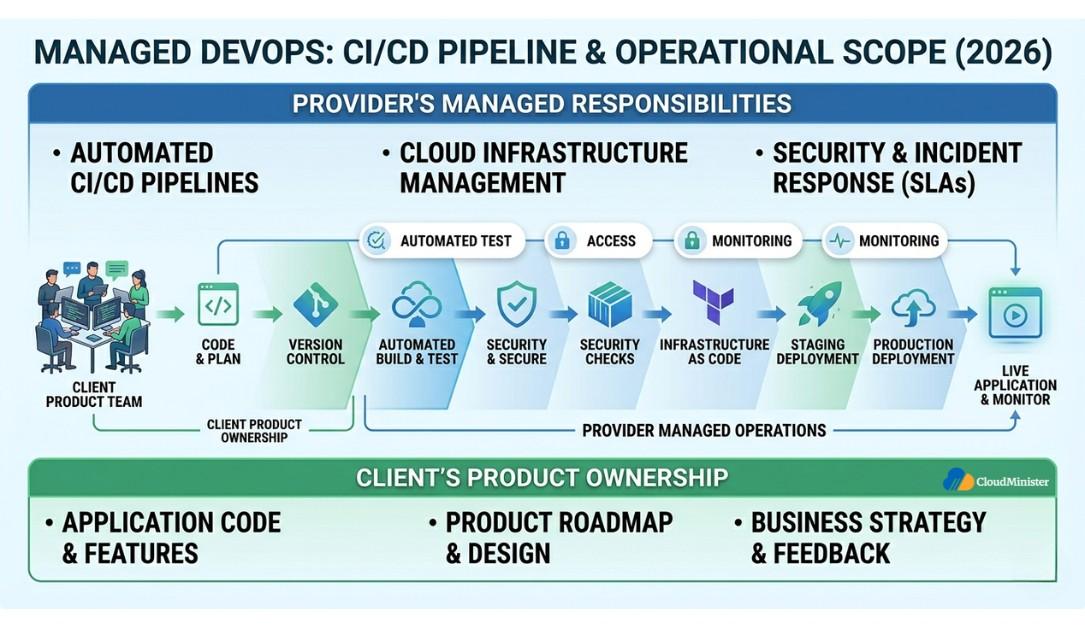
What a Managed DevOps Engagement Typically Includes
- CI/CD pipeline setup and maintenance — Automated pipelines that move code from a developer’s machine to production without manual steps, reducing release cycle times significantly
- Cloud infrastructure management — Provisioning, monitoring, cost optimisation, and scaling across AWS, Azure, Google Cloud, or hybrid environments, handled proactively
- Automated testing integration — Quality gates embedded directly into the deployment process so defects are identified and resolved before they reach users in production
- Security and compliance automation — Security scanning, access controls, and compliance checks built into the pipeline rather than applied as a final review stage
- Monitoring and incident response — Observability tooling that detects infrastructure and application failures before customers do, with defined escalation paths and response SLAs
- Infrastructure as Code (IaC) — All infrastructure defined, versioned, and managed through code — creating repeatability, auditability, and eliminating undocumented manual configurations
What It Does Not Include
A managed DevOps provider works alongside your existing engineering team — not as a replacement for product or application development capability. The provider owns the infrastructure and delivery layer. Your team owns the product. This is an important distinction when evaluating DevOps services and solutions providers: the best engagements function as a seamless extension of your engineering team, not a separate vendor operating in isolation.
Before evaluating any provider, map where your team currently loses the most time — deployments, incident resolution, environment provisioning, or security reviews. That answer tells you which capabilities to prioritise in a managed DevOps engagement, whether you are a startup with five engineers or an enterprise with two hundred.
2. The State of DevOps in 2026: What the Data Shows
The pace of DevOps adoption in 2026 directly shapes what DevOps services are available, how they are priced, and which approaches deliver the strongest outcomes at each stage of business growth.
| Metric | Figure | Source |
| Global DevOps market size (2026) | USD 19.57 billion | Mordor Intelligence |
| Projected market size by 2031 | USD 51.43 billion at 21.33% CAGR | Mordor Intelligence |
| Large enterprise DevOps revenue share (2025) | 64.05% of total market | Mordor Intelligence |
| SME DevOps CAGR through 2031 | 21.2% — fastest growing segment | Mordor Intelligence |
| Organisations reporting positive DevOps outcomes | 99% of those surveyed | Spacelift 2026 |
| Organisations reporting improved deliverable quality | 61% of adopters | Spacelift 2026 |
| Increase in deployment frequency (mature DevOps) | 200x improvement reported | Mordor Intelligence |
| Asia-Pacific DevOps CAGR through 2031 | 25.4% — fastest growing region | Mordor Intelligence |
↗ Source: Mordor Intelligence DevOps Market Report 2026 — mordorintelligence.com
Two things stand out from this data. First, SMEs are growing their DevOps adoption faster than any other segment — actively closing the capability gap with large enterprises. Second, the overwhelming majority of organisations that have implemented DevOps report positive outcomes, which means the central question for most businesses is no longer whether DevOps delivers value, but which model and which provider is the right fit for their stage. Choosing the right DevOps services and solutions is where the real competitive advantage is built.
The 200x deployment frequency improvement reflects organisations with fully mature DevOps practices — not first-year adopters. Early implementations typically produce meaningful but more modest gains in the first three to six months. The 61% deliverable quality improvement figure is drawn from Spacelift’s 2026 DevOps statistics report and reflects self-reported outcomes across surveyed organisations globally. Source: Spacelift, 2026.
3. The Startup Reality: Why Speed Is Non-Negotiable — and What It Costs Without DevOps
Startups operate in an environment where the time between idea and validated customer outcome often determines survival. Anything that slows down the release of new features, bug fixes, or product pivots is not a technical inconvenience — it is a direct threat to the business. This is precisely why managed DevOps services for startups and enterprises cannot be treated as a single offering — the startup model is almost entirely structured around delivery speed and infrastructure reliability as a growth enabler.
The Speed Problem Early-Stage Businesses Face
A startup without structured DevOps practices typically relies on manual deployments, ad hoc testing processes, and informal infrastructure management. This works until it does not. The first real scaling event — a product launch, a press mention, or a sudden increase in sign-ups — exposes every assumption the team made about capacity, reliability, and deployment coordination.
According to Spacelift’s 2026 DevOps statistics report, 61% of organisations report that implementing DevOps significantly improved the quality of their deliverables — and for startups, quality and speed of delivery are inseparable from the product’s ability to retain early customers.
↗ Source: Spacelift — Top DevOps Statistics 2026 — spacelift.io
What Startups Actually Need From a Managed DevOps Engagement
Startups do not need the most complex DevOps architecture available. They need a solid foundation — one that enables fast iteration, scales on demand, and avoids technical debt that becomes impossible to unwind during a growth phase. DevOps implementation services at startup stage should be opinionated, lean, and deployable quickly without requiring the startup to navigate months of internal DevOps hiring.
- Automated CI/CD pipelines — Developers deploy without manual coordination, compressing release cycles from days to hours and enabling the iteration speed that early-stage growth demands
- Cloud-native infrastructure — Environments that scale automatically with user demand without requiring manual capacity intervention or dedicated infrastructure management
- Reliable monitoring and alerting — Observability that surfaces problems before customers discover them, with defined escalation paths that do not depend on a specific engineer being available
- Security fundamentals embedded early — Access controls, secrets management, and dependency scanning in place before investor due diligence or enterprise customer security reviews begin
- Documented, repeatable processes — Infrastructure and deployment procedures that do not depend on any single engineer’s knowledge — critical during periods of team growth or restructuring
Many startups assign DevOps responsibility to a senior developer who already carries a full product development workload. The result is a patchwork of partially automated processes and a single point of failure. Sound DevOps implementation services remove that dependency entirely — providing a structured, documented, and accountable service that continues regardless of team composition changes, which is particularly important during the rapid hiring cycles that follow a funding round.
The Real Cost of DIY DevOps at Startup Stage
The calculation for a startup evaluating managed DevOps is straightforward: compare the monthly cost of a managed service against the cost of a deployment failure during a critical growth window, a security incident surfaced during Series A due diligence, or the opportunity cost of a senior engineer spending two months on infrastructure instead of product development. In most cases, the risk cost significantly exceeds the service cost.
Startups are facing increasing security scrutiny from investors and enterprise customers during due diligence at Series A and beyond. Buyers and investors now routinely request evidence of secure CI/CD practices, access control policies, and vulnerability management processes. Establishing these through managed DevOps early — before the pressure of a funding timeline — is significantly less costly than retrofitting them under deadline conditions.
→ Related: DevOps Security: Best Practices for Secure CI/CD Pipelines — Cloudminister
4. The Enterprise Reality: Why Scale Creates Complexity — and How Managed DevOps Untangles It
Enterprises face a categorically different set of challenges from startups. The problem is not speed in isolation — it is maintaining delivery speed while managing compliance requirements, legacy system integrations, governance frameworks, and the coordination overhead of large, distributed engineering teams. Understanding how managed DevOps services for startups and enterprises diverge at the enterprise tier is foundational to evaluating whether to supplement internal DevOps capability with a managed provider.
The Complexity Problem Large Organisations Face
An enterprise with two hundred engineers across six product teams does not have a single deployment pipeline problem. It has a standardisation problem, a coordination problem, and in many cases, a legacy infrastructure problem — all simultaneously. Organisations managing regulated cloud workloads alongside on-premise systems and multiple third-party integrations cannot adopt the same lightweight, cloud-native approach that works effectively for a twelve-person startup.
Every infrastructure decision at enterprise scale carries downstream compliance implications — SOC 2, HIPAA, GDPR, ISO 27001 — depending on the industry and markets served. This is where experienced DevOps consulting services in India and globally become particularly valuable: providers with multi-framework compliance experience can embed audit controls directly into the delivery pipeline, rather than creating a separate compliance workstream that slows delivery.
| 64.05% of DevOps market revenue in 2025 came from large enterprises, reflecting the scale of investment at this tier Source: Mordor Intelligence, 2026 | 61% of organisations reported that DevOps implementation significantly improved deliverable quality across their engineering teams Source: Spacelift, 2026 |
| 21.2% CAGR for SME DevOps adoption through 2031 — the fastest-growing segment, closing the gap with enterprise capability Source: Mordor Intelligence, 2026 | 25.4% CAGR for Asia-Pacific DevOps adoption through 2031 — the fastest-growing region globally, with India as a key contributor Source: Mordor Intelligence, 2026 |
What Enterprises Actually Need From a Managed DevOps Engagement
At enterprise scale, the priorities shift from speed alone to governed, auditable, and consistent delivery across all teams and environments.
- Standardised pipelines across all teams — The same security gates, quality checks, and deployment processes enforced consistently regardless of which product team or business unit is releasing
- Compliance automation built into the pipeline — Audit trails generated automatically at each deployment stage, eliminating manual documentation overhead for SOC 2, ISO 27001, HIPAA, and similar frameworks
- Hybrid and multi-cloud infrastructure management — Consistent DevOps practices spanning public cloud, private cloud, and on-premise environments under a single governance model
- Advanced observability at scale — Monitoring architectures that produce actionable signals rather than alert noise that overwhelms on-call engineering rotations
- Change governance integration — Deployment workflows that operate within existing Change Advisory Board structures and change management processes, rather than requiring those processes to be bypassed
- Progressive internal capability development — Managed services that transfer knowledge and build internal DevOps maturity over time, preventing permanent external dependency
For enterprises, the most effective managed DevOps engagements start with a contained, high-impact scope — one business unit, one critical pipeline, or one compliance framework. A contained first engagement demonstrates ROI, builds internal trust with stakeholders, and surfaces integration complexity before it affects the wider engineering organisation. This holds true whether you are working with DevOps consulting services in India or engaging a global managed provider.
5. Head-to-Head: How Managed DevOps Differs Across Six Business Dimensions

The practical differences between startup and enterprise DevOps models are most visible across six specific dimensions. Businesses evaluating managed DevOps services for startups and enterprises should use this framework as a primary lens — it identifies where requirements diverge most sharply and where a mismatched engagement model creates the most friction.
| Dimension | Startup Model | Enterprise Model |
| Budget & Pricing | Monthly retainer or project-based. Predictable cost replacing hiring and salary overhead. Focused on core pipeline and cloud management. | Multi-year contracts with broader scope. Larger investment reflecting higher complexity, availability requirements, and dedicated support capacity. |
| Deployment Speed | Primary metric is deployment frequency — how often code reaches users safely. Pipelines are optimised for release velocity as the core business KPI. | Deployment speed is balanced against governance requirements. Staged rollouts, change approval processes, and rollback mechanisms protect large-scale production stability. |
| Security & Compliance | Foundational security practices: access controls, secrets management, vulnerability scanning. Compliance frameworks integrated progressively as the business scales. | Multiple simultaneous regulatory frameworks. Compliance controls embedded directly into pipelines — every deployment automatically satisfies audit requirements without separate documentation effort. |
| Team Structure | Provider works alongside a small team of 3 to 15 engineers. Direct communication, fast decisions, lean workflow integration with minimal governance overhead. | Provider integrates across multiple internal teams, governance bodies, and change management processes. Becomes part of a broader organisational system rather than the sole infrastructure function. |
| Scalability | Cloud-native architecture that scales automatically with demand — growth is absorbed by the infrastructure without requiring manual capacity decisions or engineering intervention. | Scaling spans hybrid environments — public cloud for variable workloads, private infrastructure for regulated data, with security and network architecture connecting both consistently. |
| Risk Tolerance | Higher tolerance for experimentation. New tooling and architectures are adopted faster, with infrastructure expected to evolve as the product does. | Low risk tolerance for customer-facing and business-critical systems. Reliability and consistency take precedence over adopting new tooling or approaches. |
| Recommended When | Team under 50 engineers, first DevOps engagement, growth-stage business prioritising deployment speed and iteration velocity above governance overhead | Team of 100+ across multiple units, regulated industry, multi-cloud or hybrid infrastructure, or an internal DevOps team needing specialist supplement |
The startup-versus-enterprise framing is a useful simplification, but the reality is more nuanced. A significant proportion of businesses — Series B companies, regional organisations with 100 to 500 employees, professional services firms with significant technology platforms — sit between these two categories. For mid-market businesses, the engagement model that works is different from both ends of this spectrum, as covered in Section 6.
Ready to Find the Right DevOps Model for Your Business?
CloudMinister sets up, manages, and scales your DevOps infrastructure — with India-based data centres, 99.99% uptime, and engagement models built for startups and enterprises alike.
6. The Hidden Third Model: Why Mid-Market Businesses Need a Hybrid Approach
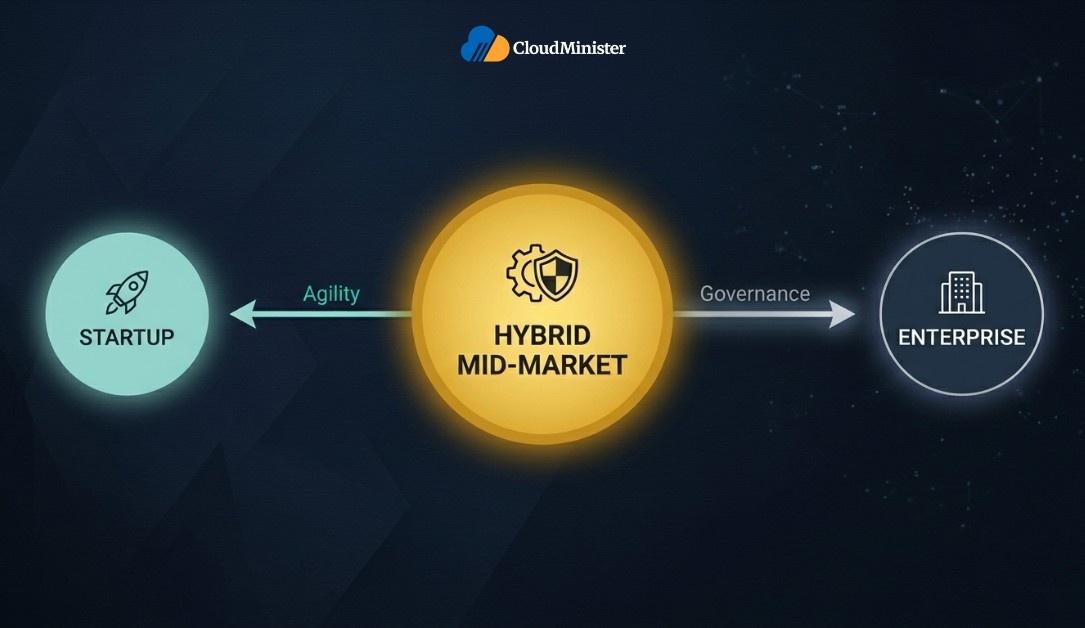
Most discussions of DevOps frame the choice as startup versus enterprise. In practice, a significant and growing segment of businesses sits between those two categories — and they are often the ones that struggle most with standard off-the-shelf managed DevOps engagements. The right approach for these businesses — mid-market organisations at the growth stage — requires a distinct model that most providers do not explicitly offer as a named service tier.
A business at Series B or C, a regional organisation that has grown to 200 employees, or a professional services firm with a significant technology platform occupies a position where startup-style DevOps has become insufficient, but full enterprise-scale managed services carry more governance overhead than the business currently needs or can absorb productively.
What the Hybrid Mid-Market Model Looks Like
This segment needs DevOps implementation services that deliver more structure than a startup engagement without the full governance overhead of an enterprise contract. Specifically, the model should provide:
- Clear runbooks, defined escalation paths, and SLA commitments that hold up under pressure — more formal than startup arrangements but more agile than enterprise frameworks
- Flexible commercial terms that accommodate rapid headcount and infrastructure growth without requiring a full re-engagement or contract renegotiation at each milestone
- Progressive knowledge transfer that builds internal DevOps maturity over time — reducing external dependency as the business scales its own engineering capability
- Security and compliance practices appropriate to the organisation’s current regulatory environment, with a clear roadmap for expanding coverage as the business enters new markets or verticals
For mid-market businesses, the most important question to ask any prospective managed DevOps provider is not what their current service includes, but what the engagement model looks like twelve months from now if the business doubles in size. A provider who cannot give a clear, specific answer to that question has not delivered enough engagements at the growth-stage transition to have a proven, repeatable model for it.
7. Five Signs Your Current DevOps Setup Has Outgrown Your Business
These signals apply regardless of business size or sector. If more than two are consistently present, the current DevOps approach is generating more operational friction than value — and that friction compounds with every sprint cycle.
1. Deployments Require Manual Steps or Human Coordination
If releasing software requires a developer to run commands manually, follow a checklist, or wait for a specific person to be available — the process is not automated to a standard that supports reliable, frequent delivery. This is one of the clearest indicators that a managed DevOps engagement would deliver immediate, measurable value.
2. Incidents Surface in Production Before Internal Monitoring Does
When customers report problems before internal monitoring detects them, the observability layer is not functioning effectively. For startups, this erodes user trust. For enterprises managing regulated data, it may also constitute a reportable event under GDPR, HIPAA, or India’s DPDP Act 2023.
3. Cloud Costs Are Growing Faster Than Usage
Unmanaged cloud infrastructure accumulates unused resources, over-provisioned instances, and inefficient architectures over time. Cost growth consistently outpacing usage growth is a reliable indicator that infrastructure management lacks the rigour that well-structured DevOps services and solutions would introduce.
4. Security Reviews Happen at the End of the Release Cycle
When security functions as a final gate before release rather than an embedded process throughout development and deployment, the team is accumulating security debt with every sprint. Discovering issues at the release stage — or after deployment — creates expensive remediation cycles. Sound DevOps implementation services embed security checks throughout the pipeline, preventing this pattern by design.
5. Engineering Time Is Spent on Infrastructure Rather Than Product
When developers or technical leads spend meaningful time managing servers, debugging deployment failures, or responding to infrastructure incidents — the organisation is paying product engineering salaries for operational work. This pattern is one of the clearest signals that managed DevOps services for startups and enterprises, matched to the right business stage, would deliver measurable ROI within the first quarter of engagement.
Infrastructure incidents are not just engineering problems — they are frequently reportable events under GDPR, HIPAA, and India’s DPDP Act 2023 when personal data is involved. Organisations without robust incident detection and defined response processes face both operational disruption and regulatory exposure simultaneously. Well-structured DevOps implementation services that include incident response as a defined, SLA-backed capability address both risks through a single engagement.
8. How to Choose a Managed DevOps Partner That Fits Your Business Stage
Selecting a managed DevOps provider is not primarily a technology decision — it is an operational and strategic one. Technical capability matters, but so does the provider’s ability to integrate with your existing team structure, communicate clearly with non-technical stakeholders, and adapt as your business changes. Whether you are evaluating DevOps consulting services in India or assessing a global provider, the evaluation criteria remain consistent.
Questions to Ask Before Committing
- What does onboarding look like, and how long until pipelines are operational? A provider who cannot give a clear, time-bound answer has not built a sufficiently repeatable process to deliver engagements efficiently
- Which compliance frameworks have you implemented in previous engagements, and for which industries? For any regulated sector — healthcare, fintech, edtech, or government — framework-specific experience is a non-negotiable qualification
- What are the incident response SLA commitments, and how is the escalation process structured? A managed service without defined incident response terms is not a managed service — it is a best-effort arrangement
- How does the commercial model change as our business scales? Understanding pricing at your next stage of growth prevents contractual friction during a scaling phase
- How do you build internal capability rather than dependency? The best providers transfer knowledge progressively — they do not protect it as a commercial retention mechanism
Red Flags to Watch For in Any Provider Evaluation
- Recommending the same toolset for every client regardless of existing infrastructure — this signals template delivery rather than context-specific engineering
- Inability to explain security practices in accessible language to a non-technical business stakeholder — a sign of either weak practice or a communication failure that will repeat throughout the engagement
- No verifiable reference customers at a similar business stage or in a comparable industry — claimed expertise without demonstrated delivery at your scale is a significant risk
- Contract structures that create significant exit costs or barriers — a provider whose model depends on lock-in rather than ongoing delivery quality is not a long-term operational partner
How Cloudminister Approaches These Criteria: Cloudminister engagements are designed around your existing technology stack — not a predefined toolset. Commercial terms are structured with flexibility to grow as the business scales, and every engagement includes structured knowledge transfer so your internal team develops capability throughout the partnership rather than at its end.
SCALABILITY CHECKLIST BEFORE COMMITTING TO A PROVIDER
Can the provider scale from your current pipeline complexity to 3x volume without requiring a full re-engagement or commercial renegotiation?
✓ Do they have verified, documented experience with your specific cloud platforms — AWS, Azure, GCP, or hybrid environments?
✓ Is Infrastructure as Code a standard deliverable in every engagement, ensuring you retain full ownership of infrastructure definitions?
✓ Is monitoring and observability included as a standard service component, or priced as an additional module?
✓ Is there a documented knowledge retention process for when key provider-side engineers change or transition off the engagement?
✓ Do they produce regular business-readable reporting that allows a non-technical owner or director to assess operational performance and ROI independently?
For businesses looking for a structured provider evaluation framework, Cloudminister’s guide to DevOps Consulting Services In India covers the complete evaluation process — including how to compare proposals, which contract terms require careful review, and how to assess a provider’s actual delivery track record beyond case study summaries.
9. Self-Managed vs. Managed DevOps: A Practical Cost and Capability Comparison
For businesses with existing internal technical capacity, the decision between building DevOps in-house and engaging a managed provider is a genuine strategic choice — not a default. Evaluating the right DevOps services and solutions model requires an honest, full-cost assessment — not just a comparison of per-hour or per-month rates.
| Factor | Self-Managed DevOps | Managed DevOps Services |
| Setup Time | Weeks to months — tooling selection, pipeline builds, environment configuration, team training, and documentation all require dedicated engineering time | Days to two weeks for a provider with a proven onboarding process — operational pipelines delivered faster with lower internal resource cost |
| Operational Overhead | Ongoing — patches, tool upgrades, incident response, driver updates, and documentation maintenance all consume engineering capacity continuously | Handled by the provider as part of the contracted service — engineering capacity is freed for product development and revenue-generating work |
| Cost Model | Requires accurate accounting of DevOps engineer salaries, hiring cost, onboarding, and the opportunity cost of technical leadership time spent on operational tasks | Predictable, contracted cost — typically lower total operational expense for businesses without an existing dedicated DevOps function |
| Configuration Flexibility | Full control over every configuration detail — appropriate for businesses with highly specific or proprietary infrastructure requirements | Built around proven, battle-tested configurations that reduce setup risk and accelerate time-to-value — appropriate for the majority of standard business workloads |
| Security Ownership | Entirely your responsibility — including staying current with emerging threats, patching cadences, and compliance requirement changes | Provider manages the infrastructure security baseline with defined accountability; the business retains ownership of application-layer security configuration |
| Best For | Large enterprises with existing, dedicated DevOps teams, consistently high pipeline utilisation, and strong internal operational capacity | Startups, growth-stage businesses, and enterprises supplementing internal capacity with specialist managed capability for specific functions |
The true value of managed DevOps services for startups and enterprises becomes most visible when the full cost of internal management is assessed honestly. According to SwitchToDevOps 2026 salary data, mid-to-senior level DevOps engineers in India earn Rs. 10 to 20 lakh per annum — and that is before accounting for recruitment costs, onboarding time, the risk of attrition, and the operational overhead that accumulates when infrastructure management competes with product development for the same engineering capacity. Managed services convert that variable, high-risk cost structure into a predictable, contracted service with defined accountability.
↗ Source: SwitchToDevOps — DevOps Engineer Salary India 2026 — switchtodevops.com
10. Common Mistakes Businesses Make When Adopting Managed DevOps
Even with the right provider selected, DevOps engagements underperform when avoidable decisions are made during evaluation and onboarding. These are the most consistent errors across managed DevOps adoptions at both startup and enterprise scale.
Selecting a Provider Based on Price Rather Than Fit
The lowest-cost managed DevOps engagement is rarely the most economical at the workload level. Providers that compete primarily on price typically win by scoping narrowly, limiting response time commitments, or applying generic configurations rather than engineering for the specific business context. The resulting capability gaps frequently cost more to remediate than the original saving was worth — particularly when compliance or security issues surface after an incident rather than before one.
Treating DevOps as a One-Time Project Rather Than an Ongoing Capability
DevOps is not a pipeline you build once and leave unchanged. Software architectures evolve, team sizes change, compliance requirements update, and cloud platforms release new capabilities that require active integration decisions. Understanding managed DevOps services for startups and enterprises as an ongoing operational capability — not a one-time implementation — is the fundamental mindset shift that determines whether the engagement delivers sustained, compounding value or a depreciating initial setup.
Not Defining Success Metrics Before the Engagement Starts
Without agreed metrics — deployment frequency, mean time to recovery, pipeline failure rate, cloud cost per deployment — it is impossible to evaluate whether a managed DevOps engagement is delivering its intended value. Define measurable outcomes before signing. Strong DevOps consulting services in India and globally will always begin with establishing baseline metrics and agreed improvement targets before any tooling is configured or deployed.
Underestimating the Organisational and Cultural Dimension
Managed DevOps delivers the technical infrastructure — but businesses that do not also address team communication patterns, development workflow alignment, and ownership of incidents will find that the tooling delivers limited impact. The DevOps implementation services that consistently deliver the strongest ROI are those that explicitly address organisational adoption alongside technical delivery — treating process change as a deliverable, not an afterthought.
Before any engagement begins, run a brief process and infrastructure audit — even an informal one conducted internally. Identify the three most painful recurring operational problems and make resolving those the explicit success criteria for the first 90 days. A provider who cannot commit to addressing specific, named problems within a defined timeframe is not operationally ready to take accountability for your infrastructure at any scale.
11. Frequently Asked Questions
What is the difference between managed DevOps and outsourced DevOps?
Outsourcing DevOps typically refers to handing off specific tasks or projects to an external team on a transactional basis — with limited ongoing accountability. Managed DevOps is a continuous service relationship in which the provider takes full operational accountability for infrastructure, pipelines, and delivery processes, with defined SLAs, regular performance reporting, and continuous optimisation. The distinction matters: a managed service implies ongoing, accountable responsibility — not just task execution.
How long does it take to see results from a managed DevOps engagement?
For startups, initial pipeline setup typically delivers measurable improvements within two to four weeks — faster deployment cycles, fewer manual intervention points, and earlier defect detection in the pipeline. For enterprises, the first meaningful compliance or governance improvement is typically observable within four to eight weeks. Full operational maturity, including monitoring optimisation and infrastructure cost efficiency, generally emerges over a three to six month period for engagements at both business stages.
Can a startup afford managed DevOps services?
The more useful question is whether a startup can afford to operate without structured DevOps during a growth phase. A mid-to-senior level DevOps engineer in India earns Rs. 10 to 20 lakh per annum according to verified 2026 salary data from SwitchToDevOps — and that is before recruitment costs, onboarding, and the ongoing risk of attrition. Managed DevOps replaces that variable cost with a predictable contracted service, while eliminating the infrastructure risk that — when it materialises — is invariably more expensive to resolve than it would have been to prevent.
Do enterprises still need managed DevOps if they already have an internal DevOps team?
Yes — but the engagement structure changes. For enterprises with internal DevOps capability, managed services typically supplement rather than replace internal teams. Common supplementary use cases include specialist compliance automation for specific regulatory frameworks, platform-specific expertise (Kubernetes, multi-cloud networking, FinOps), overflow capacity during high-demand delivery periods, and independent operational assurance that internal teams cannot objectively provide for their own infrastructure.
Why do growing businesses in India choose DevOps consulting services in India?
DevOps consulting services in India serve businesses at every stage — both for cost-efficiency and for regulatory alignment. India-based providers bring direct familiarity with the DPDP Act 2023, local data residency requirements, and the specific infrastructure landscape relevant to India-facing applications. For global businesses, Indian DevOps consulting providers also offer strong technical depth at commercially competitive engagement costs relative to European or North American equivalents, making them a strategically viable choice for organisations seeking global delivery quality with regional cost efficiency.
How do I know if my business is ready for managed DevOps services?
Prioritise: verified experience at your business stage; SLA commitments with clearly defined incident response processes and escalation paths; pricing transparency that does not change significantly as your infrastructure scales; and evidence of compliance framework experience relevant to your industry. A provider’s ability to explain their security approach in plain language — without technical deflection — is consistently one of the strongest indicators of genuine operational expertise versus surface-level tooling familiarity.
Not Sure Which DevOps Setup Is Right for Your Business Stage?
Cloudminister’s team will assess your current infrastructure and recommend the right managed DevOps engagement — tailored to your team size, compliance needs, and growth goals.
Key Conclusions: The Right Model Is Determined by Stage, Not Size
The most useful reframe when evaluating managed DevOps services for startups and enterprises is to move away from the startup-versus-enterprise binary and evaluate on business stage instead. A well-funded startup growing rapidly may need more structured governance than a stable mid-market business with a mature but lean engineering team. Stage — defined by compliance complexity, infrastructure risk profile, deployment frequency requirements, and growth trajectory — is a more reliable guide to the right DevOps model than headcount or annual revenue.
KEY TAKEAWAYS
• Managed DevOps is not a single engagement model — startup and enterprise approaches differ significantly in scope, governance requirements, compliance depth, and commercial structure
• SMEs represent the fastest-growing DevOps adoption segment in 2026, with a 21.2% CAGR through 2031 — demonstrating that managed DevOps delivers value at every business scale, not just enterprise
• 99% of organisations that have implemented DevOps report positive outcomes — the value is established; the critical decision is which model and which provider fits your specific stage
• Deployment frequency and mean time to recovery are the two metrics that most directly measure whether a managed DevOps engagement is delivering business value — both should be baselined and agreed before the engagement begins
• Mid-market businesses need a hybrid model — more structured than a startup engagement, more agile than a full enterprise contract — that most providers do not offer as a named tier
• Self-managed DevOps only wins on total cost of ownership when dedicated DevOps capacity already exists, utilisation is consistently high, and the business can absorb operational overhead without displacing product engineering capacity
Evaluate Where You Are Right Now — and Which DevOps Model Fits
If deployments are manual, monitoring is reactive, cloud costs are growing faster than usage, or security is a final gate rather than an embedded practice — the current DevOps setup is behind the business’s operational requirements. Understanding which of those problems is the most expensive is the starting point for evaluating a managed DevOps engagement that is correctly matched to your stage.
To explore how Cloudminister structures managed DevOps services for your specific business stage, visit the DevOps services overview page — covering service scope, engagement models for startups, enterprises, and growth-stage businesses.
→ Related: Kubernetes vs Docker: Which One Does Your Business Need? — Cloudminister
→ Related: DevOps Automation: Top Tools & Strategies for Efficiency — Cloudminister
→ Related: DevOps Security: Best Practices for Secure CI/CD Pipelines — Cloudminister

He is the CEO and Founder with over a decade of experience in cloud infrastructure, DevOps, and server optimization. With a strong vision and hands-on leadership approach, he has built scalable, secure, and high-performance cloud solutions trusted by businesses across industries.